How to Identify the German Prussia 20 Mark Gold
A gold coin of the German Empire's Kingdom of Prussia, identified by its Prussian king's portrait and the imperial eagle reverse.
Read the full German Prussia 20 Mark Gold encyclopedia entry →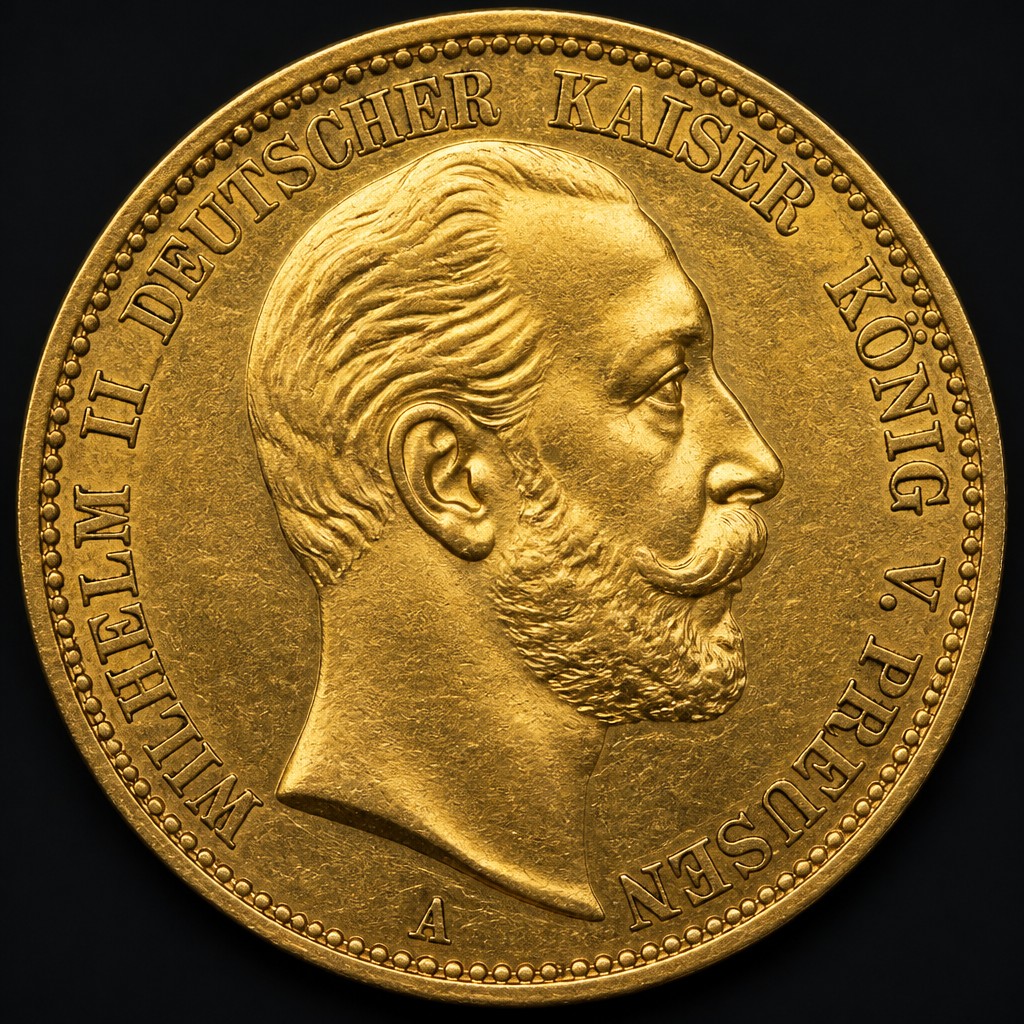
What Is the German Prussia 20 Mark Gold?
The 20 Mark gold coin was struck under the Kingdom of Prussia as part of the unified gold currency system adopted across the newly formed German Empire after 1871. While the empire's mark denomination was standardized nationwide, each constituent kingdom and state, including Prussia, issued its own coins bearing its own ruler's portrait, making these Prussian issues part of a broader family of German states' 20 Mark gold coins.
Obverse Design
The obverse shows a profile portrait of the reigning Prussian king, who also held the title of German Emperor — Wilhelm I, Friedrich III, or Wilhelm II, depending on the date of issue — along with a legend naming the ruler and his Prussian and imperial titles.
Reverse Design
The reverse displays the German imperial eagle, wings outstretched, with the national legend "DEUTSCHES REICH" around the rim, the denomination "20 MARK," and the date below the eagle.
Size, Weight & Metal
The coin is struck in .900 fine gold, weighs approximately 7.965 grams, and measures about 22.5 millimeters in diameter, consistent with the standardized gold coinage used across all German Empire states of this denomination.
Mint Marks
A small mint letter appears on the coin identifying which of the empire's several mints produced it — for example "A" for Berlin, which struck the majority of Prussian issues. This mint letter, combined with the specific king's portrait and date, allows precise identification of a given coin's origin.
Telling It Apart from Similar Coins
Because all German Empire states used the identical 20 Mark weight, fineness, and general reverse eagle design, the fastest way to identify a Prussian issue specifically is the obverse portrait and legend, which will name the Prussian king rather than the ruler of Bavaria, Saxony, Hamburg, or another state. Comparing the ruler's name against a reference list for the relevant date range confirms the coin's state of origin.
Judging Condition at a Glance
Check the king's hair, moustache, and any decorative elements like a laurel wreath for crispness, along with the feather detail on the imperial eagle. A well-preserved coin shows sharp, separated feather lines and clear facial detail, while a worn example shows a smoothed portrait and less distinct eagle plumage.
Authenticity Red Flags
Given the popularity and gold content of German Empire 20 Mark coins, verify the weight against the 7.965-gram standard, check the edge reeding for consistency, and confirm the mint letter and date combination is plausible for the named ruler's reign. A coin with an unusually soft strike, incorrect proportions between portrait and legend, or an inconsistent gold color should be examined more carefully before being accepted as genuine.
Frequently asked questions
Who appears on the German Prussia 20 Mark gold coin?
The reigning Prussian king and German Emperor at the time of issue — Wilhelm I, Friedrich III, or Wilhelm II, depending on the date.
What is shown on the reverse?
The German imperial eagle with wings outstretched, along with the legend 'DEUTSCHES REICH' and the denomination '20 MARK.'
How is a Prussian 20 Mark different from a Bavarian or Saxon one?
All German states used the same weight, fineness, and eagle reverse design, so the ruler's portrait and name on the obverse is what identifies the specific state.
What is the coin's weight and gold purity?
It weighs approximately 7.965 grams and is struck in .900 fine gold.
Where can I find the mint mark?
A small letter near the date identifies the mint, with 'A' representing Berlin, which produced most Prussian issues.
German Prussia 20 Mark Gold identified by the community
Recent German Prussia 20 Mark Gold coins identified with Coin Identifier.