
How to Identify the German Empire 5 Mark
A large silver crown coin issued by the constituent states of the German Empire between 1874 and 1918, typically showing a ruler's portrait alongside the common imperial eagle reverse.
Read the full German Empire 5 Mark encyclopedia entry →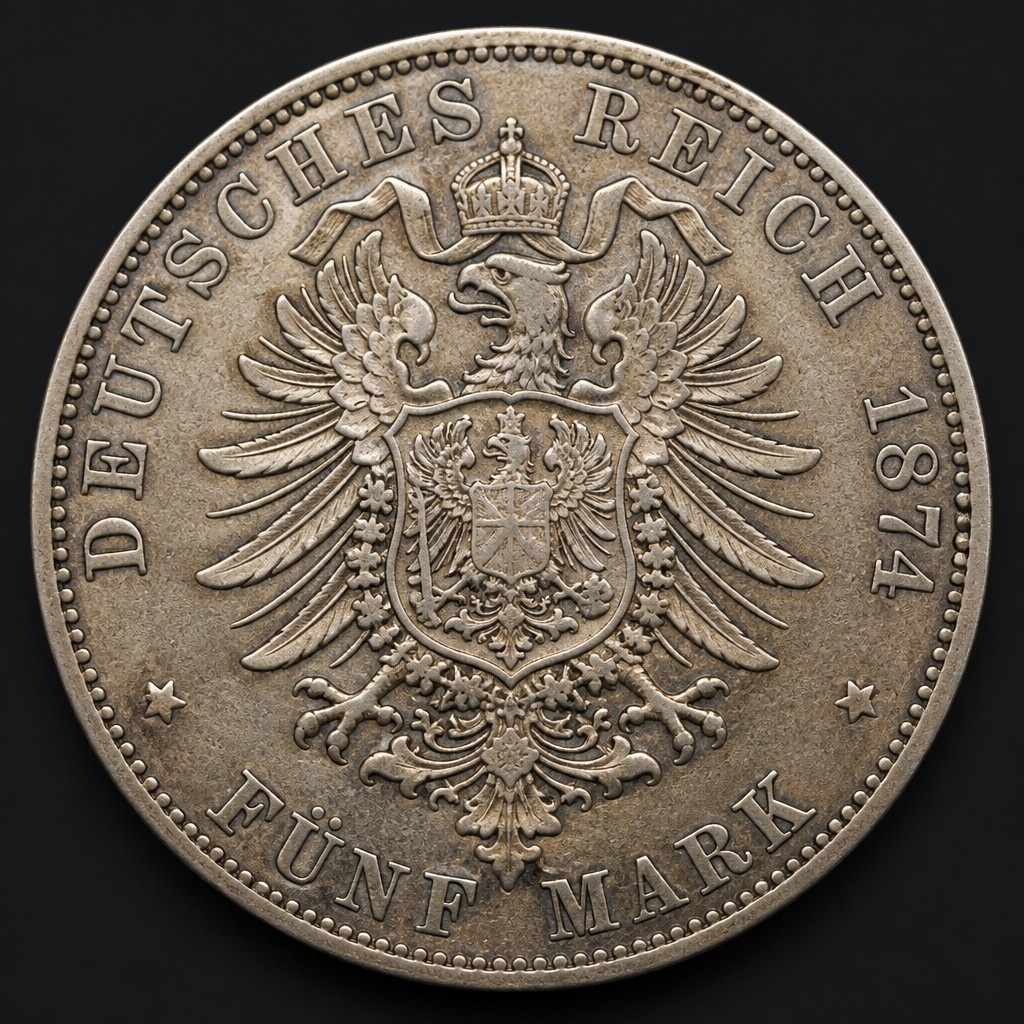
What the Coin Is
After German unification in 1871, the new Empire established a common currency system while allowing individual states, such as Prussia, Bavaria, and Saxony, to issue their own silver coinage bearing local rulers or symbols. The 5 Mark denomination was the largest circulating silver coin of the era, roughly comparable in size to other European silver crowns.
Obverse Design & Inscriptions
Most 5 Mark coins show the portrait of the ruling monarch of the issuing state, such as the King of Bavaria or Saxony, with his name and title in the surrounding legend. Free cities without a monarchy, including Hamburg, Bremen, and Lübeck, instead show a civic coat of arms or heraldic eagle in place of a portrait.
Reverse Design & Inscriptions
The reverse is standardized across all states, featuring the German Imperial eagle (Reichsadler) with wings spread, surrounded by the legend DEUTSCHES REICH, the denomination, and the date.
Size, Weight, Metal & Edge
The coin measures roughly 38mm in diameter and weighs approximately 27.77 grams, struck in .900 fine silver containing about 25 grams of pure silver. Edges vary by type, with some carrying reeding and others a lettered edge inscription specific to the issuing state or occasion.
Mint Marks & Where to Find Them
A single small letter identifying the mint city appears near the date on the reverse: A for Berlin, D for Munich, E for Dresden or Muldenhütten, F for Stuttgart, G for Karlsruhe, and J for Hamburg.
Telling It Apart From Similar Coins
Because many German states issued their own 5 Mark designs, identification relies on matching the specific portrait and legend to the correct state and ruler. Commemorative 5 Mark issues, marking events like jubilees, carry unique reverse or obverse imagery distinct from the standard portrait types and are identified by their special inscriptions and dates.
Judging Condition at a Glance
Examine the ruler's cheek, hair, and any decorations or crown details for wear, along with the eagle's breast feathers on the reverse. A well-preserved coin retains sharp lettering along the rim and clear separation between the portrait and the surrounding legend.
Authenticity Red Flags
Given the variety of states, rulers, and commemorative types, cross-check that the portrait, legend, and mint letter are a plausible combination for the stated state and date. Be cautious of coins with mismatched stylistic details, blurred or re-cut lettering, or a weight noticeably off from the expected 27.77 grams, all of which can indicate an altered or counterfeit piece.
Frequently asked questions
Why do German Empire 5 Mark coins look different from state to state?
Each constituent state of the Empire, such as Prussia, Bavaria, or Saxony, issued its own obverse design featuring its own ruler or civic emblem, while the reverse imperial eagle design was shared across all states.
Where is the mint mark located?
A single letter mint mark appears on the reverse near the date, such as A for Berlin or D for Munich.
What is the silver content of this coin?
It is struck in .900 fine silver, weighing about 27.77 grams and containing roughly 25 grams of pure silver.
What do free city issues look like compared to monarchy issues?
Free cities like Hamburg or Bremen show a civic coat of arms or heraldic eagle instead of a ruler's portrait on the obverse.