
How to Identify the German Empire 20 Mark Gold (Wilhelm II)
The German Empire's 20 Mark gold coin under Kaiser Wilhelm II shows his portrait on the obverse and the imperial eagle on the reverse, struck by multiple German states between 1888 and 1913 with distinguishing mintmarks.
Read the full German Empire 20 Mark Gold (Wilhelm II) encyclopedia entry →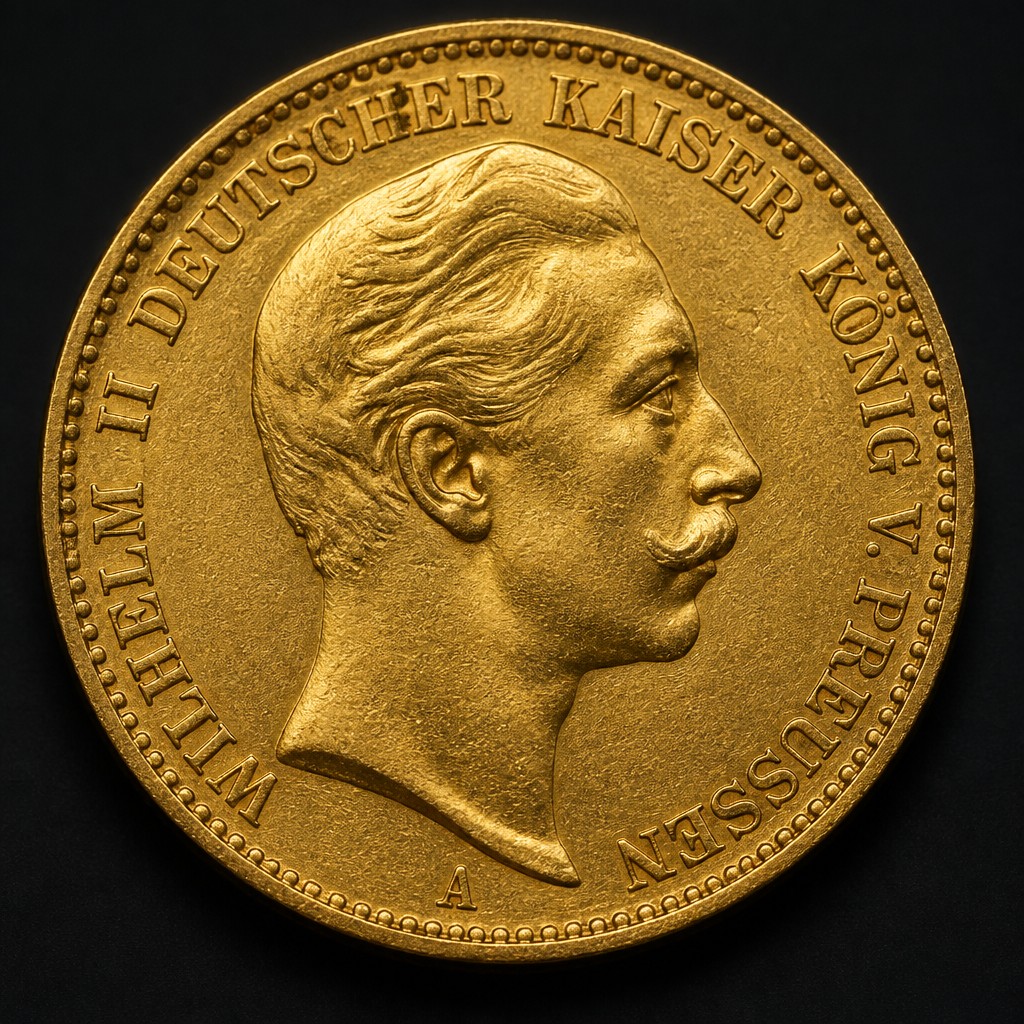
What It Is
The 20 Mark gold coin was the standard gold denomination of the German Empire following unification in 1871, struck under various individual states' rulers even though the coinage was unified in weight, fineness, and general design across the empire. Coins bearing Kaiser Wilhelm II's portrait were struck from 1888, when he ascended the throne, through 1913, shortly before the outbreak of the First World War ended German gold coin production.
Obverse Design
The obverse shows Wilhelm II in profile, most commonly in military uniform with a distinctive upturned mustache, with the legend "WILHELM II DEUTSCHER KAISER KONIG VON PREUSSEN" (German Emperor, King of Prussia) since most surviving examples were struck under the Kingdom of Prussia, though other German states also issued their own 20 Mark coins under their respective rulers during the same period.
Reverse Design
The reverse displays the German imperial eagle, wings spread, with a shield on its breast, encircled by the denomination "20 MARK," the date, and "DEUTSCHES REICH" (German Empire) around the rim.
Size, Weight & Metal
The coin is struck in 90% gold, weighing 7.965 grams with a diameter of approximately 22.5 mm, consistent across all German states' 20 Mark issues of the period.
Mint Marks & Where to Find Them
A small mint letter appears on the reverse near the base of the eagle or near the date, identifying the specific German mint: "A" for Berlin, "B" for Hannover, "C" for Frankfurt, "D" for Munich, "E" for Muldenhutten, "F" for Stuttgart, "G" for Karlsruhe, and "J" for Hamburg. Checking this letter alongside the ruling state named on the obverse helps confirm the coin's exact origin.
Telling It Apart from Similar Coins
Because multiple German states issued their own 20 Mark coins with their own local rulers (such as Bavaria's King or Saxony's King, alongside Prussia's Wilhelm II), the obverse portrait and accompanying ruler's name are the primary way to identify which state issued a given coin. All share the same imperial eagle reverse and identical size and gold content, so the obverse is the key differentiator.
Judging Condition at a Glance
Wear appears first on Wilhelm II's cheek, mustache tips, and the highest point of his uniform collar or helmet if depicted, and on the eagle's breast and wingtips on the reverse. Because these coins were widely saved and hoarded as bullion, especially after gold coinage ended, many surviving examples remain in good to excellent condition.
Authenticity Red Flags
Given the coin's well-documented weight and diameter, precise measurement is an effective first check against counterfeits. Look for sharp, well-defined portrait and eagle detail, since cast copies often show soft, blurred features, and be alert to any mismatch between the mint letter and the ruler's name, since an inconsistent combination suggests a fabricated or altered piece.
Frequently asked questions
What years show Wilhelm II's portrait on the 20 Mark gold coin?
From 1888, when he became Kaiser, through 1913, near the end of German imperial gold coin production.
What is the gold content of the coin?
It's 90% gold, weighing 7.965 grams with a diameter around 22.5 mm.
Why do some 20 Mark coins show a different ruler than Wilhelm II?
Because individual German states retained the right to strike their own 20 Mark coins with their own local rulers' portraits, even though the empire's coinage standards were unified.
Where is the mintmark located?
Near the base of the eagle or close to the date on the reverse, shown as a single letter identifying the specific German mint.
How can I be sure the obverse ruler matches the correct mintmark?
Cross-check the ruler named on the obverse against the historical mints associated with that state, since a mismatched combination would be inconsistent with genuine issues.