
How to Identify the German East Africa 1/4 Rupie
A collector's guide to identifying the German East Africa quarter Rupie by its wreathed value legend, imperial eagle, small silver flan, mint marks, and look-alikes.
Read the full German East Africa 1/4 Rupie encyclopedia entry →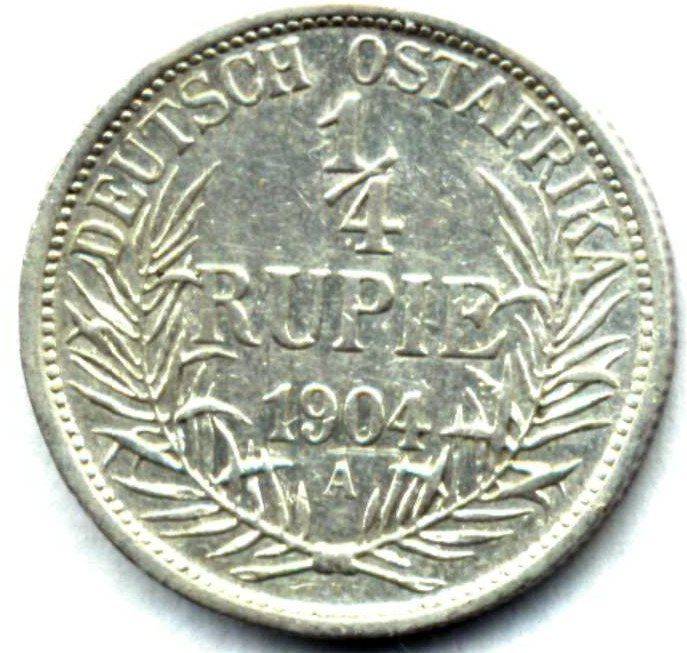
What This Coin Is
The German East Africa 1/4 Rupie is a small colonial silver coin of Deutsch-Ostafrika. Identification starts with the value face: the legend DEUTSCH OSTAFRIKA arranged around the denomination 1/4 RUPIE and the date, all enclosed in a wreath. A date such as 1904 signals the wreath-and-eagle series rather than the earlier bust coinage.
Reading the Two Faces
On the value face, confirm three things together: the country name DEUTSCH OSTAFRIKA, the fraction 1/4 RUPIE, and a wreath surrounding them. The other face of this type carries the crowned German imperial eagle. If your coin shows a uniformed bust of Kaiser Wilhelm II instead of the wreath, you have the earlier 1890s type, not the 1904-and-later issue seen here.
Size, Metal, and Fabric
This is the smallest of the colony's silver denominations, so expect a small, thin, light coin, close in size to a small modern minor coin and struck in a colonial-fineness silver alloy rather than heavy sterling. It is non-magnetic and shows the soft grey toning typical of low-to-medium silver. Weigh and measure any candidate and compare against published specifications for the quarter Rupie; a coin markedly off in weight or diameter, or one that looks like plain base metal, warrants a closer look.
Mint Marks and Dates
Look near the design for a small mint letter identifying the German mint that struck the coin. The exact date and mint-letter combination determines both attribution and rarity within the 1904–1914 span, so record them precisely. Do not judge value from the type alone, since some year-and-mint pairings are scarcer than others.
Look-Alikes and Authentication Cautions
The colony's 1/2 Rupie and 1 Rupie share the same wreath-and-eagle design family but are larger and carry higher denominations, so always read the fraction and check the size before concluding it is a quarter. Because German colonial silver is widely collected, be alert to cleaned or tooled surfaces, altered dates, and cast copies (look for seams, bubbles, and soft, mushy detail). For any coin of value, match it to a standard reference for German East African coinage or seek professional authentication before relying on a grade or price.
Frequently asked questions
How do I tell the 1/4 Rupie from the 1/2 or 1 Rupie?
They share the wreath-and-eagle design, so read the fraction in the wreath and compare size: the 1/4 Rupie clearly states 1/4 RUPIE and is the smallest and lightest of the silver denominations.
Where is the date and mint mark?
The date sits on the wreathed value face with the DEUTSCH OSTAFRIKA legend, and a small mint letter appears near the design; together they pin down the exact issue within the 1904–1914 series.
How can I confirm it is the 1904 type and not the earlier one?
The 1904-and-later type pairs a wreathed 1/4 RUPIE value with a crowned imperial eagle. The earlier 1890s type instead shows a uniformed bust of Kaiser Wilhelm II, so the wreath confirms the later series.
What are common signs of a fake or altered coin?
Casting seams, surface bubbles, soft detail, incorrect weight or diameter, altered dates, and unnaturally bright or smoothed surfaces are all warning signs worth checking on a small colonial silver coin.