How to Identify the German 5 Mark Silver (Kaiserreich)
The Imperial German 5 Mark silver coin was struck by many individual states of the Kaiserreich, each showing its own ruler's portrait alongside a common imperial eagle reverse.
Read the full German 5 Mark Silver (Kaiserreich) encyclopedia entry →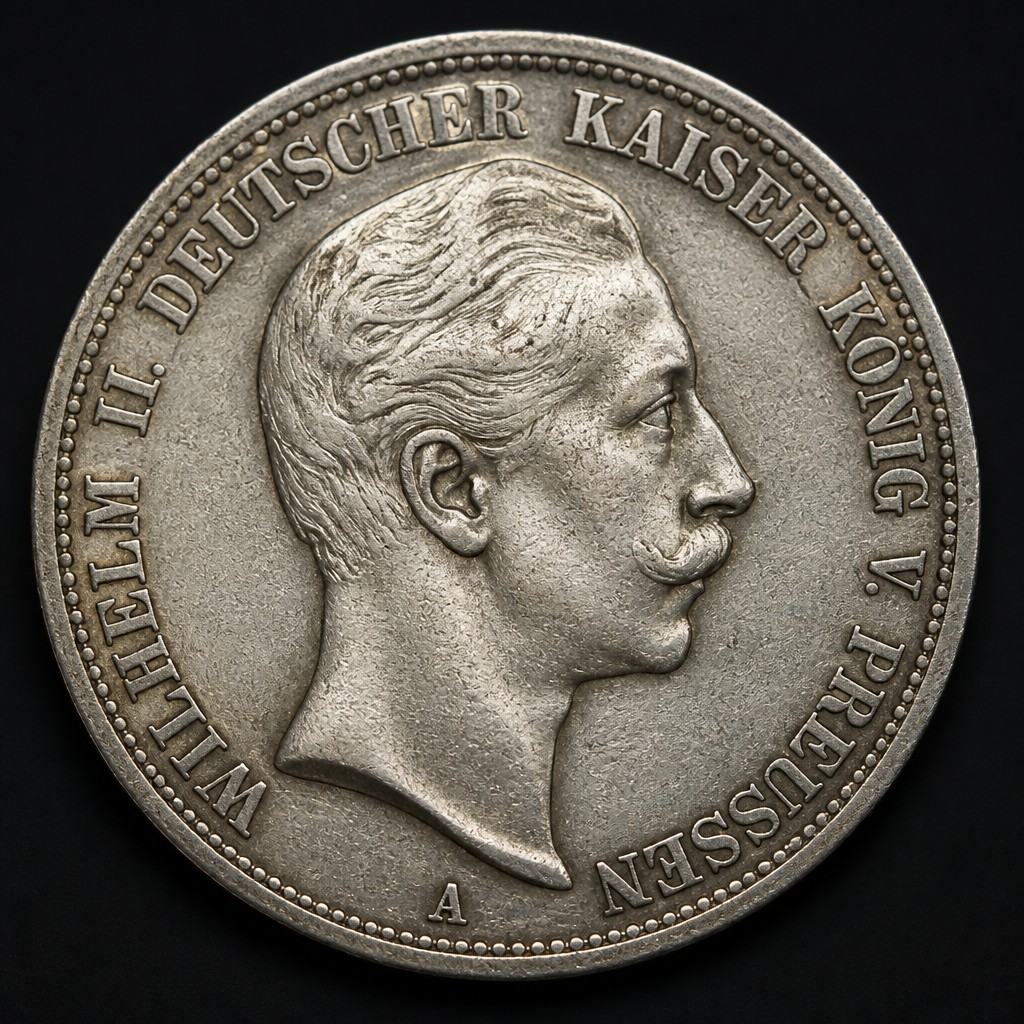
What Is the German 5 Mark Silver Coin
This large silver denomination was issued from 1874 to 1915 under the German Empire (Kaiserreich). Rather than a single uniform design, each constituent state — Prussia, Bavaria, Saxony, Württemberg, and others — struck its own obverse featuring its local ruler. This decentralized approach to imperial coinage reflected the federal structure of the newly unified Germany, where individual kingdoms and duchies retained a degree of monetary autonomy even under a shared national currency system.
Obverse Design and Inscriptions
The obverse shows a portrait of the reigning monarch of the issuing state, such as Kaiser Wilhelm I or II for Prussia, or the King of Bavaria or Saxony, with a legend naming the ruler and state along with the date.
Reverse Design and Inscriptions
Most states shared a common imperial eagle design: an eagle with spread wings beneath an imperial crown, encircled by the legend "DEUTSCHES REICH" and the denomination "5 MARK." Free cities such as Hamburg, Bremen, and Lübeck, which had no monarch, instead placed their own civic coat of arms on the obverse while still using the same standard imperial eagle reverse as the kingdoms and duchies.
Size, Weight, Metal, and Edge
The coin was struck in .900 fine silver, approximately 38mm in diameter and 27.7 grams, with a lettered edge carrying a motto that varies somewhat by issuing state.
Mint Marks and Where to Find Them
A single letter mint mark appears at the base of the reverse eagle design, indicating the mint city: A (Berlin), D (Munich), E (Muldenhütten), F (Stuttgart), G (Karlsruhe), or J (Hamburg).
Telling It Apart From Similar Coins
Since many states used an identical eagle reverse, the obverse ruler portrait and accompanying state name are key to identifying which state issued a given coin. Compare the ruler's name and title text carefully, since the size and reverse can look nearly identical between states.
Judging Condition at a Glance
Examine the eagle's feather detail and the ruler's facial features and hair for flattening. A well-preserved coin shows crisp edge lettering and sharp separation of feather lines. Because these coins are relatively large and heavy, they also tend to show edge nicks or rim bumps from handling, which are worth noting separately from actual wear on the design's raised surfaces.
Authenticity Red Flags
Fakes may show incorrect weight, mushy details from worn or recut dies, or edge lettering that doesn't match a known variety for that mint. Verify weight and diameter against known standards, and confirm the mint letter is consistent with the ruler and date shown. Because certain state and date combinations were produced in far smaller numbers than others, unusually worn or altered-looking examples of a scarcer combination deserve extra caution.
Frequently asked questions
Why do different 5 Mark coins from this era look different?
The German Empire was a federation of kingdoms and duchies, so each state struck its own obverse portrait while sharing a common imperial eagle reverse and denomination.
What is the silver content of these coins?
They were struck in .900 fine silver, common for large German coinage of the period.
How do I find the mint mark?
Look for a single letter at the bottom of the eagle design on the reverse.
Which states issued 5 Mark silver coins?
Major issuers included Prussia, Bavaria, Saxony, Württemberg, Baden, and several smaller states and free cities.
Are all 5 Mark Kaiserreich coins the same size and weight?
Yes, despite differing obverse designs, the denomination was standardized across the empire at the same silver weight and fineness.
German 5 Mark Silver (Kaiserreich) identified by the community
Recent German 5 Mark Silver (Kaiserreich) coins identified with Coin Identifier.