
How to Identify the German 3 Mark Silver
A larger silver denomination from the German Empire, issued from 1908 onward by its various constituent states, often featuring commemorative designs alongside standard rulers' portraits.
Read the full German 3 Mark Silver encyclopedia entry →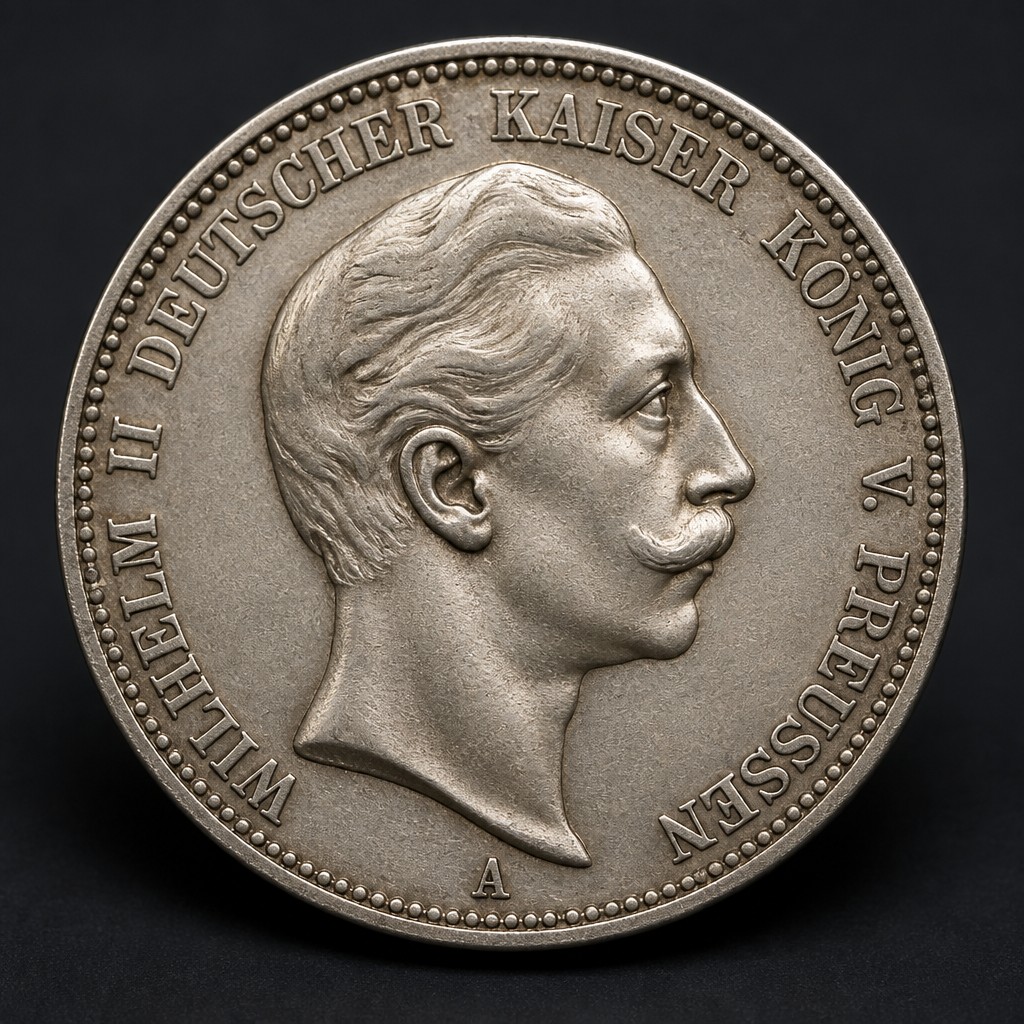
What It Is
The 3 mark silver coin was introduced across the German Empire in 1908, adding a larger denomination alongside the existing 2 mark and 5 mark coins. Because the empire consisted of multiple states, each with its own ruler, 3 mark coins were struck by numerous individual states such as Prussia, Bavaria, Saxony, and others, each with distinctive local designs, in addition to special commemorative issues marking anniversaries and historical events.
Obverse Design
Most state-issued coins show a profile portrait of the local ruler, such as the King of Prussia (who was also German Emperor), King of Bavaria, or King of Saxony, along with his name and title. City-states without a monarch, like Hamburg or Bremen, instead show a coat of arms in place of a portrait.
Reverse Design
The reverse commonly shows the German imperial eagle design shared across most states, along with the denomination "DREI MARK," the date, and sometimes the specific state's identifying text, though many commemorative issues replace the eagle side with a special design tied to the occasion.
Size, Weight, and Metal
The 3 mark coin is a substantial silver piece, approximately 33 mm in diameter and weighing about 16.67 grams, struck in .900 fine silver, giving it a similar heft to other large European silver crowns of the period.
Mint Marks and Where to Find Them
A single mint mark letter appears near the bottom of the design, usually beneath the eagle on the reverse, identifying which of the empire's mints (such as A for Berlin, D for Munich, E for Muldenhutten, F for Stuttgart, J for Hamburg) struck the piece.
Telling It Apart from Similar Coins
Because so many German states issued 3 mark coins with a shared reverse but different obverse rulers, always check the ruler's name and title, or the coat of arms for city-states, to identify the specific state of origin. It's also easy to confuse this denomination with the smaller 2 mark or larger 5 mark coins sharing similar designs; comparing size and the printed denomination avoids errors.
Judging Condition at a Glance
Examine the ruler's portrait details, particularly hair, mustache, and uniform decorations, along with the eagle's feather detail on the reverse, for wear. A well-preserved coin retains crisp lettering and fine detail throughout, while heavily circulated examples show smoothed high points and softened lettering.
Authenticity Red Flags
Watch for cast reproductions showing a seam line or pitted surface, incorrect weight or diameter for the type, and blurred or poorly formed lettering. Because certain commemorative 3 mark issues from specific states are scarcer and more valuable than common date-and-ruler combinations, be especially cautious of pieces claiming a rare state or date without crisp, consistent design details.
Frequently asked questions
When was the 3 mark denomination introduced?
It was introduced in 1908 across the German Empire, adding a larger silver denomination alongside the existing 2 mark and 5 mark coins.
Why do 3 mark coins look different from state to state?
The German Empire was a federation of states, each of which struck its own coinage bearing its own ruler's portrait or coat of arms, sharing only the common reverse eagle design in most cases.
What is the silver content of a 3 mark coin?
It is struck in .900 fine silver, weighing about 16.67 grams total.
How do I find which mint struck my 3 mark coin?
Look for a single letter mint mark near the base of the reverse design, such as A for Berlin or D for Munich, identifying the specific German mint.