
How to Identify the German 1 Deutsche Mark
Confirm a 1-Mark coin by its oak-leaf-and-numeral value side, DEUTSCHE MARK legend, eagle reverse, cupro-nickel size, and single-letter mint mark.
Read the full German 1 Deutsche Mark encyclopedia entry →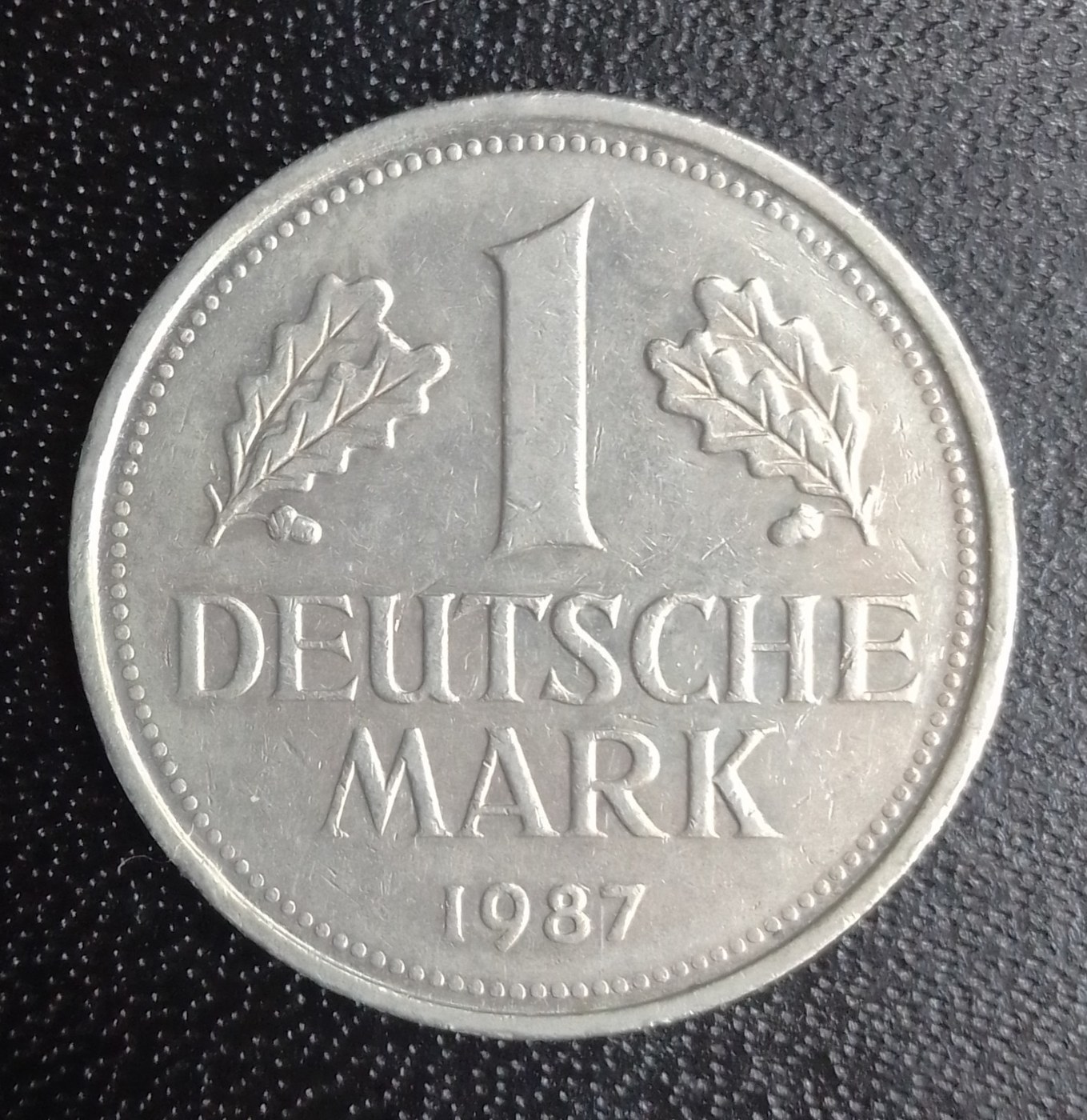
Read the value side first. The face shown here is unmistakable: a large numeral 1 flanked by oak leaves with the words DEUTSCHE MARK. This design ran essentially unchanged for the whole D-Mark era, so the value side alone tells you the denomination but not the year.
Turn the coin over for date and mint. The other side carries the Federal eagle (Bundesadler), the legend BUNDESREPUBLIK DEUTSCHLAND, the year, and a single mint-mark letter. The letters are A (Berlin), D (Munich), F (Stuttgart), G (Karlsruhe) and J (Hamburg). Recording both the year and the letter is essential, since value depends on the exact date-and-mint pairing.
Check size, metal and edge. A genuine circulation 1 Mark is cupro-nickel — silvery and non-magnetic — about 23.5 mm across, near 5.5 g, with a reeded edge. Compare it against the larger 2-Mark and 5-Mark coins so you do not confuse denominations; the 2-Mark also shows a portrait and a large 2, and the base-metal 5-Mark is bigger still.
Watch for the silver commemorative. In 1990 Germany struck a silver 1-Deutsche-Mark commemorative marking the currency itself; it looks related but is a separate collector coin. If a piece feels unusually heavy for its size or is described as silver or proof, verify the type before assuming it is an ordinary circulation coin.
Authenticate cautiously. Everyday 1-Mark coins are far too common to be widely faked, but altered dates or mint marks can be used to fake a scarce variety. For any high-value date-and-mint or a claimed silver or proof example, weigh and measure the coin, inspect the mint mark under magnification, and compare against a trusted reference or a specialist before paying a premium.
Frequently asked questions
Which side shows the year and mint mark?
The eagle side (with BUNDESREPUBLIK DEUTSCHLAND) carries the year and a single mint-mark letter. The oak-leaf side with the large 1 and DEUTSCHE MARK shows only the denomination.
How do I tell the 1 Mark from the 2 Mark or 5 Mark?
The 1 Mark is the smallest of the three at about 23.5 mm with a plain oak-leaf value side. The 2-Mark shows a statesman's portrait, and the cupro-nickel 5-Mark is larger and heavier.
Is my coin the rare silver version?
Only the 1990 commemorative was struck in silver. Ordinary dated circulation coins, including 1987, are cupro-nickel. A silver piece will typically be marked or sold as proof and feels heavier for its size.
Does a worn 1987 example still have value?
Circulated coins are common and worth little beyond exchange value. Premiums attach mainly to uncirculated or proof coins and scarcer date-and-mint combinations, so grade and mint matter most.