
How to Identify the George IV One Sixteenth Spanish Dollar
A collector's guide to spotting the 1/16 "Anchor Money" by its crowned obverse, anchor-and-XVI reverse, tiny silver size, and PRO BRITANNIA COLONIAE legend.
Read the full George IV One Sixteenth Spanish Dollar encyclopedia entry →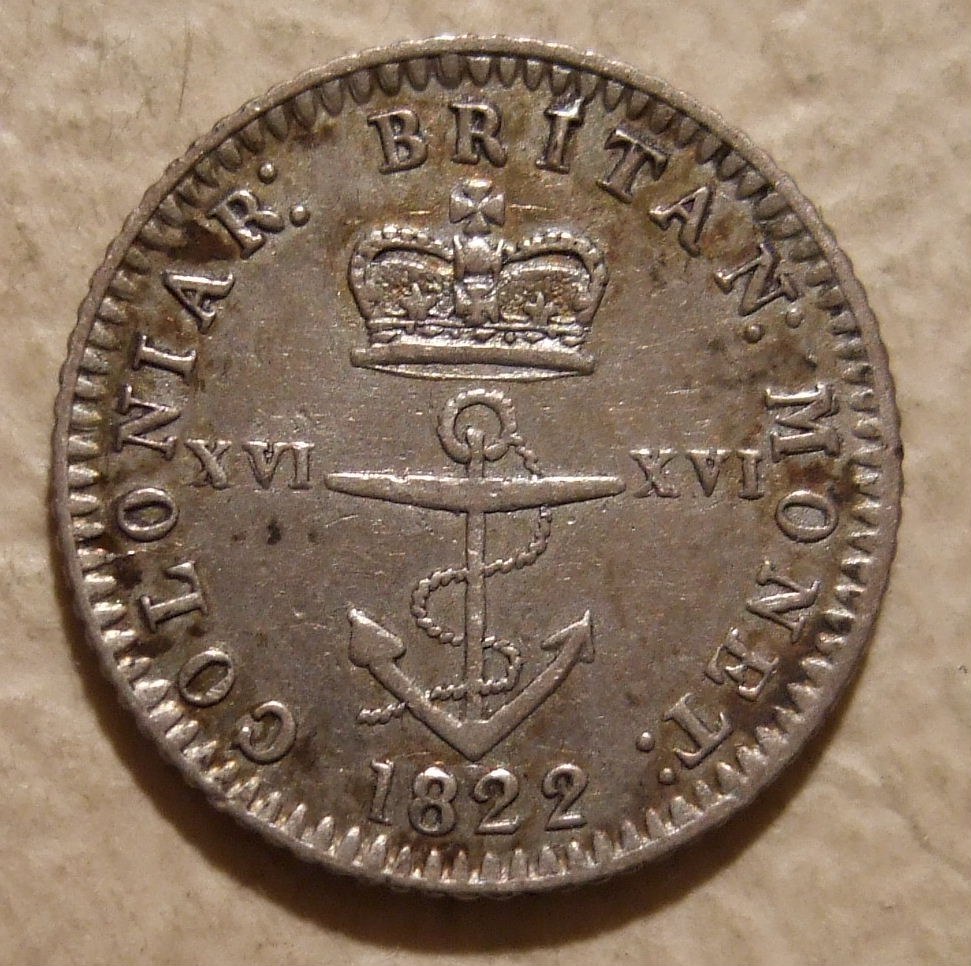
What It Is
The George IV One Sixteenth Spanish Dollar is the smallest coin in the early-1820s British colonial "Anchor Money" series. It was struck in silver as a fraction of the Spanish dollar to serve as small change in colonies where Spanish and Spanish-American dollars circulated. Correctly identifying it means confirming both the design and the specific one-sixteenth denomination.
Obverse (Front)
Look for a large crown as the central device, encircled by a Latin inscription giving the titles of George IV. Unlike most British coins of the period, there is no monarch's portrait bust here—the crown alone dominates the field. On circulated examples, expect only parts of the legend to remain readable, so use the crown shape and surviving letters together rather than relying on a full inscription.
Reverse (Back)
The reverse is the decisive side. A fouled anchor sits at the center, accompanied by the Roman numeral XVI and the legend reading toward PRO BRITANNIA COLONIAE, with the date (1822 on the photographed piece) present in the design. The XVI is what confirms the one-sixteenth denomination; if the numeral reads differently (such as a larger fraction), you are looking at one of the sister denominations, not this coin.
Size, Metal, and Denomination Check
Because it is the lowest value in the set, this is the smallest and lightest of the four Anchor Money coins—a thin, small-diameter silver piece. The metal should be silver-toned throughout, not a plated base-metal core showing at the edges or high points. Match the small size against the XVI marking: a tiny coin bearing XVI is consistent with the 1/16 dollar, while a physically larger anchor coin belongs to a higher denomination.
Look-Alikes and Authentication Cautions
Distinguish this from the other Anchor Money denominations (one-half, one-quarter, and one-eighth dollar), which share the crown-and-anchor design but differ in size and Roman numeral. Be cautious with worn, cleaned, or tooled surfaces, and with cast or plated reproductions: genuine strikes show crisp anchor and crown detail and correct weight for the size. When value is at stake, seek confirmation from a specialist in British colonial silver or a reputable grading service rather than relying on appearance alone.
Frequently asked questions
How do I tell the 1/16 dollar from the other Anchor Money coins?
Check the Roman numeral on the anchor reverse and the coin's size. XVI on the smallest, lightest piece indicates the one-sixteenth dollar; larger coins with different numerals are the higher denominations in the series.
The obverse legend is worn—can I still identify it?
Yes. Even with only part of the Latin titles legible, the combination of a central crown (no portrait) on the obverse and an anchor with XVI on the reverse is enough to identify the type.
What legend should the reverse show?
The reverse legend reads toward PRO BRITANNIA COLONIAE, wrapped around a central fouled anchor with the numeral XVI and the date. Confirming this wording helps rule out unrelated anchor-motif tokens or coins.
How can I check that it is genuine silver and not a copy?
Genuine pieces are struck silver with crisp anchor and crown detail and appropriate weight for their small size. Be wary of plated base metal, cast seams, or mushy detail, and get a specialist opinion before paying a premium.