
How to Identify the French Semeuse 2 Francs
A collector's guide to recognizing France's silver 2 francs Semeuse by its Sower obverse, denomination reverse, size, metal and mint marks.
Read the full French Semeuse 2 Francs encyclopedia entry →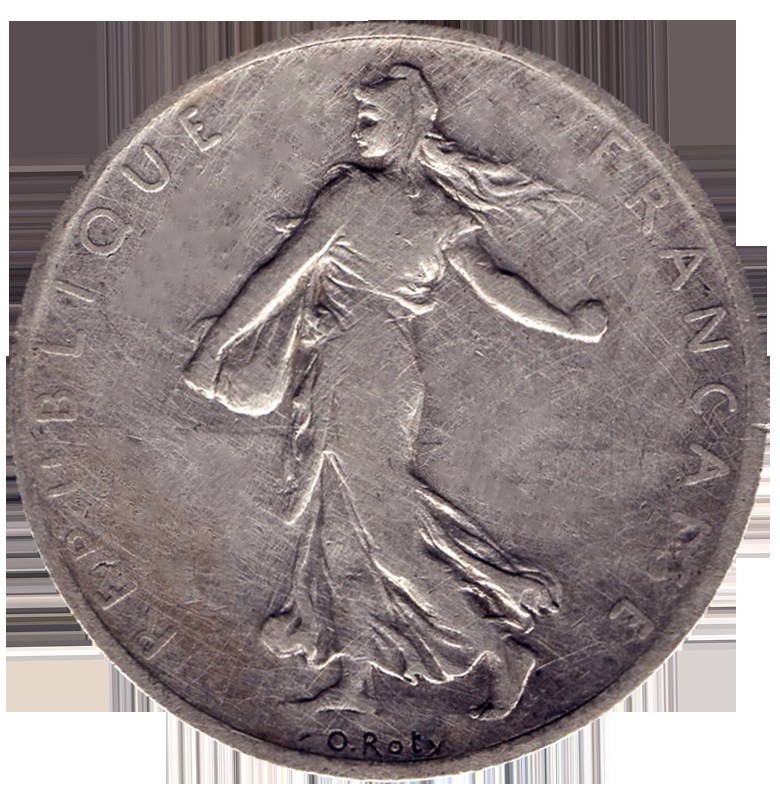
Begin with the obverse, which is the signature of the whole series. A genuine Semeuse 2 francs shows the Sower: a woman in a long dress and Phrygian-style cap walking and casting seed with her hand while facing left, a low rising sun behind her, and the legend RÉPUBLIQUE FRANÇAISE around the rim. Look near the ground line for the small engraver's signature O. ROTY; its presence is a good sign of an authentic die.
Turn to the reverse to confirm the denomination. The centre reads 2 FRANCS with the date beneath — 1899 on the pictured coin — set between leafy branches (olive and oak), usually with the Republican motto around the edge. Reading the exact numeral of value matters, because the identical Sower obverse was used on the 1 franc and 50 centimes as well; only the reverse denomination and the coin's size tell them apart.
Check size and metal to nail the denomination. The 2 francs is about 27 mm across and roughly 10 g in silver, noticeably larger than the ~23 mm 1 franc and ~18 mm 50 centimes. The coin should look bright silver-white where unworn, feel dense, and have a reeded (grooved) edge; it is non-magnetic. A weight and diameter check quickly rules out smaller Semeuse coins and base-metal look-alikes.
Locate the small marks beside the date to identify the exact issue. French silver of this period was struck mainly at Paris, and tiny privy symbols (an engraver's and a mint director's mark) flank the reverse design. These, together with the date, distinguish one year and mint from another and are essential when checking scarce dates. Do not confuse the later nickel or cupro-nickel Semeuse coins of the twentieth century with this silver piece — they share the Sower but differ in metal, colour and size.
Finally, weigh authentication cautions. Because these are silver coins, they attract cast copies and altered dates; be wary of a coin that is under- or over-weight, has a visible casting seam, mushy "soapy" detail, or a date that looks re-engraved. Cleaned, polished, holed or mounted pieces are common and lose value. For a high-grade or scarce date, confirm weight and diameter and, when in doubt, seek an opinion from a reputable dealer or grading service rather than relying on images alone.
Frequently asked questions
How do I tell the 2 francs from the 1 franc Semeuse?
They share the same Sower obverse, so read the reverse value and check the size. The 2 francs states 2 FRANCS and is about 27 mm and 10 g; the 1 franc is smaller at roughly 23 mm.
Where is the mint mark on this coin?
Look in the reverse field near the date for small privy symbols — an engraver's mark and a mint mark. French coins of this era were struck mainly at Paris, and these marks identify the exact issue.
What weight and size confirm a genuine silver 2 francs?
About 27 mm in diameter, roughly 10 g, struck in silver with a reeded edge and non-magnetic. A coin that is off-weight, magnetic, or has a casting seam should be treated with caution.
Is the O. ROTY name on the coin important?
Yes. O. ROTY is the signature of designer Louis-Oscar Roty, placed near the Sower's feet. Finding it in the right spot supports authenticity, though it should be checked alongside weight, size and detail.