
How to Identify the French Louis d'Or
The Louis d'Or was the gold coin of the French kingdom for over a century, identifiable by the reigning Bourbon king's portrait and a distinctive crossed-L cruciform reverse.
Read the full French Louis d'Or encyclopedia entry →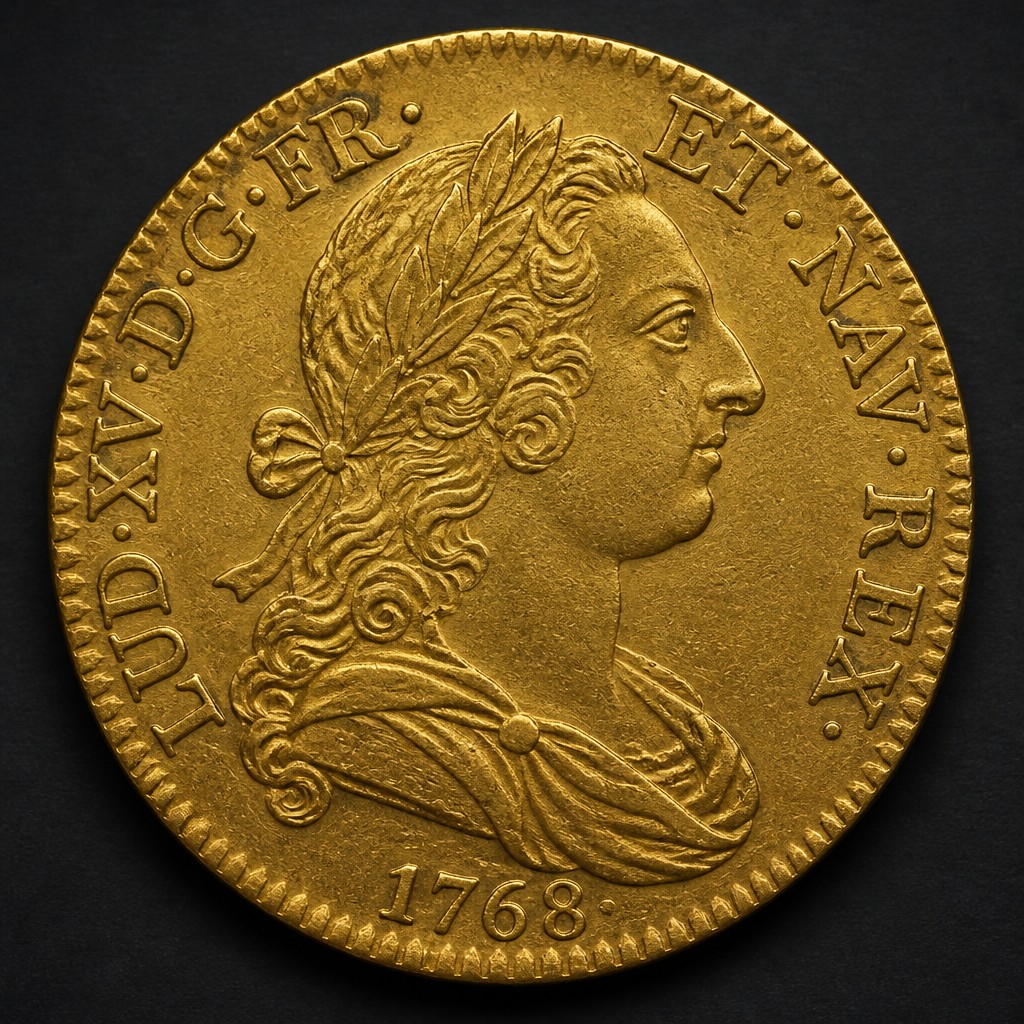
What Is the Louis d'Or
The Louis d'or was a gold coin struck by the Kingdom of France from the reign of Louis XIII in the 1640s through Louis XVI, ending with the French Revolution's switch to decimal francs. It came in several denominations, including half and double louis pieces, and served as France's principal gold trade coin for well over a century, circulating alongside the smaller silver ecu and livre coinage used in everyday transactions.
Obverse Design and Inscriptions
The obverse shows a bare-headed or laureate profile portrait of the reigning king facing right, with a Latin legend naming him and his titles, such as "LUD XV D G FR ET NAV REX" (Louis XV, by the grace of God, King of France and Navarre).
Reverse Design and Inscriptions
Later 18th-century types (often called "Louis d'or au bandeau") display crossed L's arranged in a cross pattern with crowns and fleurs-de-lis filling the spaces between the arms, surrounded by the legend "CHRS REGN VINC IMPER" (Christ reigns, conquers, commands).
Size, Weight, and Metal
The coin was struck in high-purity gold, generally around .917 to .920 fine, with the standard Louis d'or of Louis XV and Louis XVI weighing close to 8.16 grams and measuring about 24mm across — a thinner, wider planchet than most modern gold coins.
Mint Marks and Where to Find Them
A single letter mint mark sits below the portrait or near the date, identifying the minting city — A for Paris, D for Lyon, and other letters for provincial French mints — often paired with a smaller symbol marking the mint master's tenure.
Telling It Apart From Similar Coins
Compare the crowned-L cruciform reverse to later French gold coins such as the Napoleon 20 Franc, which instead shows a laurel wreath and text reading "REPUBLIQUE FRANCAISE" or "EMPIRE FRANCAIS." The Louis d'or's older lettering style and religious Latin motto are the clearest giveaways of its earlier origin.
Judging Condition at a Glance
Examine the king's hair curls and cheek, and the crowned L's, for flattening. Gold wears slowly, so centuries-old coins can still show good detail, though frequently circulated pieces show wear first on the highest points of the portrait. Because these coins are hand-struck on relatively thin planchets, slight doubling, off-center strikes, or planchet flaws are common and are not necessarily condition defects but rather characteristics of period minting technology.
Authenticity Red Flags
Later restrikes and reproductions often have incorrect weight, an off color compared to period gold alloys, or blurred lettering from worn transfer dies. Genuine pieces should have crisp, precisely engraved lettering and the correct heft and specific gravity expected of gold.
Frequently asked questions
What does 'Louis d'or' mean?
It translates to 'gold Louis,' named for the several French kings named Louis whose portraits appeared on the coin.
How do I read the date on an older Louis d'or?
Earlier issues sometimes used Roman numerals or omitted the date, while 18th-century coins show a standard four-digit date near the mint mark.
What is the difference between a Louis d'or and a double Louis d'or?
The double louis is a larger denomination struck on a bigger, heavier planchet using the same basic design elements.
Why do the reverse designs look religious?
France was a Catholic monarchy, and mottos referencing Christ reflected the belief that the king ruled by divine right.
Can I identify the mint city from the coin?
Yes, a single letter near the date or portrait indicates the mint city, with Paris typically marked 'A.'