
How to Identify the French Indochina Sarraut Piastre (1931)
A reduced-weight silver piastre introduced by French Indochina in 1931 to address rising world silver prices, noticeably smaller and lighter than the earlier Piastre de Commerce.
Read the full French Indochina Sarraut Piastre (1931) encyclopedia entry →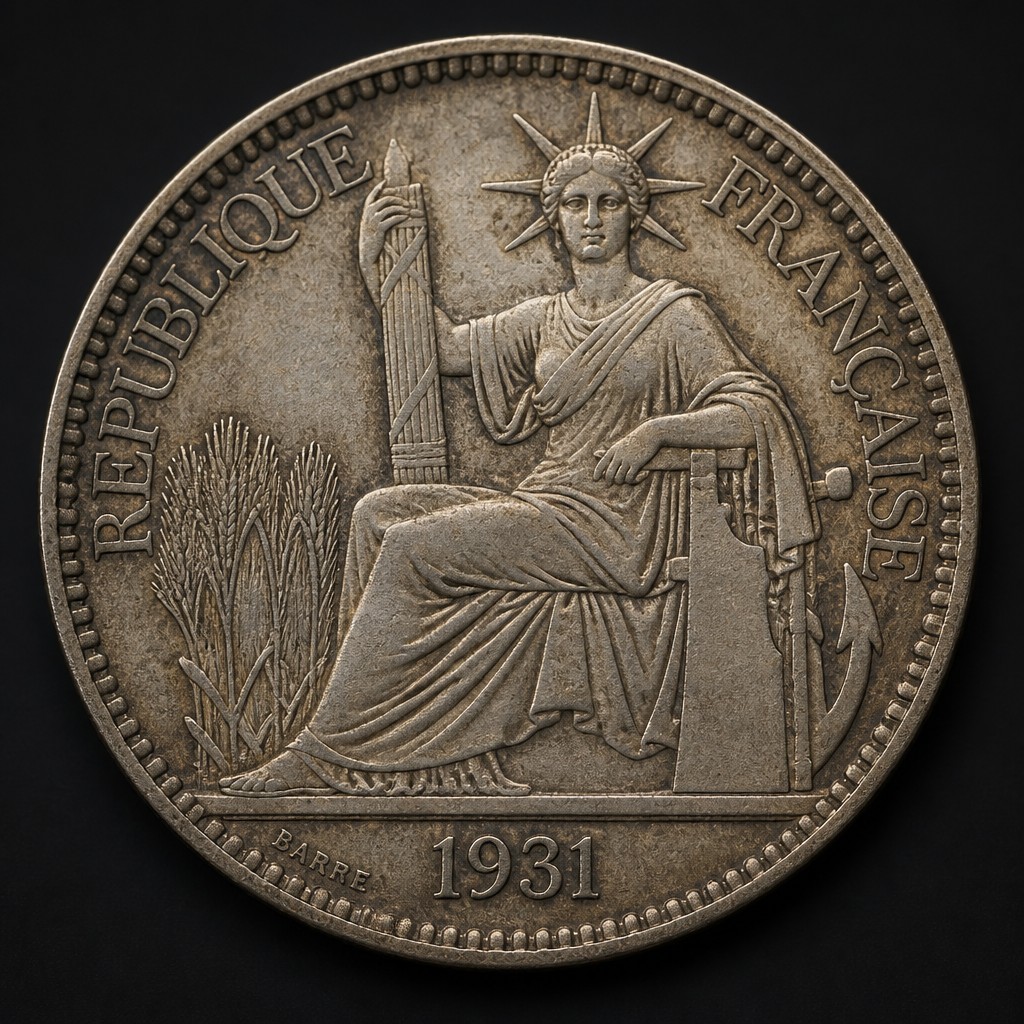
What It Is
By 1931, a sharp rise in world silver prices meant the bullion value of the older, heavier Piastre de Commerce exceeded its face value, encouraging melting and threatening the colony's money supply. French Indochina responded with a new, smaller, lighter piastre authorized under decrees associated with Governor-General Albert Sarraut's colonial administration, commonly nicknamed the "Sarraut piastre" by collectors.
Obverse Design & Inscriptions
The obverse retains the same general seated allegorical figure representing the French Republic seen on the earlier large piastre, along with the French legend identifying the Republic, but rendered at a reduced size to match the coin's smaller diameter.
Reverse Design & Inscriptions
The reverse again shows "PIASTRE DE COMMERCE" (or the equivalent value designation) within a wreath, together with the 1931 date, following the visual language of the earlier issue but scaled down proportionally.
Size, Weight & Metal
This is the key identifying feature: the 1931 piastre is noticeably smaller and lighter than its predecessor, with a reduced diameter and weight brought down to align the coin's silver value with its face value under 1931 market conditions. The silver fineness remained high, but the overall bullion content per coin dropped substantially compared to the older large piastre.
Mint Marks & Where to Find Them
As with the earlier piastre, striking was carried out under French Indochina's colonial mint authority, with any mint or engraver initials appearing as small letters near the date rather than a large standalone mark. Because 1931 was effectively a one-year transitional issue before further monetary reforms, surviving specimens are tied closely to that single date.
Telling It Apart from Similar Coins
The most reliable way to distinguish the 1931 Sarraut piastre from the earlier Piastre de Commerce is simply to compare size and weight side by side, or against published reference measurements — the 1931 coin is visibly smaller in hand. Date is also decisive, since this reduced type is specifically associated with 1931, unlike the older design that spans several earlier decades.
Judging Condition at a Glance
Look for crisp definition in the seated figure's drapery and facial features and clear separation of the wreath leaves on the reverse for higher-grade examples. Circulated pieces show smoothing on the figure's raised areas and a flattened wreath, along with overall dulling of the surface luster consistent with handling.
Authenticity Red Flags
Verify diameter and weight against known reference figures for the 1931 issue, since a piece matching the older, larger piastre's dimensions but bearing a "1931" date would be inconsistent and worth close inspection. As with other silver trade-era coins, watch for grainy or pitted surfaces, soft detail, or an incorrect edge treatment that can indicate a cast counterfeit rather than a genuine struck coin.
Frequently asked questions
Why was the 1931 piastre made smaller than earlier piastres?
Rising world silver prices in 1930-31 made the older, heavier piastre worth more as bullion than as currency, so French Indochina reduced the coin's size and weight to bring it back in line with its face value.
How can I quickly tell a Sarraut piastre from the older Piastre de Commerce?
Compare the diameter and weight directly; the 1931 issue is noticeably smaller and lighter than the earlier large piastre, even though the designs are visually similar.
Is the design completely different from the older piastre?
No, it keeps the same general seated-figure obverse and wreathed value reverse, just scaled down to the smaller coin size.
Was this a long-running coin type?
The reduced-size 1931 issue represented a short transitional period in French Indochina's monetary history rather than a decades-long series like the earlier piastre.