
How to Identify the French Indochina Piastre de Commerce
A large silver trade coin issued by French Indochina from the 1880s onward, easily recognized by its seated allegorical figure of Liberty on the obverse and a wreathed value on the reverse.
Read the full French Indochina Piastre de Commerce encyclopedia entry →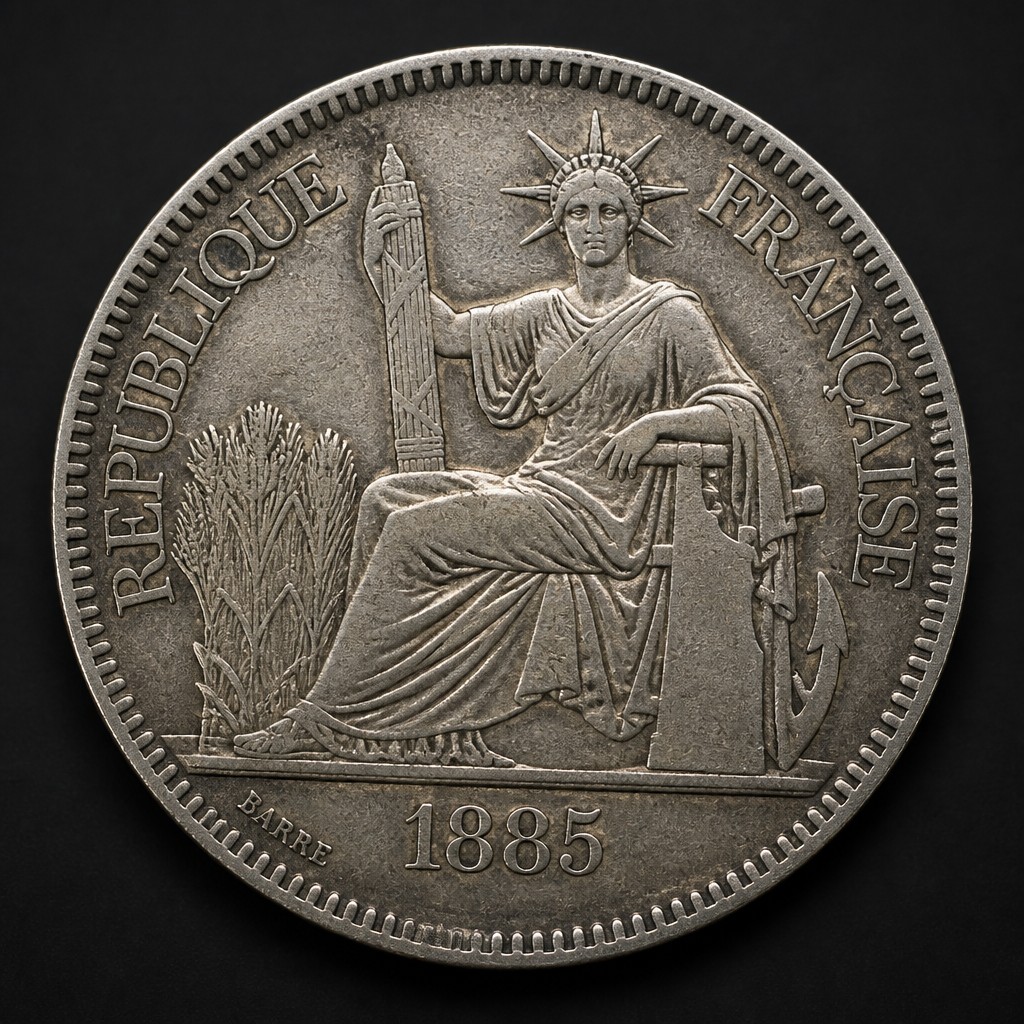
What It Is
The Piastre de Commerce was the standard silver trade dollar of French Indochina, first issued in the 1880s to give the colony a large silver coin comparable to the Mexican eight reales and other silver trade dollars circulating across Asian ports at the time. It remained the backbone of French Indochina's coinage until its weight was reduced in 1931.
Obverse Design & Inscriptions
The obverse depicts a seated allegorical female figure representing the French Republic (often described as Liberty or Marianne), shown in flowing robes, typically holding attributes associated with the Republic and seated in a classical pose. Around the border runs the legend "REPUBLIQUE FRANCAISE" or similar French text identifying the issuing authority.
Reverse Design & Inscriptions
The reverse centers on a wreath enclosing the denomination "PIASTRE DE COMMERCE" along with the date of issue. The wreath is typically composed of stylized branches, and the overall layout closely mirrors other 19th-century silver trade dollars used to facilitate commerce with China and Southeast Asia.
Size, Weight & Metal
This is a large, heavy silver coin, roughly 38-39mm in diameter, with a silver fineness around .900 and a weight in the neighborhood of 27 grams before the 1931 weight reduction. The edge is reeded, consistent with a machine-struck trade coin intended to deter clipping and file marks.
Mint Marks & Where to Find Them
Piastres were struck primarily at the Paris Mint for French Indochina, and mint or engraver initials, when present, appear as small letters near the date or along the rim rather than as a prominent standalone mark. Because these coins circulated heavily in East and Southeast Asian trade, many surviving examples carry Chinese merchant "chop marks" — small punched characters — stamped by traders who verified the silver content.
Telling It Apart from Similar Coins
The Piastre de Commerce is often confused with other large 19th-century trade dollars such as the Mexican 8 reales, the US Trade Dollar, the British Trade Dollar, or the Straits Settlements dollar. The clearest distinguishing feature is the French legend and the seated-figure obverse design, which is unique to the French Indochina issue; no other trade dollar of the period uses this exact seated allegorical composition paired with French text.
Judging Condition at a Glance
On a well-preserved piece, the seated figure's drapery folds and facial features remain crisp, and the wreath on the reverse shows distinct individual leaves. Circulated coins show smoothing across the highest relief points — the figure's torso and the central wreath ties — along with a duller, grayer surface from handling. Heavy chop-marking, while historically interesting, does reduce the coin's original surface and is typically noted separately from wear-based grading.
Authenticity Red Flags
Because these large silver trade coins have long been targeted by counterfeiters (both historically, for circulation, and more recently, for the collector market), check for correct weight and diameter, a properly reeded edge, and sharp, well-centered lettering. Cast fakes often show a slightly grainy or pitted surface texture, softer overall detail, and incorrect weight compared to genuine struck examples.
Frequently asked questions
What makes the Piastre de Commerce different from a Mexican 8 reales?
The Piastre de Commerce has a French legend and a distinctive seated allegorical figure unique to French Indochina, while the Mexican 8 reales shows an eagle-and-cactus design with Spanish/Mexican text.
Why do many examples have small stamped characters on them?
These are Chinese merchant chop marks, applied historically by traders to verify silver content as the coin circulated through Asian commerce; they are common and expected on circulated pieces.
What is the approximate size and silver content?
Around 38-39mm in diameter, about 27 grams, roughly .900 fine silver, prior to the 1931 weight reduction.
Does heavy chop-marking mean the coin is damaged or fake?
Chop marks are a historical circulation feature, not evidence of a fake, though they do affect the coin's original surface and are usually assessed separately from standard wear grading.