
How to Identify the French 5 Francs "Napoleon"
A large silver coin struck under Napoleon Bonaparte, showing his portrait as First Consul or Emperor, prized for its historic imagery and heavy silver content.
Read the full French 5 Francs "Napoleon" encyclopedia entry →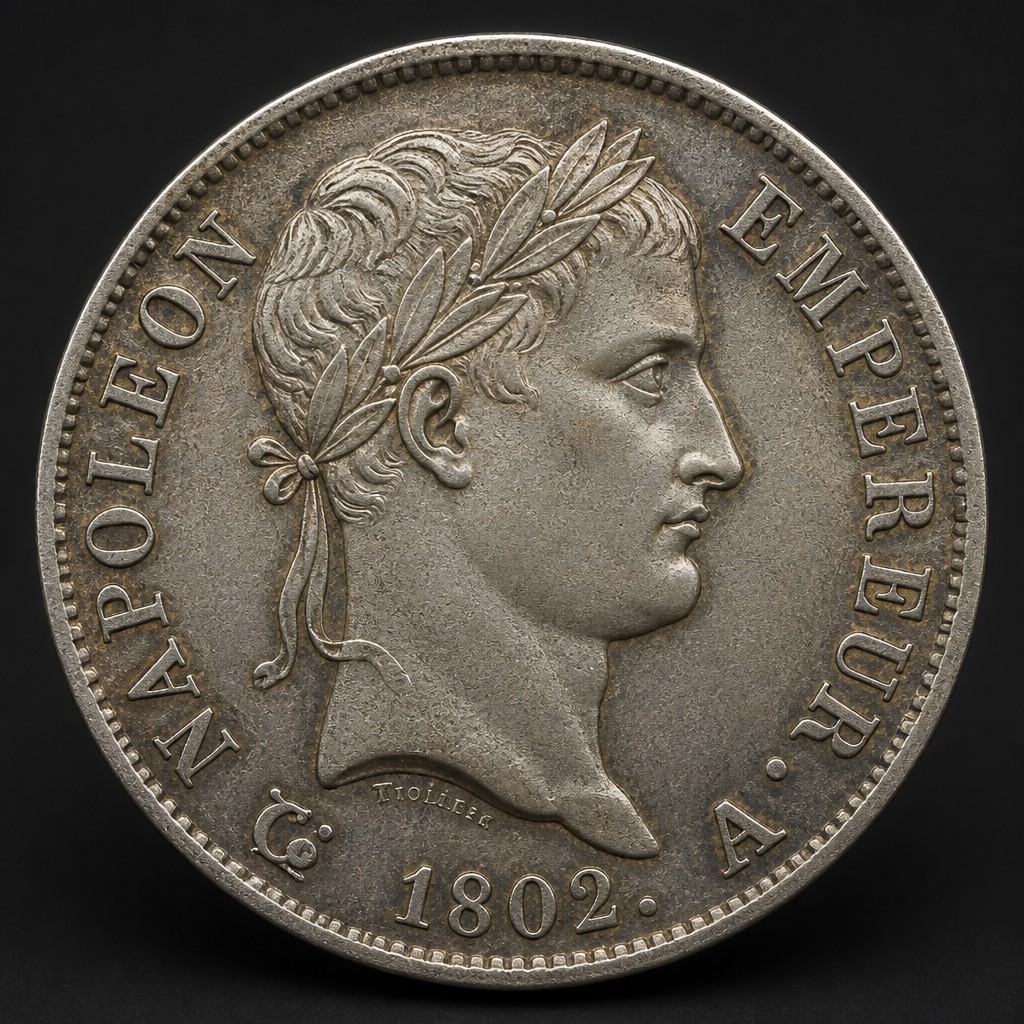
What This Coin Is
The French 5 Francs "Napoleon" refers to the large silver crown-sized coins struck under Napoleon Bonaparte between 1803 and 1815, first as First Consul and later as Emperor of the French. These coins circulated widely across Europe during the Napoleonic Wars, often traveling far beyond French borders with occupying armies and through trade, and are among the most recognizable French silver issues thanks to their bold portraiture and generous silver content.
Obverse Design & Inscriptions
The obverse carries a left- or right-facing portrait of Napoleon, either bare-headed as "Bonaparte, Premier Consul" (1803-1804) or laureate as "Napoleon Empereur" (1804-1815). The legend runs around the rim in Latin-style French lettering, and the engraver's initials (often "TIOLIER F." or similar) may appear small beneath the bust truncation.
Reverse Design & Inscriptions
The reverse shows the denomination "5 FRANCS" within a wreath, with the date below and "REPUBLIQUE FRANCAISE" or "EMPIRE FRANCAIS" curving around the border depending on the political phase. A mintmark letter sits at the bottom near the wreath ribbon.
Size, Weight, Metal, and Edge
These are large silver crowns, roughly 37 mm in diameter and about 25 grams, struck in .900 fine silver. The edge carries an incuse or raised lettered inscription (commonly "DIEU PROTEGE LA FRANCE") rather than plain reeding, which is an important genuineness check.
Mint Marks and Where to Find Them
A single letter mintmark appears on the reverse near the bottom, identifying the French mint city that struck the coin (A for Paris, and other letters for provincial mints). A small privy mark or engraver's symbol may also sit near the date or truncation.
Telling It Apart From Similar Coins
Later French 5 Francs coins depicting Louis XVIII, Charles X, or the Bourbon Restoration kings look similar in size and denomination but carry different portraits and legends. Compare the bust style and the wording "Empire Francais" versus "Republique Francaise" versus a king's name to date the piece to the correct political era. Coins struck during the brief "Hundred Days" return of 1815 also exist and are worth noting as a distinct short-lived variety within the broader Napoleon type.
Judging Condition at a Glance
Check the hair curls and laurel leaves on the portrait and the wreath detail on the reverse for wear; these high points flatten first. Well-preserved examples show sharp lettering on the edge and strong relief on Napoleon's profile, while heavily circulated coins show a smoothed, low-relief portrait.
Authenticity Red Flags
Watch for coins with a plain or poorly executed edge lettering, incorrect diameter or weight, or a portrait style that does not match known date ranges. Cast copies often show a grainy surface texture, soft details, and a seam line around the edge instead of crisp lettering.
Frequently asked questions
What years were French 5 Francs Napoleon coins struck?
Primarily 1803 to 1815, spanning Napoleon's rule as First Consul and then Emperor.
What metal is the coin made of?
It is struck in .900 fine silver, giving it a bright white appearance when uncirculated.
How can I tell if my coin is a fake?
Check the lettered edge inscription and weigh the coin; genuine pieces weigh close to 25 grams with crisp raised edge letters, while fakes often feel light or have a blurry edge.
What does the mintmark tell me?
A single letter near the wreath on the reverse identifies which French mint city struck the coin.