
How to Identify the French 5 Francs Hercules
A French silver coin featuring an allegorical group of Hercules flanked by Liberty and Equality, first used during the Revolutionary era and revived for the Second Republic.
Read the full French 5 Francs Hercules encyclopedia entry →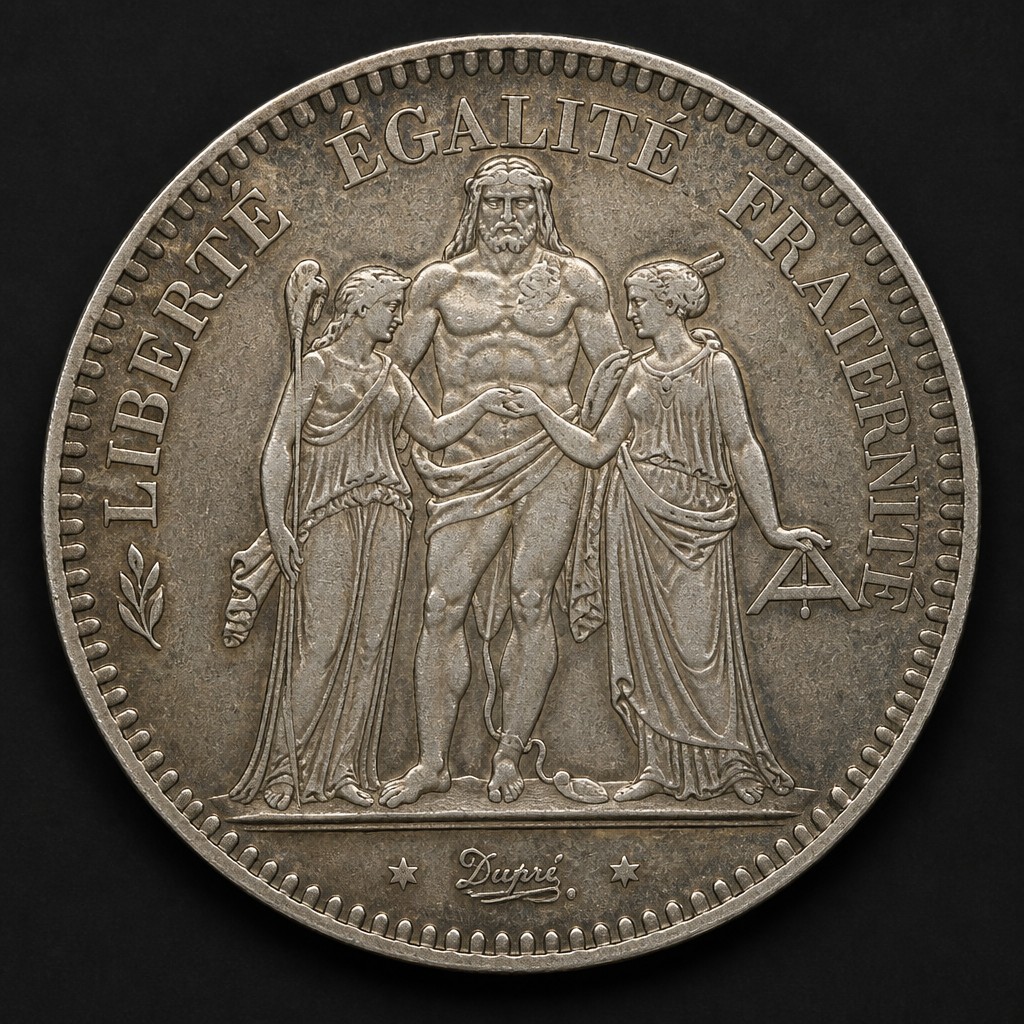
What the Coin Is
The Hercules design, created by engraver Augustin Dupré, first appeared on French 5 franc silver coins during the Directory and Consulate periods in the late 1790s and early 1800s, then was revived nearly half a century later for the Second Republic in 1848 and 1849, making it identifiable across two distinct historical eras.
Obverse Design & Inscriptions
The obverse shows an allegorical group: Hercules standing at center, flanked by female figures representing Liberty and Equality, their hands joined together above his shoulders. The legend UNION ET FORCE (Union and Strength) arches around the group, with the date below, rendered in the French Revolutionary calendar on the earliest issues and in standard Gregorian numerals on the 1848-1849 revival.
Reverse Design & Inscriptions
The reverse displays the denomination 5 FRANCS within a wreath, encircled by the legend REPUBLIQUE FRANCAISE.
Size, Weight, Metal & Edge
The coin measures approximately 37mm in diameter, weighs about 25 grams, and is struck in .900 fine silver. Edge treatment includes lettered inscriptions such as DIEU PROTEGE LA FRANCE (God protect France) on some issues, distinguishing it from plainer reeded edges used on other French coinage.
Mint Marks & Where to Find Them
Small privy marks and mint letters appear near the base of the design on the obverse, identifying both the specific mint that struck the coin and the mint director in office at the time, a system used broadly across historical French coinage.
Telling It Apart From Similar Coins
The Hercules group design is unmistakable compared to other French 5 franc types, such as the seated Ceres or Napoleon portrait issues, due to its unique three-figure allegorical scene. Distinguishing the original Directory-era strikes from the 1848-1849 revival relies on the date format and specific style details of the lettering and figures.
Judging Condition at a Glance
Examine the raised details of the three figures, particularly their faces, joined hands, and drapery folds, for smoothing from circulation. A well-preserved coin will show crisp separation between the figures and clear, unworn lettering in the surrounding legend.
Authenticity Red Flags
Because this design spans two historically significant periods and remains popular with collectors, verify that the date format, lettering style, and edge inscription are consistent with a genuine issue from either era. Be cautious of coins with a weight or diameter noticeably outside expected ranges, blurred figure details suggesting a cast reproduction, or an edge inscription that doesn't match known genuine varieties.
Frequently asked questions
What does the design on this coin represent?
It shows Hercules flanked by figures representing Liberty and Equality with joined hands, an allegory of unity and strength referenced in the legend UNION ET FORCE.
Was this design used more than once?
Yes, it first appeared in the late 1790s and early 1800s during the Directory and Consulate periods, then was revived for the Second Republic in 1848 and 1849.
How can I tell the two eras apart?
The earliest issues use the French Revolutionary calendar for the date, while the 1848-1849 revival uses standard Gregorian dates, along with some differences in lettering style.
What is the silver content of this coin?
It is struck in .900 fine silver, weighing approximately 25 grams.