How to Identify the French 20 Franc Rooster
A visual guide to the Third Republic's Marianne and Rooster 20 franc gold coin, covering its design, specifications, mint marks, and how to spot restrikes.
Read the full French 20 Franc Rooster encyclopedia entry →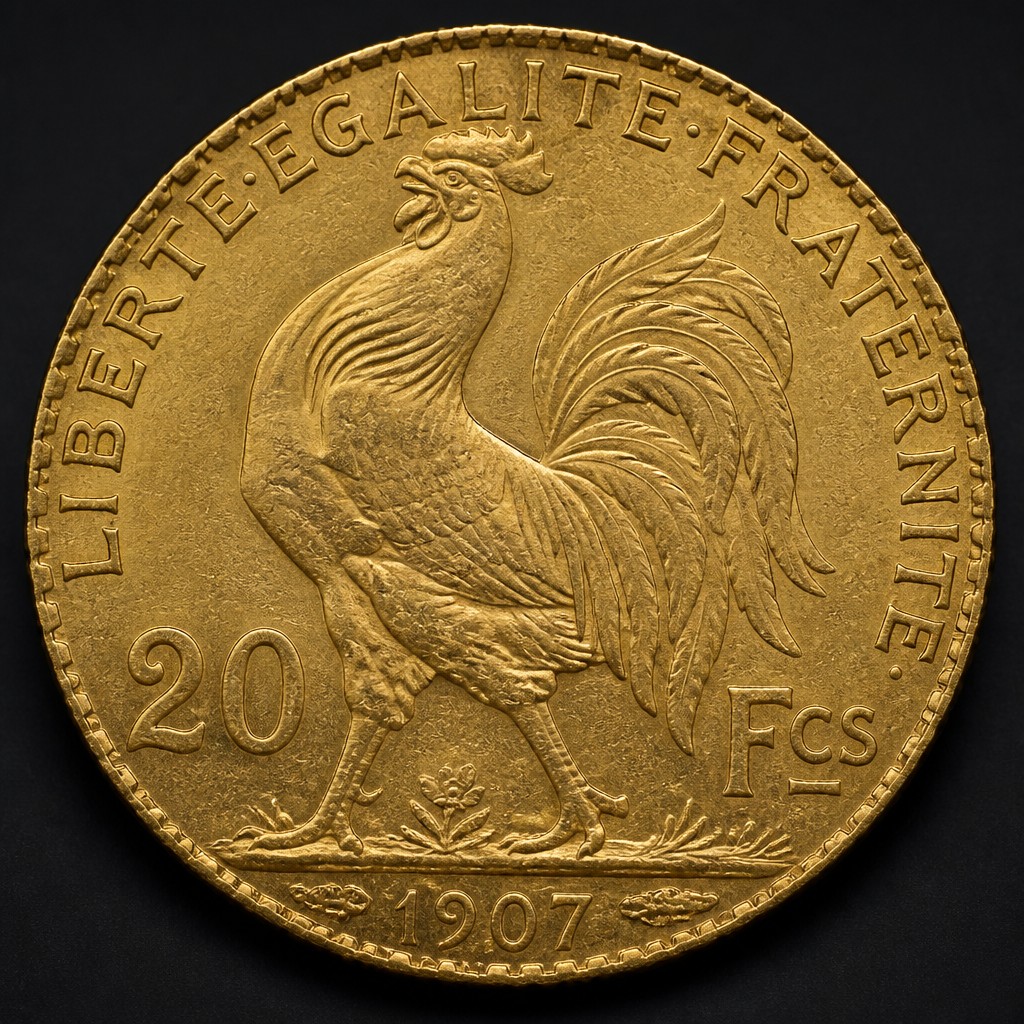
What Is the Coin
The French 20 Franc "Rooster" (Coq) is a gold coin struck by the Third Republic from 1899 to 1914, with additional official restrikes made in 1951 all dated 1907. It is one of the most common French gold coins found in the market today because of both its original mintages and later restrikes.
Obverse Design
The obverse, designed by Jules-Clement Chaplain, shows the head of Marianne, the female personification of the French Republic, facing right and wearing a laurel wreath. The inscription "REPUBLIQUE FRANCAISE" surrounds the portrait, along with the engraver's name in small letters near the neck truncation.
Reverse Design
The reverse depicts a Gallic rooster standing proudly with wings partly spread, facing left, with rays of sunlight behind it. Below the rooster is the denomination "20 FRANCS" and the date; the legend "LIBERTE EGALITE FRATERNITE" (Liberty, Equality, Fraternity) arcs around the upper rim.
Size, Weight, Metal & Edge
Like other Latin Monetary Union 20 franc gold coins, it is struck in .900 fine gold, weighs 6.45 g, and has a diameter of 21 mm with a reeded edge.
Mint Marks and Where to Find Them
A small mint mark and privy marks appear near the date on the reverse; nearly all surviving examples were struck in Paris and carry the corresponding mark. The 1951 restrikes, though struck decades later, still carry the 1907 date and matching mint marks, so date alone cannot distinguish an original 1907 coin from a later restrike; this is a well-known and openly documented characteristic of the series rather than a deceptive flaw.
Telling It Apart From Similar Coins
The Rooster type is easy to distinguish from the earlier Napoleon-portrait 20 franc coins by its Marianne head and rooster reverse rather than an emperor's portrait. It shares identical size, weight, and fineness with several other European 20 franc/franc-equivalent gold coins (Swiss Vreneli, Belgian Leopold issues, Italian 20 lire), so the design, not the specifications, is what confirms the country of origin.
Grading and Condition at a Glance
Wear first appears on Marianne's cheek and the highest curls of her hair, and on the rooster's breast and wing tips on the reverse. Strong original luster in the fields around these high points indicates a well-preserved, lightly circulated coin.
Authenticity Red Flags
Given how commonly this type is reproduced, check that weight (6.45 g) and diameter (21 mm) are correct, and look for crisp, well-defined feathers on the rooster and sharp lettering in the legends; soft or blurred details often indicate a cast counterfeit rather than a genuine struck coin. Because so many original coins and official restrikes both exist in the market, an unusual metallic color, incorrect specific gravity, or a magnetic reaction are additional practical tests worth applying before assuming a coin is genuine.
Frequently asked questions
What does the rooster reverse represent?
The Gallic rooster is a traditional national symbol of France, distinct from the Napoleonic portraits used on earlier 20 franc gold coins.
Are 1907-dated coins always original strikes?
Not necessarily; official 1951 restrikes also carry the 1907 date, so the date alone does not distinguish an original from a restrike.
What is the gold content of this coin?
.900 fine gold at 6.45 g total weight, the same standard used across several European 20 franc-equivalent gold coins.
How is it different from the 'Napoleon' 20 franc coin?
The Rooster type shows a Marianne head and rooster design from the Third Republic (1899-1914), while 'Napoleon' coins show Napoleon I or III portraits from earlier periods.
French 20 Franc Rooster identified by the community
Recent French 20 Franc Rooster coins identified with Coin Identifier.