
How to Identify the France 1 Euro
A collector's guide to recognizing France's 1 euro by its tree-in-hexagon national side, bimetallic build, size, mint marks and 2-euro look-alike.
Read the full France 1 Euro encyclopedia entry →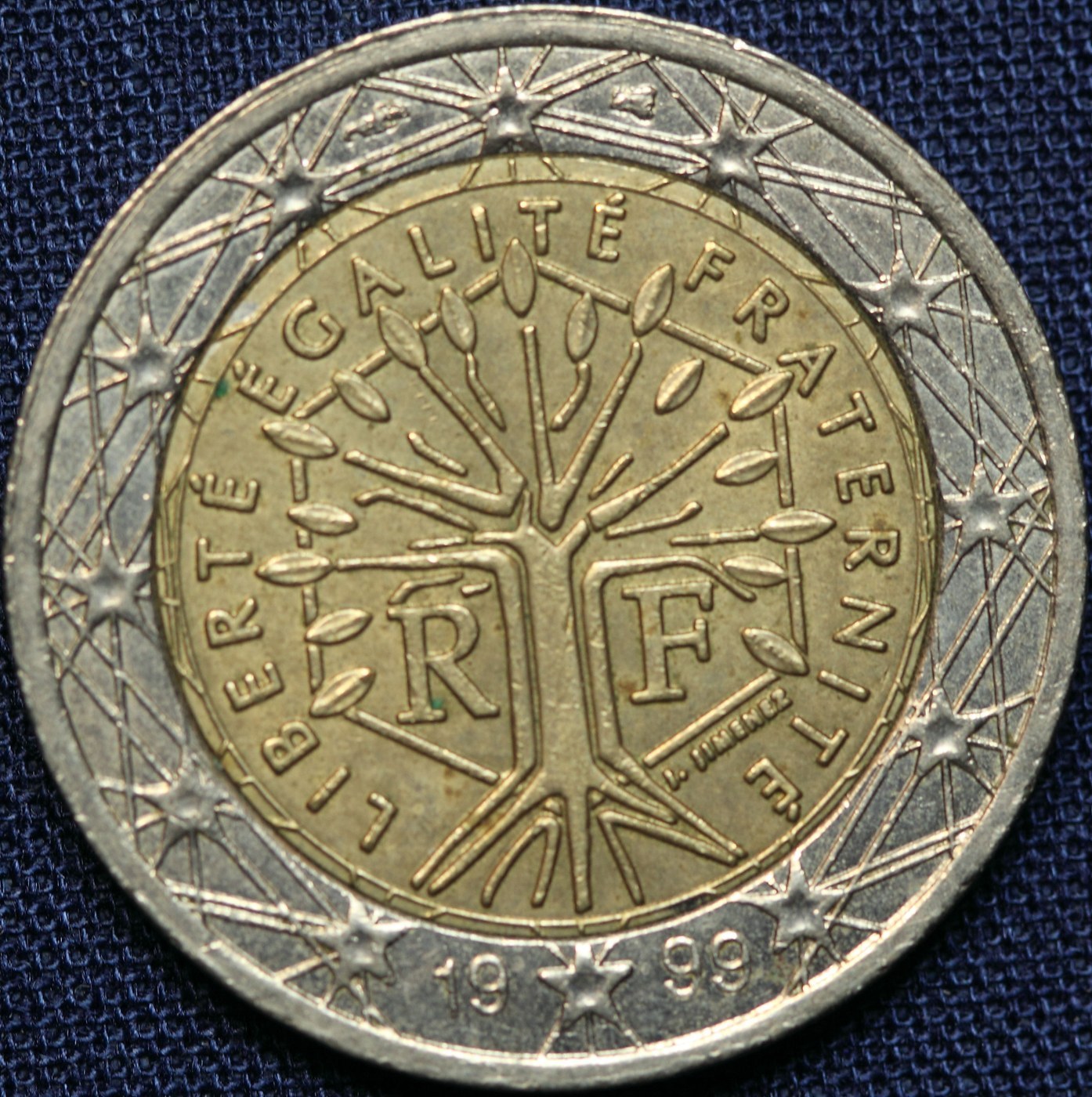
Begin with the national side. The France 1 Euro shows a stylized tree with spreading, leafy branches enclosed in a six-sided hexagon, wrapped by the motto LIBERTÉ ÉGALITÉ FRATERNITÉ and the initials RF for République Française. The date sits in the field—2000 on this coin—and twelve EU stars ring the edge. This leafy tree inside a hexagon is the most reliable identifier that a euro coin is French rather than from another eurozone country.
Confirm the value on the common side. The shared European face carries the numeral 1 with the word EURO beside a map of Europe. Reading this matters because the French 1 and 2 euro coins use the very same tree design; the denomination on the common side is what separates them. If the coin says 2, it is the two-euro piece, not this one.
Check the bimetallic build and size. The 1 euro has a gold-colored (nickel-brass) outer ring around a pale silver-colored center and measures roughly 23 mm—clearly larger and heavier than the single-metal 50 cent coin, and with the color arrangement reversed compared with the 2 euro, which has a silver ring around a gold-colored center. The two-metal contrast and the ring-and-center color order are quick visual cues.
Look for the tiny mint marks flanking the tree design: the Monnaie de Paris privy mark (historically a cornucopia) and the mint engraver's mark. These small symbols identify the French mint and the year's officials; they confirm French striking and help pin down the exact issue without altering the type itself.
For authentication, note that genuine coins pair a magnetic-responsive center with the correct weight, diameter and clean bimetallic bond—euro coins use specific security-tuned alloys. Be wary of coins where the two metals are loose or misaligned, where the edge or lettering looks soft, or where a common date has been passed off as a rare error. When a premium or error claim is involved, rely on weight, measurements and trusted reference images rather than appearance alone.
Frequently asked questions
How do I tell the French 1 euro from the 2 euro?
Both share the tree-in-hexagon design, so read the common side: one says 1 EURO, the other 2. The color order also differs—1 euro has a gold ring and silver center, the 2 euro the reverse.
How do I know a euro coin is French?
Look at the national side. A stylized leafy tree inside a hexagon with the motto LIBERTÉ ÉGALITÉ FRATERNITÉ and the letters RF marks it as a French issue.
What are the small symbols next to the tree?
They are the Monnaie de Paris mint mark and the engraver's privy mark. They identify the French mint and the year's mint officials rather than changing the coin type.
Does the France 1 Euro contain silver or gold?
No. The colors come from base-metal alloys—nickel-brass for the gold-colored ring and copper-nickel for the silver-colored center. It holds no precious metal.