France 1 Euro
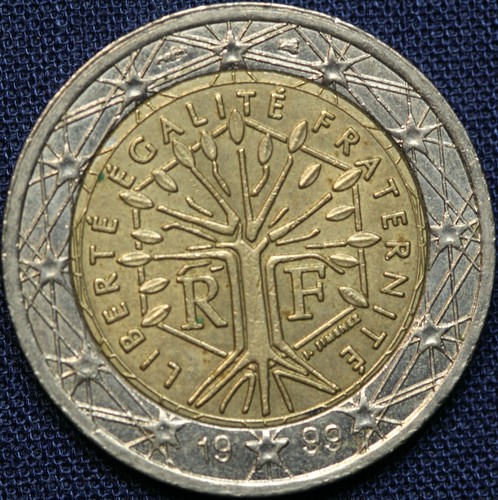
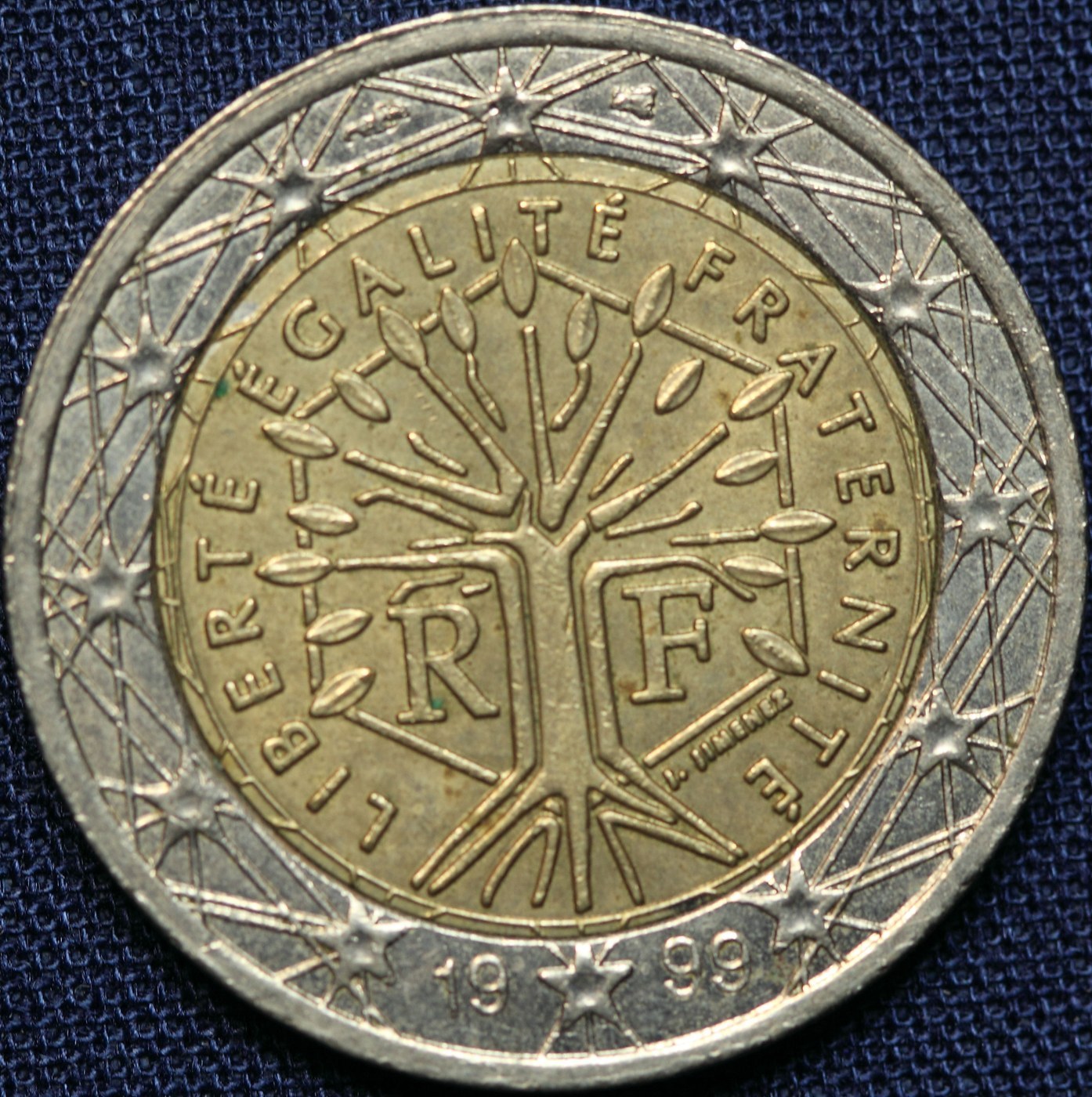
France's bimetallic 1 euro coin, with a stylized leafy tree inside a hexagon on the national side and the euro value with a map of Europe on the common side.
- Country
- France
- Denomination
- 1 Euro
- Metal
- Bimetallic
Got a coin like this?
Identify any coin from a photo, free.
Overview
The France 1 Euro is a bimetallic circulation coin issued for the euro currency. Its French national side shows a stylized tree with spreading branches and leaves set inside a hexagon—an emblem often called the 'tree of life' that echoes the shape of France—framed by the republican legend and the initials RF. Twelve small stars of the European Union run around the outer ring. The example here is dated 2000.
The other face is the common European design shared by every eurozone country at this value: a map of Europe beside the large numeral 1 and the word EURO. Struck with a gold-colored outer ring around a silver-colored center, the coin is an ordinary circulating denomination used across France and the wider euro area rather than a commemorative piece.
History & Background
France was among the founding members of the euro, and its national euro coin designs were prepared in the late 1990s ahead of the currency's launch. Euro coins entered circulation in January 2002, but the coins themselves carry earlier dates from when striking began, which is why French pieces are found dated 1999, 2000 and 2001 as well as later years.
The French 1 and 2 euro coins share the tree-in-a-hexagon motif, a modern design by the engraver Joaquín Jiménez that pairs the national motto LIBERTÉ ÉGALITÉ FRATERNITÉ with the abbreviation RF for République Française. The common side, with its map and value, is the work of Belgian designer Luc Luycx and appears on the matching denomination of every euro-area nation.
The 2000 date on this coin places it in the pre-circulation minting run struck before the physical changeover. The common European side was later revised to show an expanded map of Europe on coins struck from the mid-2000s onward, but the French national side has continued the tree design across the life of the series.
How to Identify
Start with the national side: a stylized tree with leafy, branching foliage sits inside a six-sided hexagon, surrounded by the words LIBERTÉ ÉGALITÉ FRATERNITÉ and the letters RF. The year—2000 on this example—appears in the field, and twelve EU stars ring the outer band. This leafy tree in a hexagon is the key French diagnostic.
The opposite face is the shared euro design: the numeral 1 and the word EURO next to a map of Europe, with the twelve stars. Physically the coin is bimetallic—a gold-colored (nickel-brass) outer ring around a pale silver-colored center—about 23 mm across, larger and thicker than the 50 cent coin but smaller than the 2 euro.
Look near the tree design for two tiny mint marks: a small privy symbol for the Monnaie de Paris (historically a cornucopia) and the mint engraver's mark. These identify the French mint and the year's mint director rather than changing the type. Because the 1 and 2 euro share the same tree motif, always read the value on the common side to confirm you have the 1 euro and not the 2 euro.
Value & Collectibility
As a current circulating coin, an ordinary France 1 Euro is worth its face value—one euro—and the vast majority of dated pieces, including common early years, carry little or no premium above that in worn condition.
Collector value is limited to specific cases: uncirculated or proof examples from mint sets, the earliest dates in top grade, and any coin with a genuine striking error. The 2000-dated coin shown here is a normal circulation issue, so it is common and generally trades at or near face value unless it is in pristine, uncirculated preservation.
Because premiums depend on grade and the exact year, check recent sales for high-grade or set examples rather than assuming a figure. Ordinary handled coins are best regarded as spendable currency with modest collector interest.
Frequently asked questions
What coin is the France 1 Euro?
It is France's bimetallic one-euro circulation coin, with a stylized leafy tree inside a hexagon and the motto LIBERTÉ ÉGALITÉ FRATERNITÉ on the national side and a map of Europe with the value on the common side.
What is the France 1 Euro made of?
It is bimetallic: a gold-colored nickel-brass outer ring around a silver-colored copper-nickel center. It is not a precious-metal coin.
Why is my French euro dated 2000 when euros started in 2002?
Euro coins circulated from January 2002, but minting began earlier, so French coins carry dates such as 1999, 2000 and 2001 from the pre-launch striking run.
Is a France 1 Euro coin worth more than one euro?
Usually no. Ordinary circulated coins are worth face value. Only uncirculated or proof examples, the earliest dates in top grade, or genuine error coins carry a premium.
France 1 Euro guides
In-depth guides for identifying, valuing, and collecting France 1 Euro.