
How to Identify the Follis of Licinius I
A collector's guide to reading the LICINIVS legend, standing Jupiter reverse, small bronze fabric, and eastern mint marks of a Licinius I follis.
Read the full Follis of Licinius I encyclopedia entry →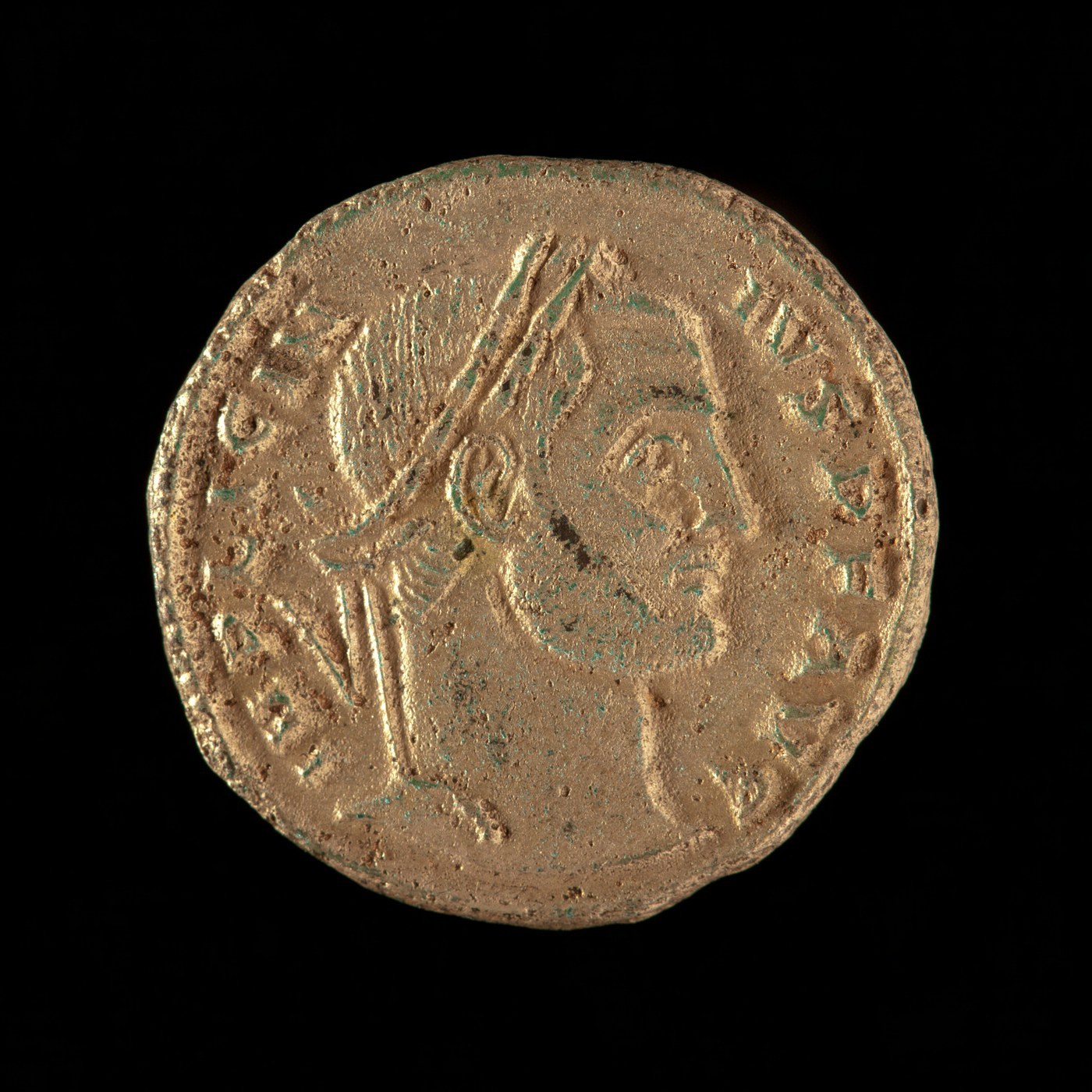
Start with the portrait and the name. This coin shows the bust of Licinius I facing right, and the surrounding legend is what confirms the ruler. Look for the name LICINIVS, most often in a form such as IMP LICINIVS AVG or IMP LIC LICINIVS P F AVG. The single most important check is to separate the father from the son: Licinius I is the senior Augustus with a mature, often heavier portrait and the title AVG, while Licinius II is a boy Caesar with a youthful bust and junior titles like NOB C. Confusing the two is the most common attribution error with this coinage.
Check the fabric, size, and weight. A follis of this date is a small bronze coin, roughly 18-20 mm across and about 2.5-3.5 grams, with a brown or green patina; some examples keep patches of the original silvery surface wash. A large, heavy bronze would belong to the earlier, pre-reduction follis and would be inconsistent with an issue of AD 320-321. Hand-struck irregularity, slightly off-centre legends, and minor flan cracks are all normal.
Use the reverse to attribute the type. Around AD 320-321 the standing figure on Licinius's folles is most often Jupiter, legend IOVI CONSERVATORI, holding a small Victory on a globe in one hand and a long sceptre in the other, with an eagle at his feet and sometimes a bound captive. Read the attributes together with the legend rather than guessing from the pose alone, since other standing figures and vota reverses also occur. In the field and exergue, look for an officina letter and a mint mark such as SMN, SMK, SMH, SMANT, or TS, which fix the coin to a specific eastern mint and workshop.
Watch for look-alikes and authenticity. Contemporary folles of Constantine I, Constantine II, Crispus, Maximinus II, and Licinius II share the same small bronze fabric and similar reverses, so always read the obverse name rather than assuming from appearance. Modern cast forgeries and tooled or re-patinated coins exist. Warning signs include a visible casting seam around the edge, a soft or grainy surface, bubbling or unnaturally even silvering, mismatched portrait and legend styles, and weight far outside the expected range. For a significant purchase, seek attribution from a specialist in late Roman coinage or a coin with reputable provenance.
Frequently asked questions
What is the quickest way to confirm a follis of Licinius I?
Read the obverse legend for the name LICINIVS with the title AVG and a mature bust, then check the size: a small bronze of about 18-20 mm and 2.5-3.5 grams. A standing Jupiter reverse marked IOVI CONSERVATORI is typical for the period.
How can I be sure it is Licinius I and not Licinius II?
Compare the bust and titles. Licinius I is the Augustus (AVG) with an adult portrait, while Licinius II is a youthful Caesar with junior titles such as NOB C or CAES. The age of the portrait and the imperial title settle it.
What do the letters in the reverse exergue mean?
They are the mint mark and officina. Codes like SMN (Nicomedia), SMK (Cyzicus), SMH (Heraclea), SMANT (Antioch), or TS (Thessalonica), often with an added workshop letter, identify which eastern mint and workshop struck the coin.
The coin has no silver shine. Is that a problem?
No. These are bronze coins that once had only a thin silvery wash, and most circulated examples have lost it, leaving a brown or green surface. Even, bright, or bubbling silvering is instead a possible warning sign of a modern reproduction.