
How to Identify the Follis of Crispus
A collector's guide to the small Constantinian bronze of Crispus: youthful diademed bust, CRISPVS legend, Victory reverse, size, and mint marks.
Read the full Follis of Crispus encyclopedia entry →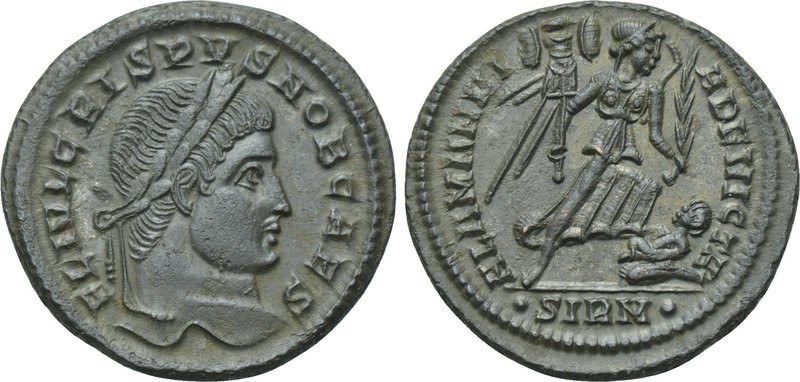
Start with the obverse legend, because it names the ruler directly and is the single most reliable clue. A follis of Crispus shows a youthful bust facing right, here in a diademed wreath rendered in the smooth, rounded Constantinian style. Read the letters around the edge: they should include CRISPVS, usually with the rank NOB C or NOB CAES (for Nobilissimus Caesar), in forms such as CRISPVS NOB CAES or IVL CRISPVS NOB C. Because Constantine and his other sons struck near-identical bronzes, this name, not the portrait style, is what distinguishes a Crispus coin.
Measure and weigh the piece next. This is a small, thin bronze, typically about 18-20 mm across and roughly 2.5-3.5 grams, far lighter than the large early follis of Diocletian. A silver-colored coin, or one much larger and heavier, is a different denomination or ruler and not this issue. The metal is bronze; expect a brown, green, or dark patina, occasionally with faint traces of the original silvering surviving in protected areas.
Read the reverse figure and its legend together. The coin shown here has a winged Victory holding a palm and a trophy or standard, a triumphal type. Confirm the wings and the objects in her hands, then match them to the surrounding Latin legend to identify the exact reverse. Be aware that Constantinian bronzes used a family of shared reverse types, so the reverse alone rarely fixes the ruler; use it together with the obverse name.
Check the exergue, the space below the reverse figure, for the mint mark and workshop (officina) letters. These short codes identify where the coin was struck across the empire's network of imperial mints and are essential for full attribution and for confirming the coin fits a known, standardized issue. A legible mint mark greatly strengthens both identification and value.
Finally, weigh authenticity and look-alikes. The chief confusion is with the near-identical folles of Constantine I, Constantine II, Constantius II, and Licinius II, so always read the obverse name to be sure. Cast and tooled forgeries exist; warning signs include an edge seam, a soft or bubbly surface, lettering or a portrait that does not match known Constantinian dies, and weight well outside the normal range. For a meaningful purchase, favor coins with a clear legend and mint mark and, where possible, specialist attribution or reputable provenance.
Frequently asked questions
How do I know a follis is Crispus's and not Constantine's or his brothers'?
Read the obverse legend. Crispus's coins include CRISPVS, usually with NOB C or NOB CAES. Constantine I and his other sons struck nearly identical bronzes with the same reverse types, so the name in the legend, not the portrait or reverse, identifies the ruler.
What size and weight should a genuine Crispus follis be?
It is a small late bronze, typically about 18-20 mm in diameter and roughly 2.5-3.5 grams. A coin far outside this range, or one that is silver rather than bronze, is a different denomination and warrants closer scrutiny.
Where is the mint mark and why does it matter?
Look in the exergue, the area below the reverse figure. Short letter codes and a workshop numeral there identify the mint and officina. They are key to full attribution and to confirming the coin matches a known, standardized issue.
My Crispus coin has no silvery surface. Is it authentic?
Very likely yes. These small folles once carried only a thin silver wash, which has almost always worn away over the centuries. A brown, green, or dark bronze patina is normal; surviving silvering is a bonus, not a requirement for authenticity.