
How to Identify the Flying Eagle Cent
A collector's guide to recognizing the Flying Eagle Cent by its eagle obverse, wreath reverse, small size, and pale copper-nickel color.
Read the full Flying Eagle Cent encyclopedia entry →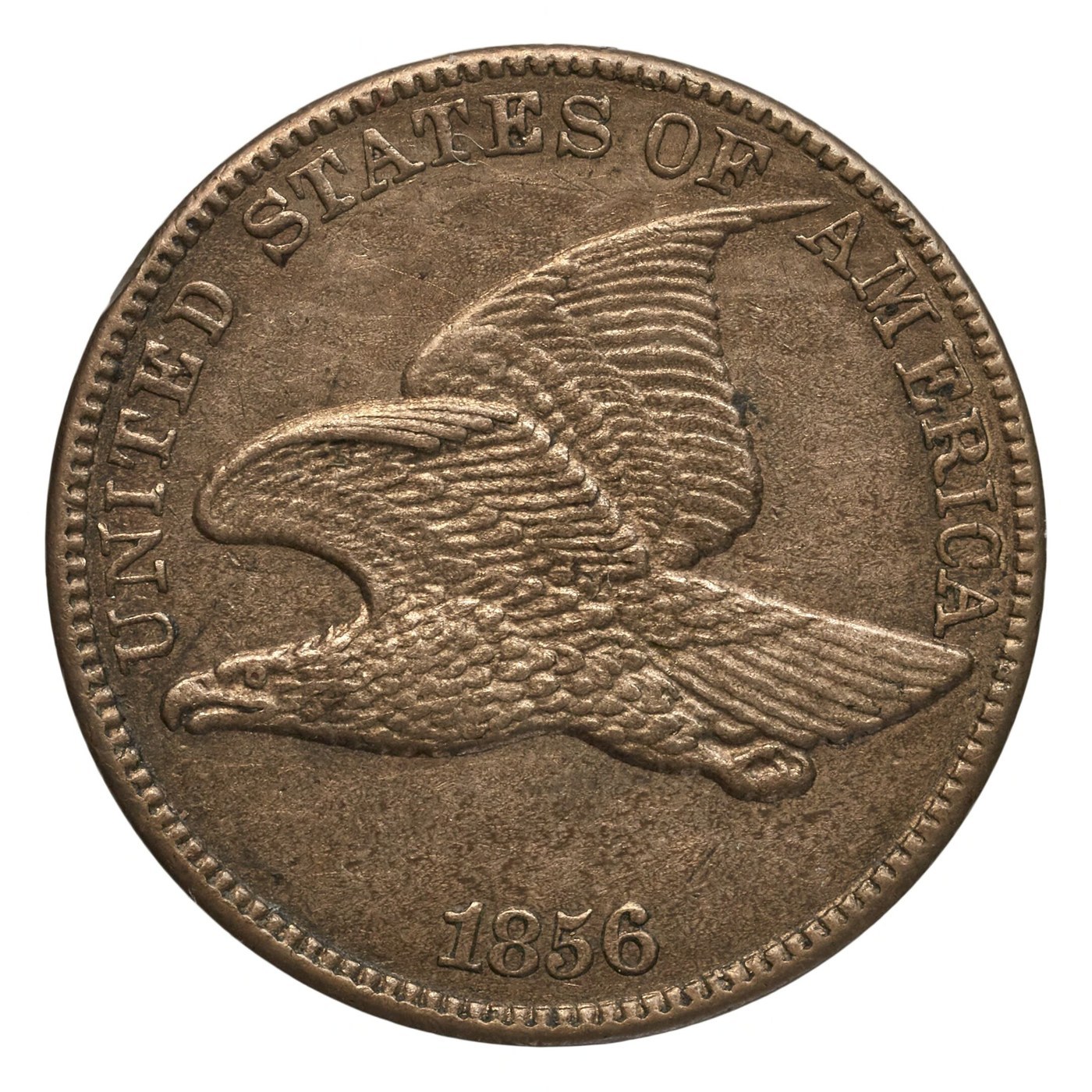
Start with the design. A genuine Flying Eagle Cent shows an eagle in flight with outstretched wings on the obverse, ringed by "UNITED STATES OF AMERICA" and the date, and an agricultural wreath enclosing "ONE CENT" on the reverse. If you see a Liberty head, an Indian head, or a Lincoln portrait, you have a different cent type.
Check size, metal, and edge next. The coin should measure about 19 mm in diameter with a plain (smooth) edge. Its copper-nickel composition gives a characteristic pale tan to whitish color and a slightly heavier, harder feel than later bronze cents; a strongly reddish coin of this design should be examined carefully. There is no mint mark on any genuine example, since all were struck at Philadelphia.
Read the date. Only 1856, 1857, and 1858 are correct for the type. On 1858 coins, compare the lettering to distinguish the Large Letters and Small Letters varieties. Be especially cautious with any coin dated 1856: because it is valuable, a common trick is to alter an 1858 into an 1856, so inspect the final digit for tooling, reshaping, or an unnatural surface.
Watch for look-alikes and problem coins. The Indian Head Cent that followed shares the same size and copper-nickel look for 1859–1864 but has a very different design. Cleaned, corroded, or environmentally damaged pieces are common in this early series, and such issues sharply reduce value even on a correctly identified coin.
When a coin appears to be a scarce date or a high grade, seek authentication. Reputable third-party grading services can confirm both genuineness and condition, which is strongly recommended before buying or selling any expensive Flying Eagle Cent, particularly an 1856.
Frequently asked questions
How can I tell a Flying Eagle Cent from an Indian Head Cent?
Both are small copper-nickel cents of similar size, but the Flying Eagle shows an eagle in flight on the obverse, while the Indian Head Cent shows a Liberty head wearing a feathered headdress.
How do I spot a fake or altered 1856 Flying Eagle Cent?
Examine the last digit of the date closely for signs of tooling or reshaping, since altering an 1858 into an 1856 is a common deception; when in doubt, have it authenticated by a professional grading service.
What size and weight should a genuine Flying Eagle Cent be?
It should be roughly 19 mm in diameter with a plain edge and struck in copper-nickel, giving a pale color and a harder feel than the bronze cents that came later.
Is a pale or whitish color a sign my coin is cleaned or fake?
Not by itself. The copper-nickel alloy naturally looks pale tan to buff or whitish, though harsh cleaning can also lighten a coin, so judge color together with surface texture and detail.