
How to Identify the Flowing Hair Stella
Confirm an 1879 $4 Stella by its flowing-hair Liberty, metric alloy legend, big-star "ONE STELLA" reverse, ~22 mm gold planchet — and beware the many replicas.
Read the full Flowing Hair Stella encyclopedia entry →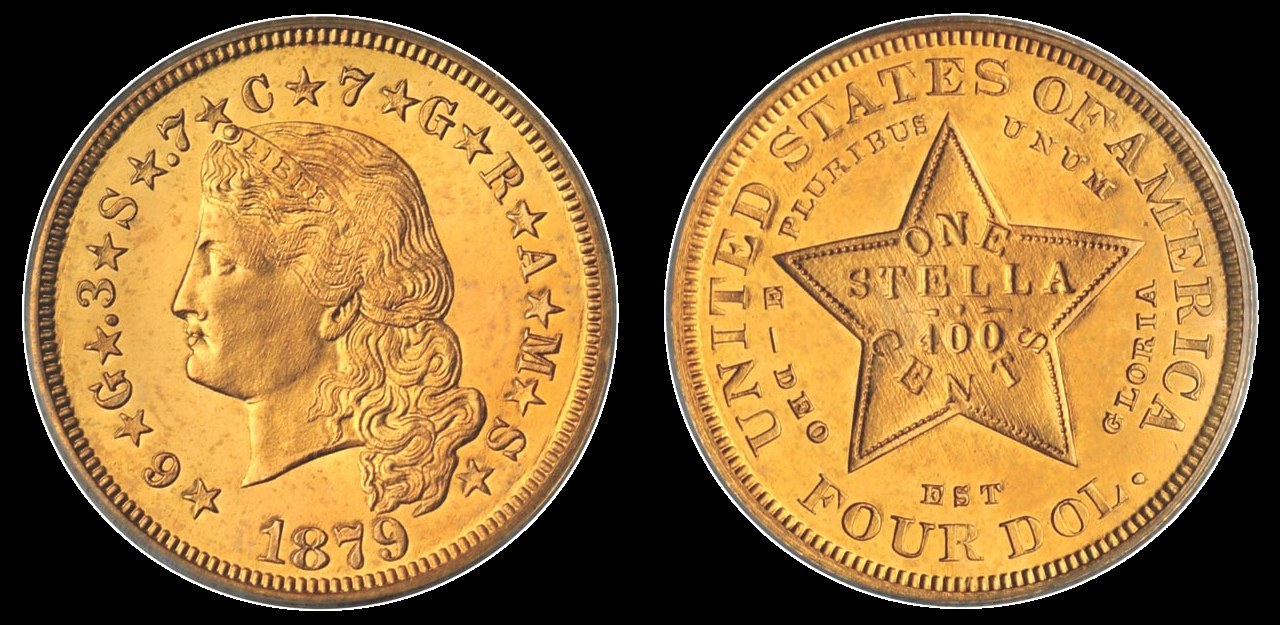
What It Is
The Flowing Hair Stella is an 1879 United States four-dollar gold pattern, not a circulating coin. Because it is one of the most copied rarities in the hobby, identification is really two tasks: recognizing the design, and then treating any example as suspect until it is authenticated.
Obverse Check
Look for Liberty facing left with long, loose, flowing hair and a band reading "LIBERTY" across her hair. The surrounding legend is unusual: instead of stars alone it states the metric alloy, reading as "6 G," ".3 S," ".7 C," and "7 GRAMS," with the date "1879" at the bottom and the mottos "E PLURIBUS UNUM" and "DEO EST GLORIA." The flowing hair separates this type from the Coiled Hair Stella, whose hair is tightly braided and wound.
Reverse Check
The reverse must show a single large five-pointed star with "ONE STELLA" and "400 CENTS" inside it, ringed by "UNITED STATES OF AMERICA" and the denomination "FOUR DOL." This bold central star is the coin's signature and the source of its name. A reverse without the prominent star, or with different denomination wording, indicates a different coin or a fantasy piece.
Size, Weight, and Metal
A genuine Stella is small — about 22 millimeters across, close to a U.S. nickel in diameter — and weighs roughly seven grams. The planchet is a mostly-gold alloy, giving a warm yellow color, and the edge is reeded. A caliper and an accurate scale are useful first screens: pieces that are markedly heavier, lighter, or the wrong diameter are not genuine.
Look-Alikes and Authentication
Gold-plated base-metal copies, jeweler's replicas, and outright counterfeits of the Stella are common because the design is so famous and valuable. Original strikes were made in tiny numbers as proofs, so almost any "bargain" Stella is not real. Do not rely on eye appeal alone — even convincing fakes exist. Because authentic examples are worth six figures, only trust coins certified and encapsulated by a major grading service such as PCGS or NGC, and be wary of raw coins, loose "family heirloom" pieces, and anything sold well below auction levels.
Frequently asked questions
How can I quickly tell a Flowing Hair Stella from the Coiled Hair type?
Study the hair on the obverse. The Flowing Hair Stella shows long, loose, wavy hair, while the Coiled Hair type shows the hair tightly braided and wound close to the head. Both share the same star reverse and $4 denomination.
Are there mint marks on the Stella?
No. The Stellas were struck at the Philadelphia Mint and carry no mint mark. The key identifying inscriptions are the metric alloy legend and date on the obverse and "ONE STELLA" on the reverse.
I found a cheap $4 Stella — is it real?
Almost certainly not. Genuine Stellas are extreme rarities worth six figures, and vast numbers of replicas, souvenir copies, and counterfeits exist. Have any candidate authenticated by PCGS or NGC before believing it is genuine.
What size and weight should a genuine one be?
About 22 millimeters in diameter and roughly seven grams, struck in a mostly-gold alloy with a reeded edge. Pieces of the wrong size or weight, or that are plated base metal, are not authentic.