Flowing Hair Stella
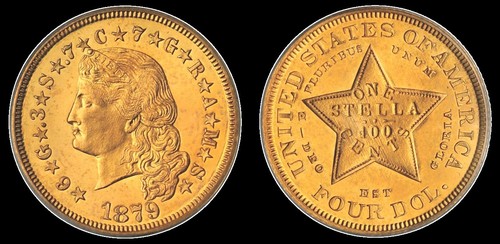
An 1879 U.S. $4 gold pattern coin with a flowing-hair Liberty obverse and a large-star "ONE STELLA" reverse; famous rarity, never circulated.
- Country
- United States
- Denomination
- 4 dollars
- Metal
- Gold
Got a coin like this?
Identify any coin from a photo, free.
Overview
The Flowing Hair Stella is a United States four-dollar gold pattern coin dated 1879, one of the most celebrated rarities in American numismatics. It was a proposed "international" coin intended to slot between existing gold denominations and align U.S. gold with the metric coinage systems of Europe. It was never adopted for regular circulation.
The coin takes its nickname "Stella" — Latin for star — from the large five-pointed star on the reverse that frames the "ONE STELLA" inscription. Two obverse portraits exist across the short-lived series; this piece is the Flowing Hair type, showing Liberty in left-facing profile with long, loose hair. It is a small gold coin, roughly the size of a nickel, and today changes hands for six-figure sums.
History & Background
In the late 1870s Congress and the State Department explored a U.S. gold coin that could trade easily alongside the metric-based gold currencies of France, Italy, and other members of the Latin Monetary Union. The result was the four-dollar Stella, a pattern struck to a metric standard of roughly seven grams of a gold, silver, and copper alloy — the composition spelled out around Liberty's portrait as grams of each metal.
Mint Engraver Charles E. Barber prepared the Flowing Hair design, while George T. Morgan produced a competing Coiled Hair portrait. Only a small number were struck in 1879 as samples for members of Congress to study, and additional Flowing Hair examples were later made to satisfy demand from legislators and collectors. The denomination was never approved, so no Stella ever entered circulation. Because Congressmen were said to have carried the shiny gold pieces around Washington, a persistent legend holds that some ended up in the jewelry of the city's social scene.
How to Identify
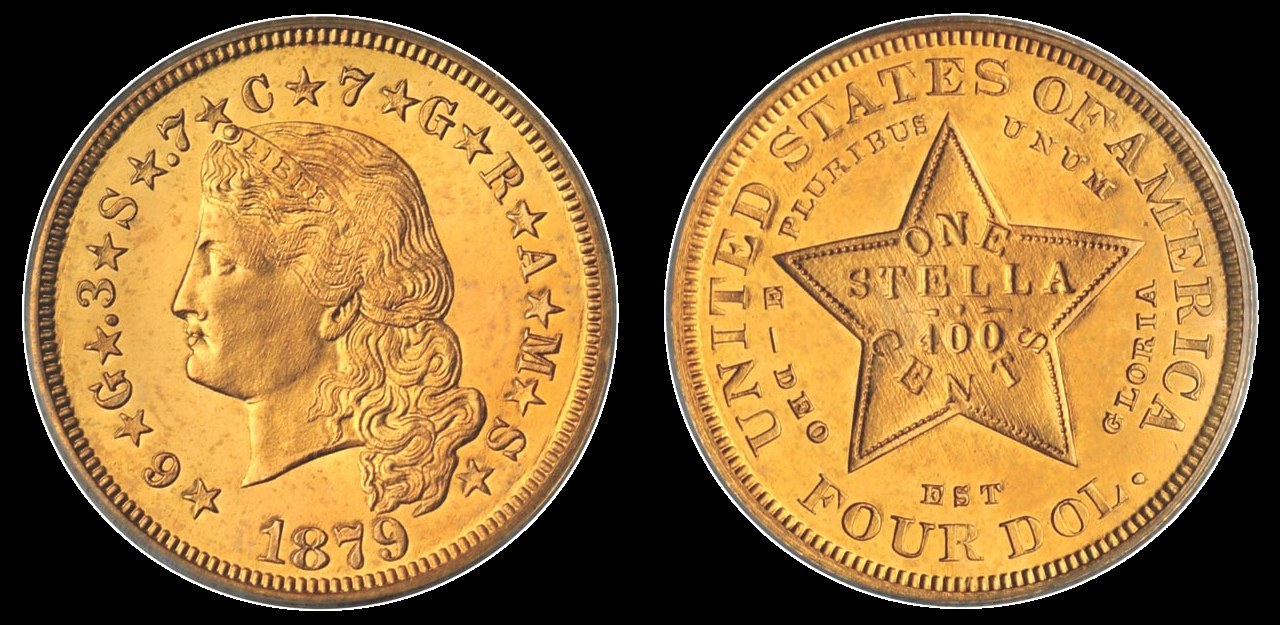
The obverse shows Liberty facing left with long flowing hair and a coronet or band reading "LIBERTY." Encircling the portrait is the metric alloy statement — rendered as stars separating "6 G," ".3 S," ".7 C," and "7 GRAMS" — with the date "1879" below and "E PLURIBUS UNUM" plus "DEO EST GLORIA" around the rim. The loose, wavy hair distinguishes this type from the tightly braided Coiled Hair Stella.
The reverse is dominated by a large five-pointed star inscribed "ONE STELLA" and "400 CENTS." Around the star runs "UNITED STATES OF AMERICA" and the denomination "FOUR DOL." The coin measures about 22 millimeters across and weighs roughly seven grams. Its alloy is predominantly gold, so it shows a warm yellow-gold color, and most survivors carry a proof-like or prooflike finish rather than the wear of a circulating coin.
Value & Collectibility
The Flowing Hair Stella is a major rarity, with only a few hundred examples believed to exist across all strikings — yet it is still the most obtainable Stella, since the Coiled Hair variety and the 1880 issues are far scarcer. As a result it commands strong prices whenever it appears.
Genuine certified examples typically bring well into the six figures, with prices climbing further for high grades, strong eye appeal, and prooflike surfaces. Because so few trade in any given year, value is best judged from recent certified auction results rather than any fixed figure. Any coin offered at a modest price is almost certainly a replica, souvenir, or counterfeit.
Frequently asked questions
Is the Flowing Hair Stella a real circulating coin?
No. It is a pattern — an experimental four-dollar gold piece struck in 1879 to be studied by Congress. The denomination was never approved, so no Stella ever circulated as money.
Why is it called a "Stella"?
"Stella" is Latin for star, and the reverse features a large five-pointed star inscribed "ONE STELLA." The nickname comes directly from that design element.
What is the difference between the Flowing Hair and Coiled Hair Stella?
Both are $4 gold Stellas, but the obverse portraits differ. The Flowing Hair type, designed by Charles E. Barber, shows Liberty with long loose hair; the Coiled Hair type, by George T. Morgan, shows the hair tightly wound. The Coiled Hair is much rarer.
How much is a Flowing Hair Stella worth?
Genuine examples sell for six figures, varying with grade and eye appeal. Because so few exist, prices are best gauged from recent certified auction sales. Inexpensive pieces are replicas or counterfeits.
What is the coin made of?
It was struck to a metric standard of about seven grams of an alloy that is mostly gold with small amounts of silver and copper, described on the obverse as 6 grams gold, 0.3 silver, and 0.7 copper.
Flowing Hair Stella guides
In-depth guides for identifying, valuing, and collecting Flowing Hair Stella.