
How to Identify the Flowing Hair Half Dime
A guide to the Flowing Hair Half Dime (1794-1795), the first half dime struck by the US Mint, covering its Liberty portrait, small eagle reverse, tiny size, and scarcity considerations.
Read the full Flowing Hair Half Dime encyclopedia entry →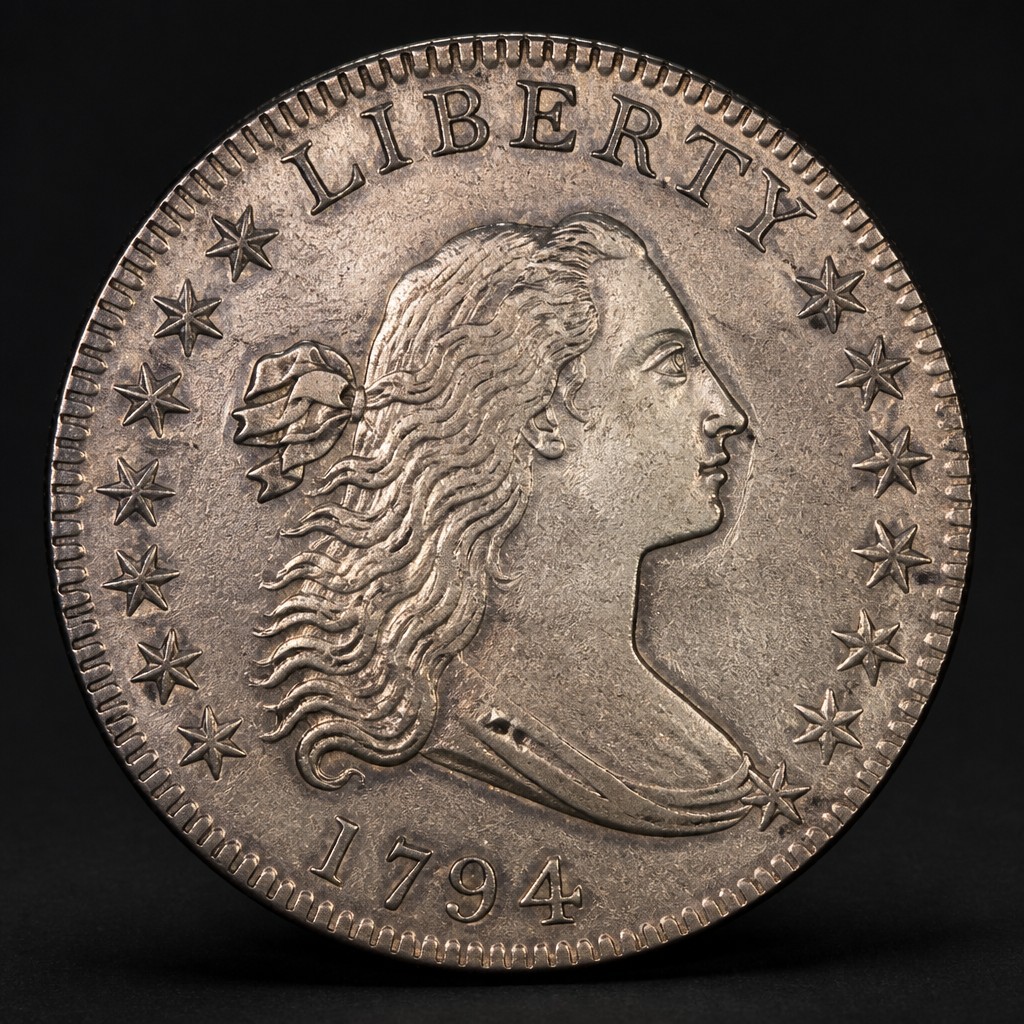
What It Is
The Flowing Hair Half Dime, struck only in 1794 and 1795, was the very first half dime issued by the United States Mint and one of the earliest coins of any kind produced under the new federal coinage system. Its design closely parallels the Flowing Hair silver dollars and half dollars of the same brief era.
Obverse (Front) Design
Liberty appears in profile facing right, her hair flowing loosely behind her, an image meant to evoke liberty rather than depict a specific person. "LIBERTY" arcs above her head, a row of stars lines the border (fifteen stars, matching the number of states at the time), and the date sits below.
Reverse (Back) Design
The reverse shows a small, spread-winged eagle perched on a rock or cloud, encircled by a thin wreath, with "UNITED STATES OF AMERICA" arranged around the border. This "small eagle" reverse was used only briefly before the Mint moved to a larger heraldic eagle design on later coinage.
Size, Weight, Metal, and Edge
This is a tiny coin, about 16.5 mm in diameter, weighing roughly 1.35 grams, struck in .8924 fine silver (the standard fineness set by the original Mint Act of 1792). The edge is plain.
Mint Marks
No mint mark appears on this coin. The Philadelphia Mint was the only mint in operation at the time, so mint marks were unnecessary.
Telling It Apart from Similar Coins
The Flowing Hair Half Dime is easily distinguished from later half dime designs by its small eagle reverse and lack of any drapery on Liberty's bust; the following Draped Bust type, introduced in 1796, added drapery at the shoulder and a more sculpted portrait. Because of the coin's tiny size, it should not be confused with the similarly designed but larger Flowing Hair Dollar or Half Dollar of the same years.
Judging Condition at a Glance
Given the coin's age and typically soft striking, look at Liberty's hair strands near the forehead and the eagle's breast feathers on the reverse; these are the first areas to wear smooth. Because early Mint technology often produced weakly struck coins even when new, some softness in these areas may reflect the original strike rather than circulation wear.
Authenticity Notes
Given the high value and historical importance of this short-lived issue, replicas and altered coins are a real concern. Precise diameter and weight are useful first checks, since reproductions often deviate slightly from the original specifications. Genuine coins should show die characteristics consistent with hand-engraved dies of the 1790s, including some irregularity in letter spacing; a coin with mechanically perfect, uniform lettering is worth examining closely. Because of the sums involved, third-party certification is strongly advisable before treating any example as genuine.
Frequently asked questions
How many years was the Flowing Hair Half Dime made?
It was struck only in 1794 and 1795, making it a short-lived first design for the denomination.
What does the reverse of a Flowing Hair Half Dime show?
A small eagle with spread wings perched on a rock or cloud, encircled by a thin wreath, with 'UNITED STATES OF AMERICA' around the border.
How big is a Flowing Hair Half Dime?
It is quite small, about 16.5 mm in diameter and roughly 1.35 grams in weight, struck in .8924 fine silver.
Does this coin have a mint mark?
No, since the Philadelphia Mint was the only mint operating when it was struck, mint marks were not used.