
How to Identify the Flowing Hair Dollar
A collector's walkthrough for confirming a Flowing Hair Dollar: the loose-hair Liberty, small eagle reverse, lettered edge, size, and counterfeit cautions.
Read the full Flowing Hair Dollar encyclopedia entry →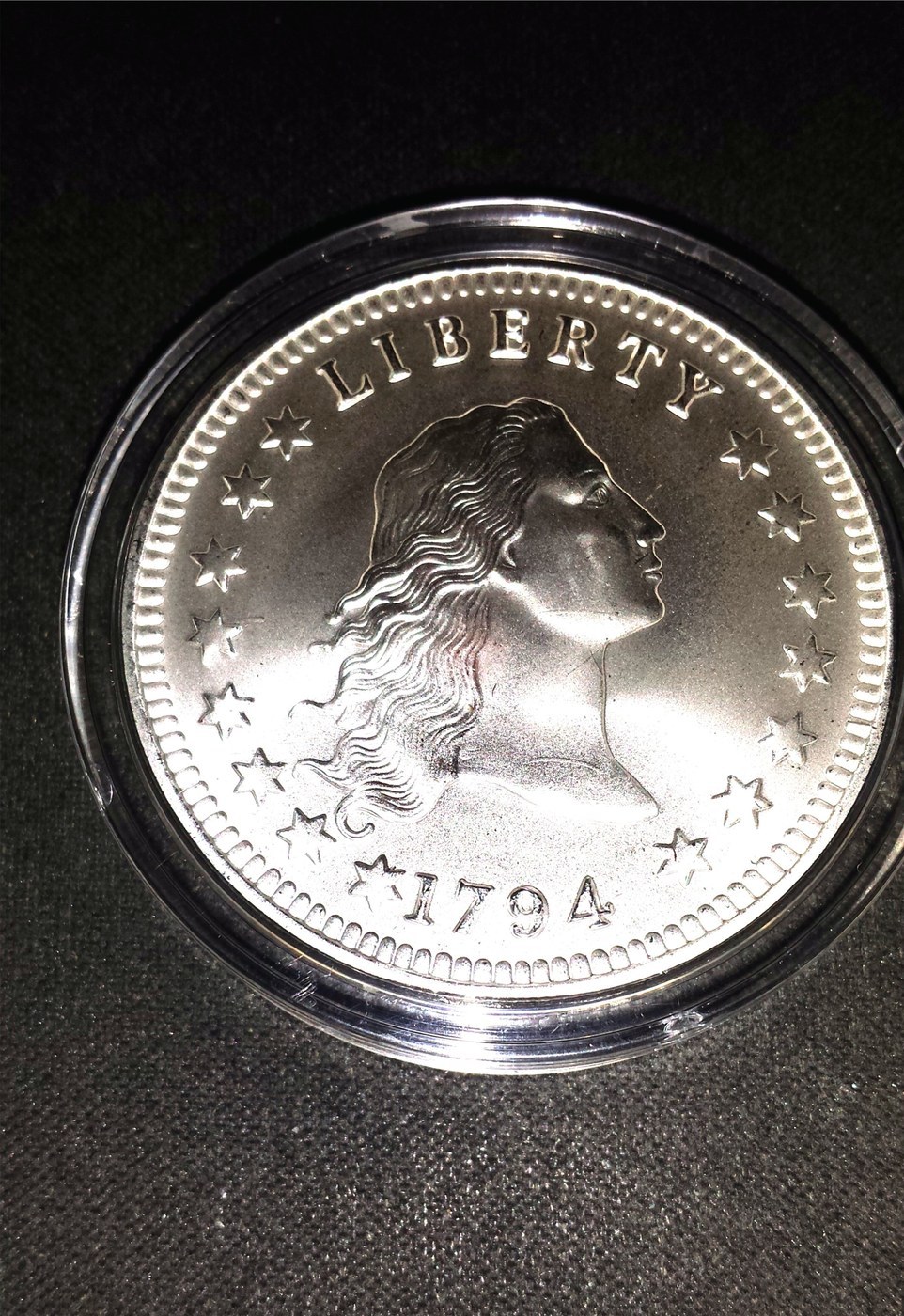
Begin with the portrait. The Flowing Hair Dollar shows Liberty facing right with her hair long and unbound — no cap, no headband, no wreath in the hair. This loose, flowing hair is what names and defines the type, and it separates it from the later Draped Bust dollar, where Liberty faces right but her hair is tied back with a ribbon and her bust is draped in cloth. LIBERTY curves above the head, the date is below, and stars run up each side (fifteen on the 1794).
Turn to the reverse. You should see a small, thin eagle standing with wings spread inside an open wreath, ringed by UNITED STATES OF AMERICA. This early "small eagle" is delicate and naturalistic — not the large heraldic shield-breasted eagle of later dollars. Note that neither face carries the denomination as a number or words.
That is because the value lives on the edge. Check the edge for incused lettering reading HUNDRED CENTS ONE DOLLAR OR UNIT with ornaments. A genuine Flowing Hair dollar has a lettered edge, never a plain or reeded one. Confirm size and heft as well: the coin should be large, roughly 39–40 mm, and heavy at about 26.9 g of silver. A piece that is lightweight, magnetic, undersized, or has the wrong edge is a red flag.
Finally, weigh authenticity carefully. This type is among the most counterfeited and altered coins in the U.S. series because of its value. Genuine early-Mint striking is often uneven, with weakness at the left and occasional adjustment marks, but the design elements and lettering should still be correct and well-formed. Cast fakes look mushy, show seams, or carry an incorrect edge. Given the stakes, do not accept any Flowing Hair dollar as genuine without certification from a reputable third-party grading service such as PCGS or NGC.
Frequently asked questions
How do I tell a Flowing Hair Dollar from a Draped Bust Dollar?
Look at Liberty's hair and dress. Flowing Hair shows loose, untied hair and no drapery; the Draped Bust type has hair tied back with a ribbon and a cloth-draped bust. Both types can appear on 1795-dated dollars.
Why is there no denomination on the front or back?
Early dollars expressed the value on the edge, not the faces. The edge is lettered HUNDRED CENTS ONE DOLLAR OR UNIT, so a plain or reeded edge indicates a problem or a fake.
Should I clean or 'improve' a suspected Flowing Hair Dollar?
No. Never clean it. Cleaning destroys surfaces and value on a coin this important. Leave it as-is and take it to a professional grading service for authentication and evaluation.
Is a coin easier to fake because it is so old?
This type is a frequent target for counterfeits and alterations precisely because it is rare and valuable. Correct size, weight, lettered edge, and design details help, but expert certification is the only reliable confirmation.