
How to Identify the Flowing Hair Chain Cent
A visual guide to the Flowing Hair Chain Cent of 1793, the first official U.S. cent design, covering its Liberty portrait, controversial chain-link reverse, and how it was quickly replaced due to public criticism.
Read the full Flowing Hair Chain Cent encyclopedia entry →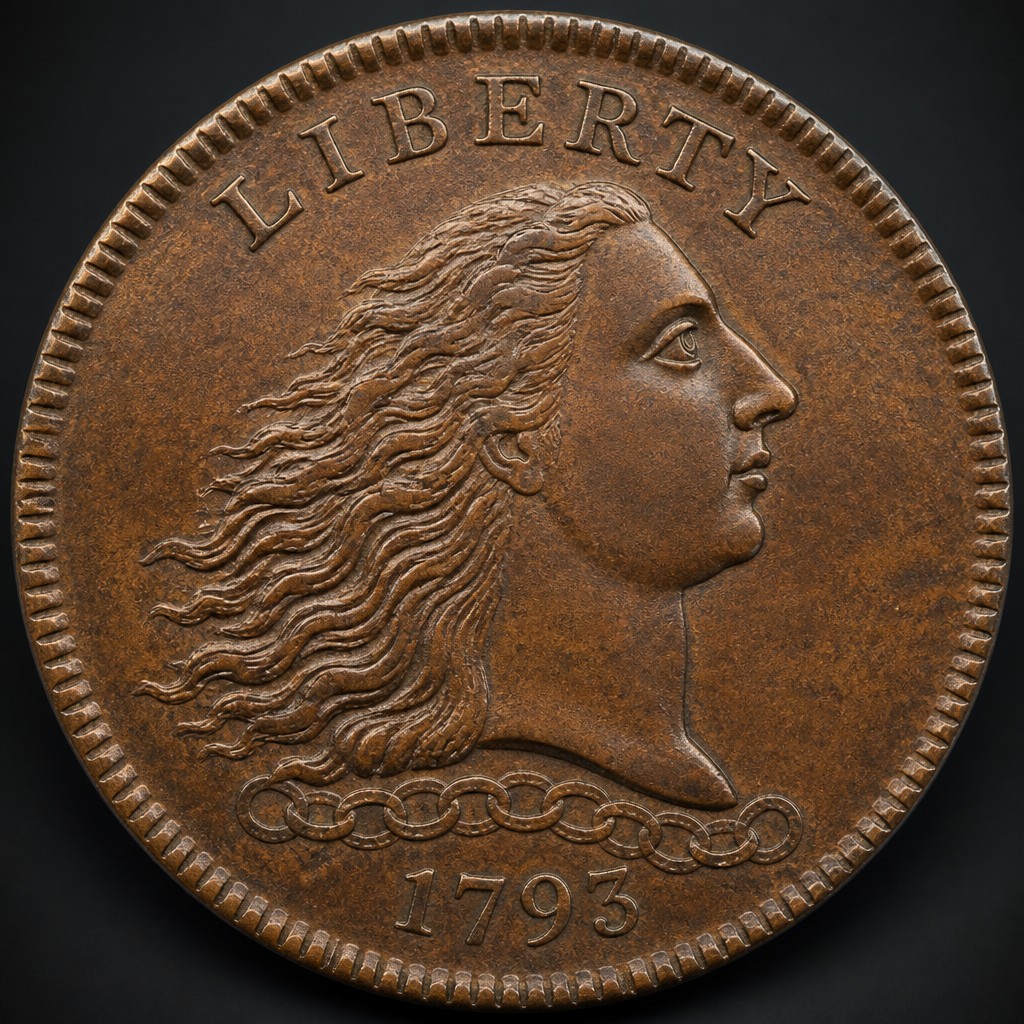
What It Is
The Flowing Hair Chain Cent was the very first cent struck for circulation by the United States Mint, produced only in 1793 for a few weeks before public criticism led to a design change. It is one of the most historically significant coins in the American series.
Obverse Design
Liberty is shown in right-facing profile with loose, flowing hair and no cap or headband. The word LIBERTY appears above her, and the date sits below. The engraving is comparatively crude, reflecting the Mint's very early tooling and inexperience.
Reverse Design
The reverse features a chain of interlocking links, generally counted as fifteen, meant to represent the unity of the states, encircling the words ONE CENT and the fraction 1/100. This chain motif proved deeply unpopular with the public, who associated chains with slavery and oppression rather than unity, and it was replaced within weeks by a wreath design.
Size, Weight, Metal, and Edge
The coin is struck in pure copper. Early 1793 cents were produced at a slightly heavier weight standard before the general reduction to 168 grains (about 10.89 grams) that applied to later 1793 cents and beyond; diameters on these early large cents vary somewhat due to inconsistent striking, generally falling in the high 20s of millimeters. Edges vary by variety, including a lettered edge reading a phrase referencing the cent's value relative to a dollar, as well as other edge treatments used on very early Mint production.
Mint Marks
No mint mark appears on this coin. It was struck exclusively at the original Philadelphia Mint, the only mint in operation in 1793.
Telling It Apart From Similar Coins
Because the Chain Cent was replaced so quickly, it is sometimes confused only in casual description with the Wreath Cent that succeeded it later the same year; the reverse chain links versus a wreath of leaves is the unmistakable difference. It is also visually distinct from the following Liberty Cap design, which shows Liberty wearing a cap on a pole rather than bare, flowing hair.
Judging Condition
Given the crude striking of 1793 cents, look at the clarity of the chain links, the readability of LIBERTY, and the definition of Liberty's hair strands. Even lightly worn examples often show planchet or striking imperfections that are typical of the coin's production rather than damage.
Authenticity Notes
Because the Chain Cent is a landmark rarity, it has long been a target for counterfeiters, including cast copies and coins with details that have been altered or enhanced. Signs of concern include an unnaturally smooth or grainy surface texture inconsistent with a struck copper coin, a diameter or weight noticeably off from known genuine ranges, and details that appear too crisp or too uniform for the Mint's known 1793 die work.
Frequently asked questions
Why was the Chain Cent design replaced so quickly?
The public criticized the chain-link reverse as symbolizing slavery or bondage rather than unity, prompting the Mint to switch to a wreath design within weeks.
How many links are in the chain on the reverse?
The chain is generally described as having fifteen links, one representing each state in the Union at the time.
Does the Chain Cent have a mint mark?
No, it was struck only at the original Philadelphia Mint in 1793.
What is the main visual difference between the Chain Cent and the Wreath Cent?
The reverse design: the Chain Cent shows interlocking chain links, while the Wreath Cent shows a leafy wreath.