
How to Identify the Florentine Florin
A guide to the medieval gold florin of Florence, focused on its lily obverse and St. John the Baptist reverse, its gold standard, and how to separate genuine Florentine issues from the many imitative florins struck elsewhere.
Read the full Florentine Florin encyclopedia entry →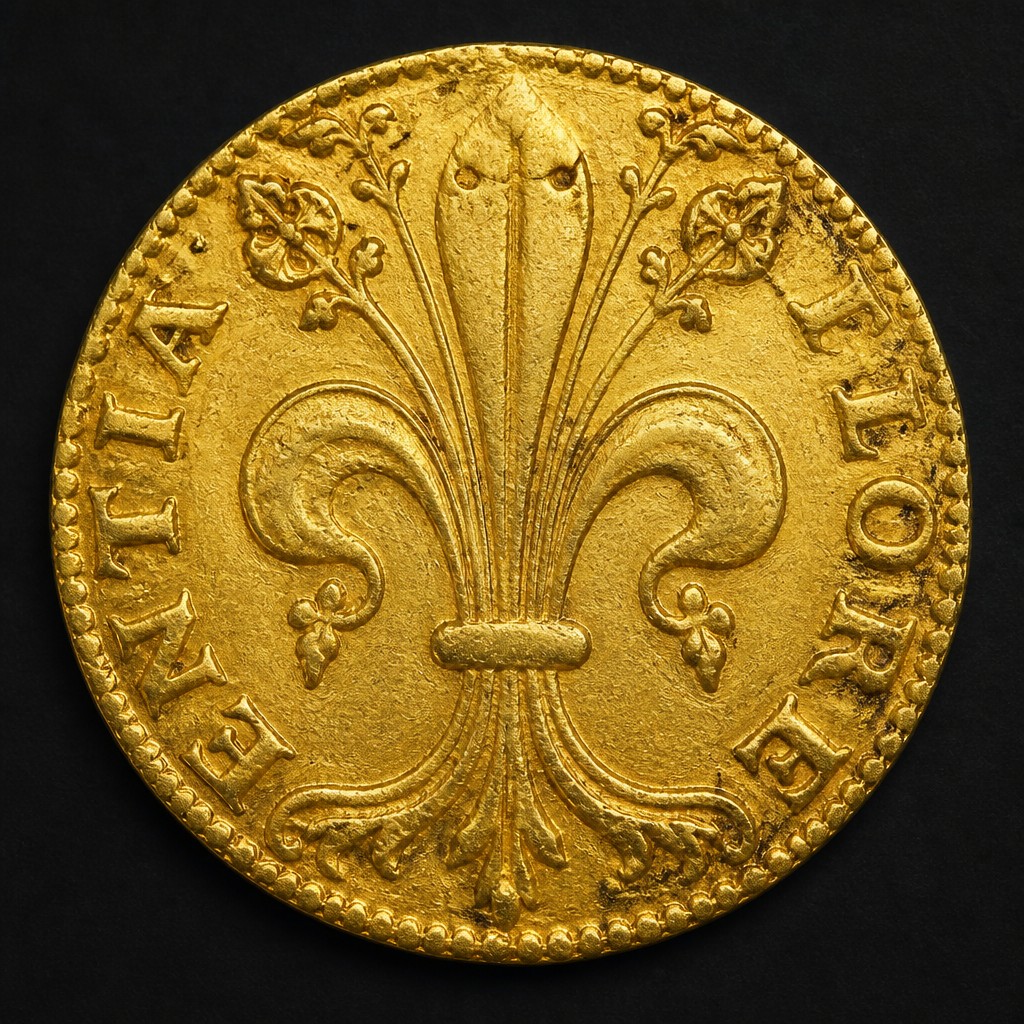
What This Coin Is
The florin was first struck by the Republic of Florence in 1252 and quickly became one of the most influential gold trade coins of medieval Europe. Its reliability led many other states to strike their own "florins," so the name became a generic term for gold coinage across the continent.
Obverse Design
The obverse shows a stylized lily (fleur-de-lis), the heraldic emblem of Florence, along with the legend FLOR EN TIA spelling out the city's name around the design.
Reverse Design
The reverse depicts a standing figure of Saint John the Baptist, patron saint of Florence, shown in simple robes with a raised hand, accompanied by the legend S IOHANNES B (Saint John the Baptist).
Size, Weight, Metal, and Edge
Florins were struck at a standard of roughly 3.5 grams in high-purity gold, with a diameter of about 20mm, and a plain edge typical of hand-hammered coinage of the period.
Mint Marks and Attribution
Florence did not employ a mint-mark system in the modern sense; genuine Florentine florins are identified by their consistent style, lettering, and the specific rendering of the lily and Saint John figure. Because so many other city-states and rulers issued their own "florins" copying the design, attribution depends on close comparison of legend wording and artistic style to confirmed Florentine issues.
Telling It Apart From Imitations
Numerous Italian city-states and other European mints, including Perugia and various German and Hungarian issuers, struck imitative florins that closely resemble the Florentine original but substitute their own city name or ruler's title in the legend, or show subtle differences in the lily's shape or the saint's pose. Careful reading of the full legend, rather than a glance at the general design, is essential to confirm a coin was genuinely struck in Florence.
Judging Condition
Look at the crispness of the lily's petals and the folds of Saint John's robe, as well as the legibility of the surrounding legend. Centering can vary due to hand striking, and moderate wear on the high points of the design is normal for circulated examples.
Authenticity Red Flags
Cast copies typically show soft, blurred detail and sometimes a visible seam around the edge. Gilt base-metal fakes may reveal a different color where the surface has worn. Be wary of florins whose legend does not clearly spell out Florence's name or that combine a Florentine-style lily with an unrelated or garbled inscription, which usually indicates an imitation rather than a genuine Florentine strike.
Frequently asked questions
Why is the florin important in coin history?
It was one of the first reliable gold trade coins of medieval Europe, and its trusted standard led many other states to strike their own imitative 'florins,' making the name generic for gold coinage.
What symbols appear on a genuine Florentine florin?
The obverse shows Florence's heraldic lily with the legend FLORENTIA, and the reverse shows Saint John the Baptist, the city's patron saint.
How do I know if my florin was actually struck in Florence?
Check that the legend clearly reads FLORENTIA and that the lily and saint figure match the standard Florentine style rather than a substituted city name or ruler's title used by imitators.
What metal and weight should a genuine florin have?
Genuine florins are struck in high-purity gold at approximately 3.5 grams, with a diameter around 20mm.