
How to Identify the Five Pound Gold (Quintuple Sovereign)
A visual guide to the British Five Pound gold coin, the largest of the Sovereign family, identified by its monarch's portrait obverse and Saint George and the dragon reverse.
Read the full Five Pound Gold (Quintuple Sovereign) encyclopedia entry →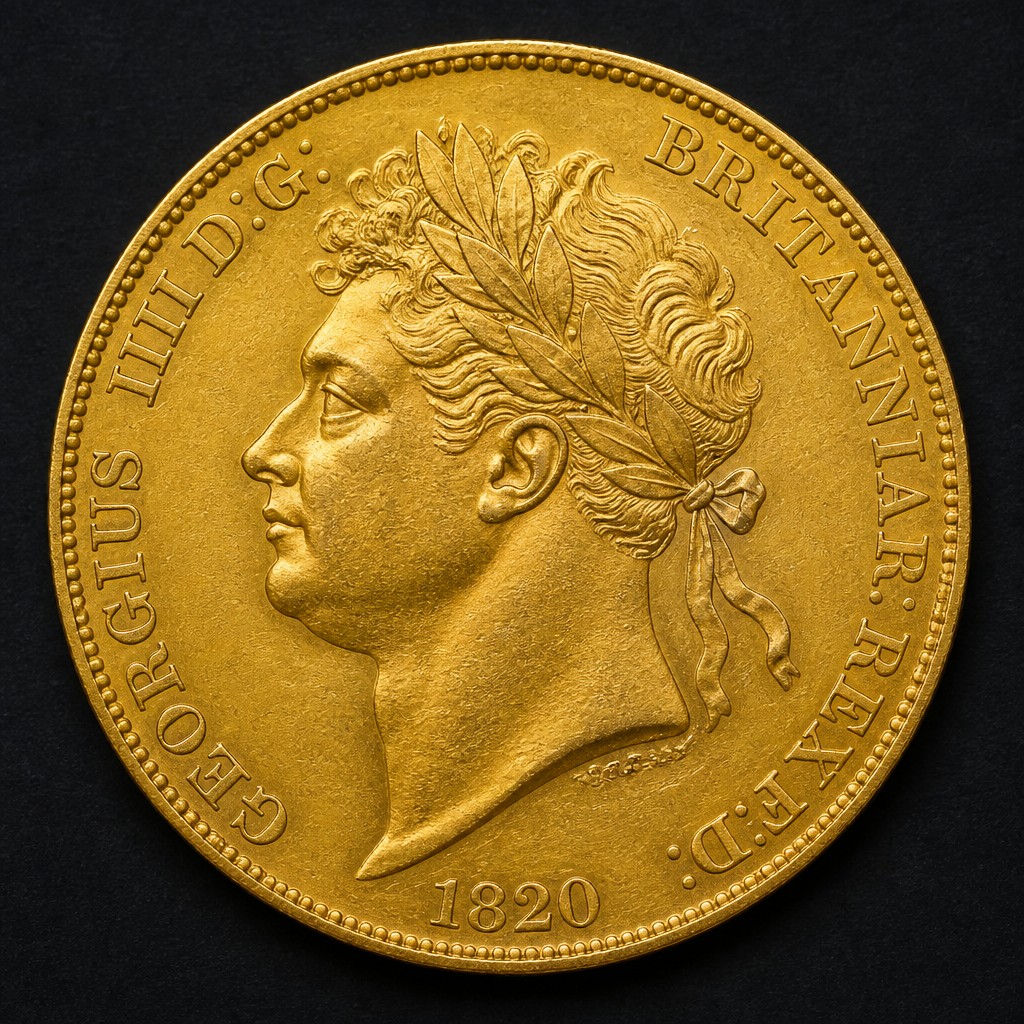
What It Is
The Five Pound gold coin, sometimes called the Quintuple Sovereign since it is five times the weight of a standard Sovereign, is the largest denomination in Britain's traditional gold Sovereign family. Struck intermittently since the 19th century, it has historically been produced mainly for special occasions, commemorative sets, and collectors rather than for everyday circulation. Its substantial size has made it a popular choice for major royal anniversaries, jubilees, and coronations, where a larger canvas allows for especially fine detail in the portrait and reverse artwork.
Obverse Design and Inscriptions
The obverse features the profile portrait of the reigning monarch at the time of striking, with the corresponding date of issue.
Reverse Design and Inscriptions
The reverse most commonly shows Benedetto Pistrucci's celebrated design of Saint George on horseback slaying a dragon, rendered at a grand scale befitting the coin's size, matching the design tradition shared with the standard Sovereign, Double Sovereign, and Half Sovereign. Some historic and commemorative issues instead use a crowned shield or other special reverse design tied to a particular anniversary or event.
Size, Weight, Metal, and Edge
The Five Pound gold coin weighs 39.94 grams and measures 36.02 mm in diameter, exactly five times the weight of the standard Sovereign, and is struck in the same 22-carat (.9167 fine) gold standard used across the Sovereign family. The edge is reeded.
Mint Marks and Where to Find Them
Modern Royal Mint issues struck in London generally carry no separate mint mark. Older or branch-mint issues from earlier periods may show a small mint mark near the base of the design on the reverse, in the same location used on other Sovereign-family coins from that era.
Telling It Apart From Similar Coins
As the largest coin in the Sovereign family, the Five Pound gold coin is readily identified by its substantial size and weight compared to the standard Sovereign (22 mm, 7.99 grams), Half Sovereign, and Double Sovereign. Confirming diameter and weight against official specifications is the most reliable way to distinguish it from these smaller relatives, since all share closely related designs.
Judging Condition at a Glance
Examine the fine detail in Saint George's figure, the horse, and the dragon, along with the coin's broad, open fields, which will show any handling marks or hairlines clearly given the coin's large surface area. Because these coins are frequently struck to proof standard for collectors, a fully mirrored or frosted finish with no visible marks indicates top condition.
Authenticity Red Flags
Precisely check weight and diameter against official specifications, since a coin that is underweight or the wrong size for a genuine Five Pound gold piece is the clearest sign of a counterfeit. Be equally cautious of a surface color inconsistent with genuine 22-carat gold or any magnetic response, since gold itself is not magnetic. Given its high value, verifying provenance through a reputable dealer or grading service is a sensible extra step before assuming a coin is genuine.
Frequently asked questions
Why is the Five Pound coin called a Quintuple Sovereign?
Because it weighs exactly five times as much as the standard one-pound Sovereign, making it the largest member of the Sovereign coin family.
How much does the Five Pound gold coin weigh?
It weighs 39.94 grams and is struck in 22-carat (.9167 fine) gold.
What design is usually on the back of the Five Pound coin?
Most commonly Benedetto Pistrucci's Saint George and the dragon design, shared with the rest of the Sovereign family, though some special issues use alternative designs.
Was the Five Pound gold coin ever used in everyday circulation?
It has mainly been struck for special occasions, commemorative sets, and collectors rather than for general circulation.