
How to Identify the Fasces Three-Cent Nickel
A visual guide to the Three-Cent Nickel (1865-1889), explaining its Liberty obverse, bundled Roman numeral reverse, and how to date and grade it.
Read the full Fasces Three-Cent Nickel encyclopedia entry →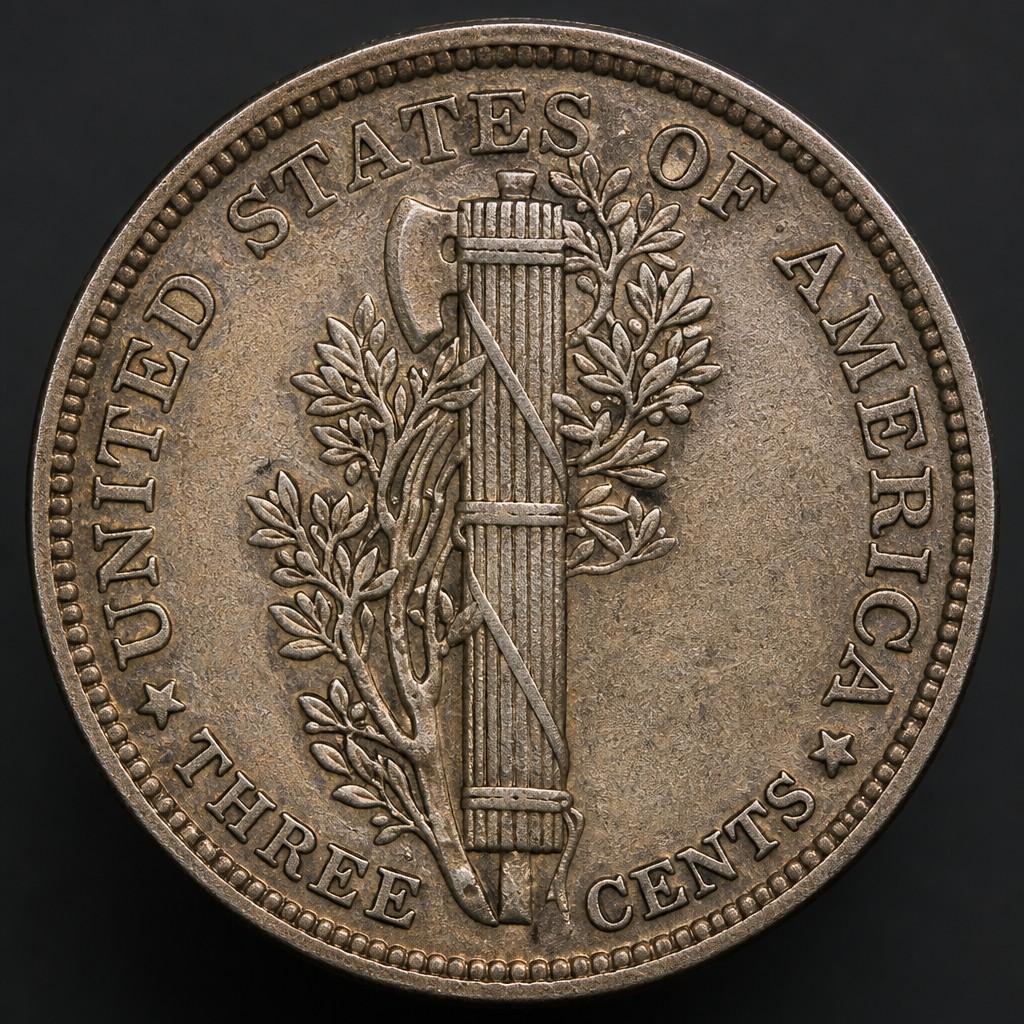
What It Is
This coin is the Three-Cent Nickel, struck from 1865 to 1889 and designed by James B. Longacre. It was introduced to replace the fragile silver three-cent piece and to use up surplus nickel supplies after the Civil War. Collectors sometimes refer to its reverse motif, built around a bundled cluster of design elements, informally by the nickname used here, though the coin's official name is simply the Three-Cent Nickel.
Obverse Design
The obverse depicts a coronet-style head of Liberty facing left, with "LIBERTY" inscribed on a headband. Thirteen stars ring the border and the date appears below the truncation of the neck. There is no motto on this side.
Reverse Design
The reverse is dominated by a large Roman numeral "III" at the center, encircled by a wreath of olive leaves and, in the coin's first year (1865 only), a ring of rays between the surrounding stars. "UNITED STATES OF AMERICA" runs around the upper and lower rim. The design is bold and low-relief, which helped the coin strike well and wear evenly.
Size, Weight, Metal, and Edge
The Three-Cent Nickel is 75% copper and 25% nickel, weighing about 1.94 grams with a diameter of 17.9mm, and has a plain edge. Its pale, silvery-gray color distinguishes it immediately from copper coinage of the same era.
Mint Marks
Every Three-Cent Nickel was struck exclusively at the Philadelphia Mint, so none of them carry a mint mark. Any example showing a letter such as "S," "O," or "CC" on it is not a genuine Three-Cent Nickel.
Telling It Apart from Similar Coins
Because of its size and silvery color, this coin is sometimes confused with the Shield nickel (five cents) of the same period, but the Shield nickel is larger, heavier, and shows a large shield rather than a Roman numeral. It can also be confused with the silver three-cent piece ("trime"), which is much smaller, thinner, and made of silver rather than a copper-nickel alloy.
Judging Condition at a Glance
Check the tip of Liberty's coronet and the hair above her ear, which are the first points to flatten with wear. On the reverse, examine the olive leaves and the numeral's serifs; on well-struck, lightly worn coins these remain crisp and separated from the surrounding field.
Authenticity Red Flags
Because the design is simple and the metal common, outright counterfeits are less frequent than for gold or silver coins, but watch for added or re-engraved dates, unusually soft or mushy details (a sign of a cast copy rather than a struck coin), and a magnetic response, since a genuine nickel-copper alloy is only weakly magnetic at most — a strongly magnetic example suggests a plated fake.
Frequently asked questions
What does the Roman numeral III mean on this coin?
It simply indicates the denomination, three cents, in an era when Roman numerals were commonly used for cent and mill denominations.
Does the Three-Cent Nickel have a mint mark?
No. All Three-Cent Nickels were struck only at the Philadelphia Mint, so genuine examples never show a mint mark.
How do I tell it apart from a Shield nickel?
The Shield nickel is larger and shows a shield design on the reverse, while the Three-Cent Nickel is smaller and shows a large numeral III.
What metal is the Three-Cent Nickel made from?
It is 75% copper and 25% nickel, giving it a pale, silvery-gray appearance.