
How to Identify the Elagabalus Denarius
A silver denarius of the teenage emperor Elagabalus, recognized by his soft, youthful portrait and, on his most distinctive issues, a sacred stone riding in a chariot honoring his sun god.
Read the full Elagabalus Denarius encyclopedia entry →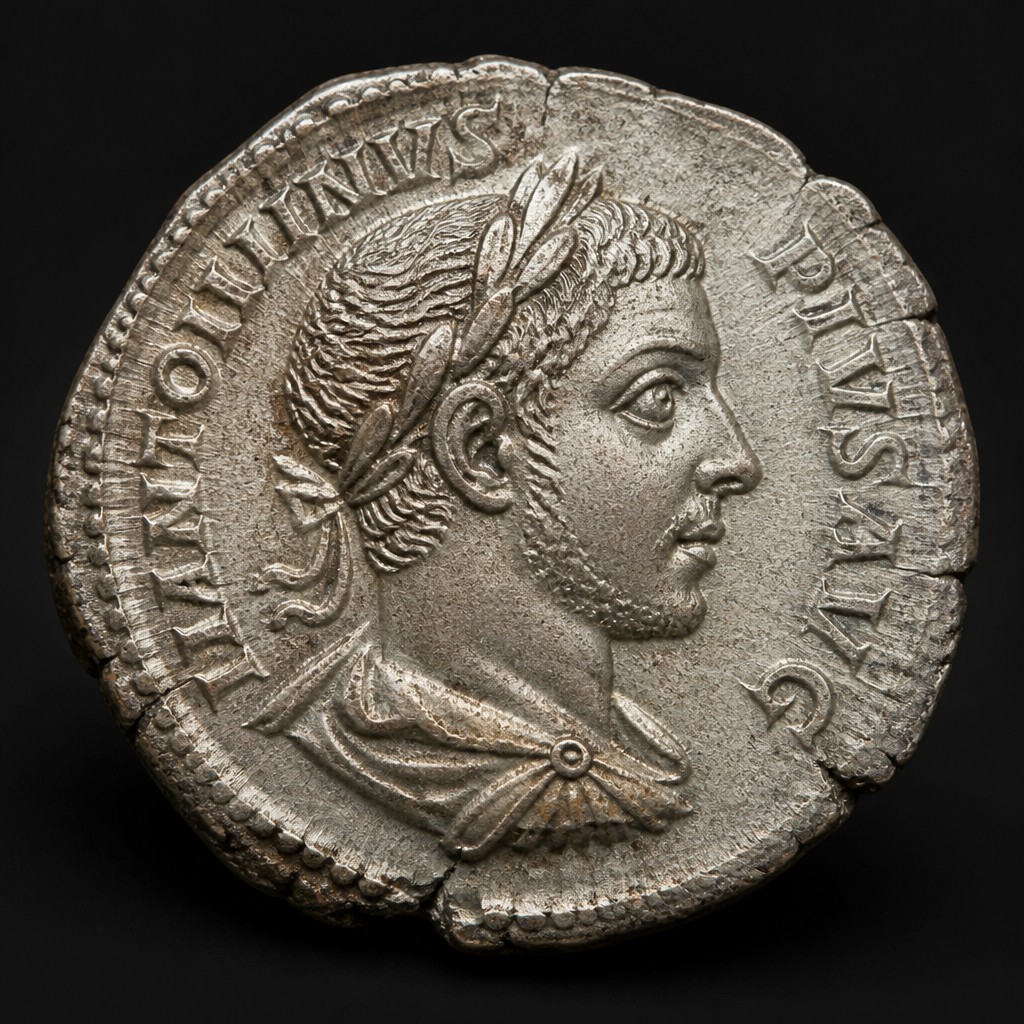
What the Coin Is
Elagabalus, born Varius Avitus Bassianus, became emperor as a teenager in AD 218 through the efforts of his grandmother Julia Maesa and ruled until his assassination in 222. His coinage is notable both for standard imperial types and for a set of unusual religious issues reflecting his controversial promotion of the Syrian sun god Elagabal.
Obverse Design & Inscriptions
The obverse shows a youthful, soft-featured bust, usually laureate though radiate on some special religious issues, facing right. The legend generally reads IMP ANTONINVS PIVS AVG or IMP CAES M AVR ANTONINVS AVG, reflecting his adoption of the Antonine dynastic name to bolster his claimed descent from Caracalla.
Reverse Design & Inscriptions
Most reverses use standard imperial personifications such as Pax, Victoria, Fides Militum, Providentia, and Salus. The most visually distinctive reverse, however, shows a conical black sacred stone (a baetyl) set within a four-horse chariot (quadriga), topped by a parasol with a star above, accompanied by the legend SANCT DEO SOLI ELAGABAL ("to the holy sun god Elagabal"), one of the most unusual and immediately recognizable reverse designs in the entire Roman coinage series.
Size, Weight, Metal & Edge
The coin measures roughly 18-19mm across and weighs about 2.9-3.2 grams, with silver fineness continuing to decline, generally in the 40-45 percent range. The edge is plain.
Mint Marks & Where to Find Them
Coins were struck at both Rome and Eastern mints, with Antioch-style issues showing a noticeably different engraving character from Rome's output, though there is no formal mint-letter system to search for.
Telling It Apart from Similar Coins
Elagabalus's portrait is softer, rounder, and more youthful than Caracalla's grim, jowly late-reign features, making the two reasonably easy to distinguish once compared side by side. Compared to his eventual successor and cousin, Severus Alexander, whose portraits are similarly youthful, look for the absence of any SEVERVS ALEXANDER legend and the presence of the unique sun-cult reverse types, which belong to Elagabalus alone.
Judging Condition & Grade at a Glance
On standard portrait types, check the roundness and smoothness of the youthful facial features for wear. On the sun-god chariot reverse, examine the clarity of the conical stone, the parasol, and the small star above it, since these fine details are what make the type identifiable and are quick to wear down or corrode.
Authenticity Red Flags
The sun-god chariot reverse is rare and highly desirable, making it a frequent forgery target; look for an inconsistent or wrongly proportioned stone shape, an incorrectly formed parasol, or visible tooling marks around the small figures and chariot wheels. As with other heavily debased Severan-era silver, also check for a coppery flash at any wear point, which would indicate a plated fourrée rather than a genuine, if low-fineness, silver coin.
Frequently asked questions
What is the sacred stone shown on some of Elagabalus's coins?
It represents the baetyl, a conical black stone worshipped as the physical embodiment of the Syrian sun god Elagabal, shown riding in a four-horse chariot on one of his most distinctive reverse types.
How do I tell Elagabalus apart from Caracalla?
Elagabalus has a noticeably softer, rounder, more youthful face, in contrast to Caracalla's harsher, jowly, mature soldier-emperor portrait, especially from Caracalla's later sole-reign coins.
How do I distinguish him from Severus Alexander, who also looks young?
Check the legend for the name; Severus Alexander's coins will carry his own SEVERVS ALEXANDER titulature, and only Elagabalus's coins feature the unique sun-cult reverse type with the sacred stone and chariot.
Why does he use the name Antoninus rather than his birth name?
He adopted the Antonine dynastic name to reinforce a claimed, and likely fabricated, descent from Caracalla in order to strengthen his legitimacy as emperor.
Why is the sun-god reverse type especially risky to buy?
Its rarity and strong collector demand make it a common forgery target, so buyers should look closely for an incorrectly shaped stone or parasol and any visible tooling marks before purchasing.