How to Identify the Eisenhower Dollar Bicentennial
A collector's walkthrough for confirming a Bicentennial Ike dollar: the Liberty Bell reverse, the 1776-1976 date, size, edge, and mint marks.
Read the full Eisenhower Dollar Bicentennial encyclopedia entry →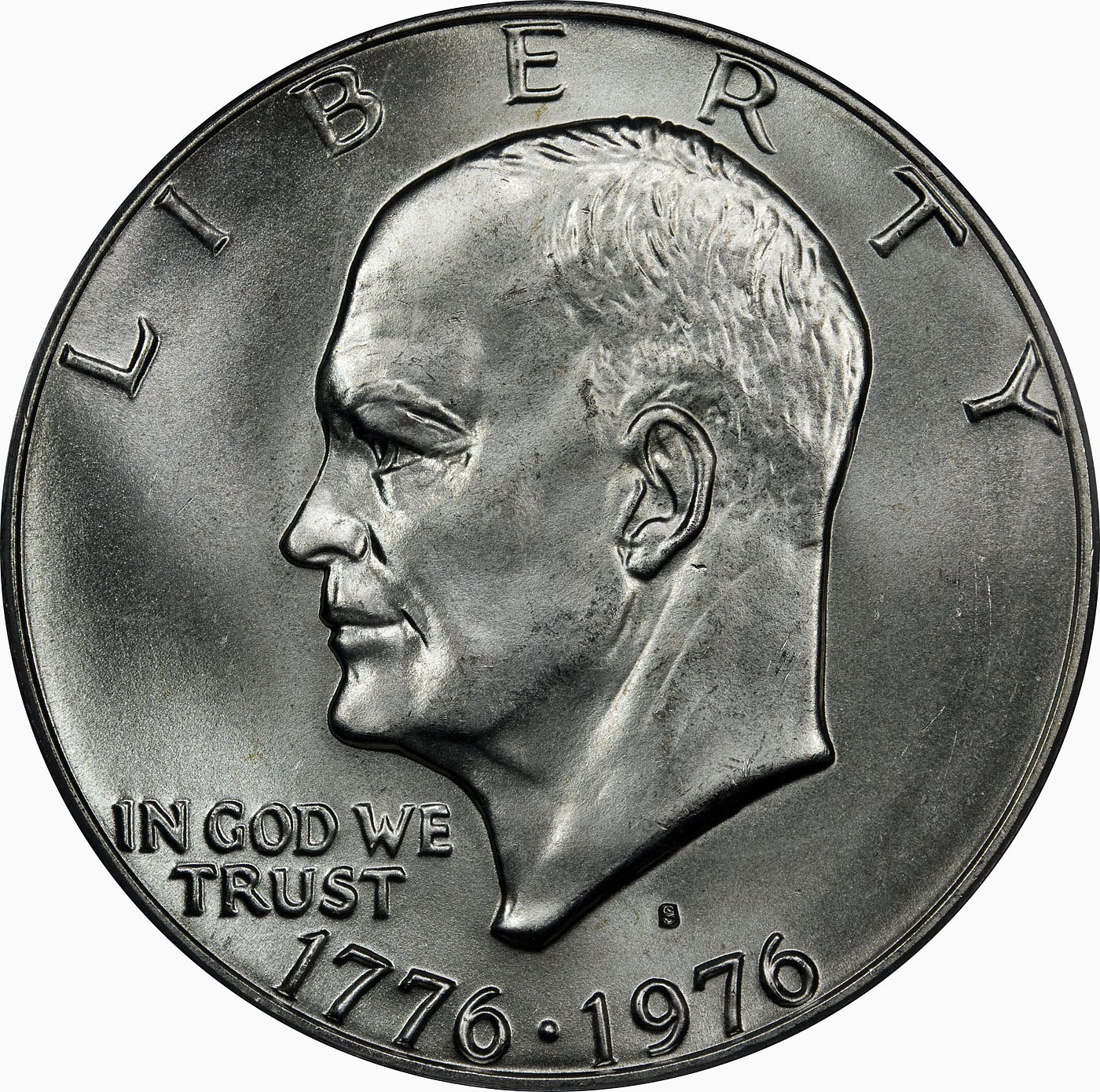
Begin with size and weight. The Eisenhower dollar is a big coin — about 38.1 mm across, the diameter of a classic silver dollar and much larger than a modern Sacagawea or Presidential dollar. If your coin is small and golden, it is not an Ike dollar. The heft in the hand is itself a useful first clue.
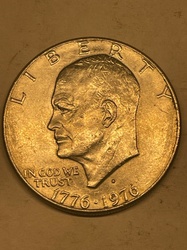
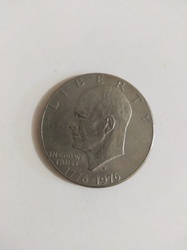
Confirm the obverse. You should see a large left-facing profile of Dwight D. Eisenhower, LIBERTY curved above the head, and IN GOD WE TRUST beside the neck. The mint mark sits just below the neck: S for San Francisco, D for Denver, or nothing for Philadelphia. This portrait is the same on every Eisenhower dollar, so it confirms the type but not the Bicentennial variety.
The reverse is the decisive test. A Bicentennial coin shows a Liberty Bell overlapping an image of the Moon, with the dual date 1776-1976. Every other Eisenhower dollar (1971-1974 and 1977-1978) instead shows an eagle landing on the Moon with a single date. If you see the eagle, it is a regular Ike, not the Bicentennial issue.
Check the edge to judge composition. A standard clad coin reveals a reddish copper core sandwiched between copper-nickel layers, visible as a stripe around the reeded edge. The 40% silver-clad collector version shows a solid, uniform edge with no copper stripe and weighs slightly more. This edge check is the quickest way to separate the common clad coin from the more desirable silver one.
A note on look-alikes and authentication: the Bicentennial dollar is common and rarely counterfeited, so most identification is simply confirming the variety and composition. Watch for cleaned or polished coins that mimic proof surfaces, and for the two obverse lettering styles collectors note on 1976 dollars (Type 1 with bold, blockier reverse lettering versus Type 2 with finer lettering). For high-grade, silver, or possible-error coins, third-party grading (such as PCGS or NGC) confirms both authenticity and value.
Frequently asked questions
How do I tell a Bicentennial Ike from a regular Eisenhower dollar?
Look at the reverse. The Bicentennial coin shows a Liberty Bell over the Moon with the date 1776-1976. Regular Ike dollars show an eagle on the Moon with a single year.
How can I check if mine is the silver version?
Examine the edge. Clad coins show a copper stripe between the outer layers; the 40% silver-clad version has a uniform edge with no copper stripe and weighs a bit more.
Is a coin with no mint mark a problem?
No. A coin with no mint mark was struck at the Philadelphia Mint. D marks Denver and S marks San Francisco. All three struck Bicentennial dollars.
What are the Type 1 and Type 2 varieties?
They refer to two reverse lettering styles on 1976 dollars: Type 1 has bolder, thicker lettering and Type 2 has finer, thinner lettering. Both are collectible; a grading service can confirm which you have.
Eisenhower Dollar Bicentennial identified by the community
Recent Eisenhower Dollar Bicentennial coins identified with Coin Identifier.