
How to Identify the Eisenhower Centennial Dollar
A collector's walkthrough for confirming the 1990 Eisenhower Centennial silver dollar: the profile obverse, dual 1890-1990 dates, Gettysburg home reverse, size, silver, and mint mark.
Read the full Eisenhower Centennial Dollar encyclopedia entry →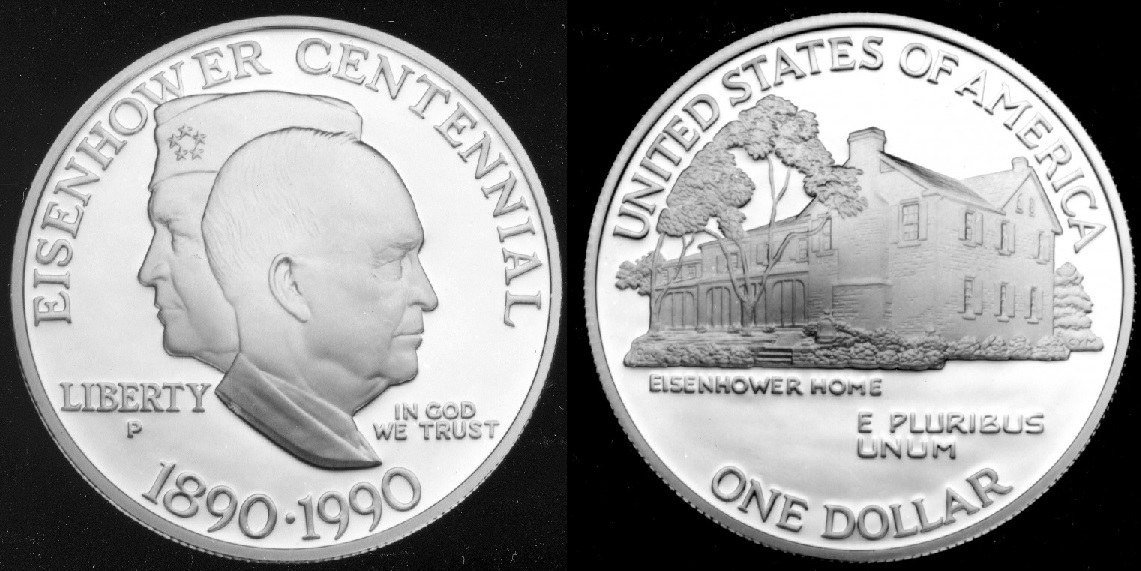
Start with the obverse portrait and dates. This coin shows Dwight D. Eisenhower in profile facing left, with LIBERTY and IN GOD WE TRUST, and crucially the paired dates 1890-1990. The dual dates are the single most useful diagnostic: they mark a centennial commemorative and immediately separate this coin from the circulating 1971-1978 Ike dollar, which carries just one year and a front-facing bust.
Confirm with the reverse. Look for a house, the Eisenhower home at Gettysburg, along with E PLURIBUS UNUM, UNITED STATES OF AMERICA, and ONE DOLLAR. A building on the reverse rather than an eagle landing on the moon is the clearest confirmation that this is the silver commemorative and not the earlier clad dollar.
Check size and metal next. A genuine example is a large silver dollar, about 38.1 mm (roughly 1.5 inches) across and near 26.73 grams, struck in .900 fine silver with a reeded edge. It is the same diameter as a 1970s Ike dollar but heavier and fully silvery through the edge; a clad Ike shows a copper-colored stripe on the edge, while this coin does not. It is non-magnetic.
Locate the mint mark and read the finish. As a modern commemorative it carries a small mint mark on the coin (this program used Philadelphia, P, and West Point, W, across its proof and uncirculated finishes). Proof coins have mirror-like fields with frosted raised design; uncirculated coins show a more even satin surface. Be cautious with any piece sold as this coin that lacks the correct diameter, weight, silver fineness, or the specific 1890-1990 obverse and Gettysburg-home reverse. Privately made Eisenhower medals and rounds exist and are not the U.S. Mint commemorative. For higher-value examples, third-party certification from a recognized grading service such as PCGS or NGC confirms authenticity, grade, and silver content.
Frequently asked questions
How do I tell this from the 1970s Ike dollar?
Check the obverse dates and the reverse. This commemorative has a left-facing profile with dual dates 1890-1990 and the Eisenhower home on the reverse. The circulating Ike dollar has a single date, a facing bust, and an eagle-and-moon reverse, and is copper-nickel clad rather than silver.
How can I confirm it is genuine silver?
It should measure about 38.1 mm, weigh near 26.73 grams, be non-magnetic, and show a solid silvery reeded edge with no copper stripe. Genuine examples are .900 fine silver; certification can verify the metal.
Where is the mint mark?
As a modern commemorative it carries a small mint mark on the coin. This program was struck at Philadelphia (P) and West Point (W) across its proof and uncirculated finishes; the finish itself also helps identify how a given coin was sold.
Could my coin be a private-mint copy or medal instead?
Possibly. Many privately made Eisenhower rounds and medals exist. Verify the correct diameter, weight, and silver fineness, the 1890-1990 obverse, and the Gettysburg-home reverse with ONE DOLLAR; if in doubt, have it authenticated by PCGS or NGC.