
How to Identify the Egyptian 20 Piastres Commemorative
A collector's guide to identifying the 1980 Egyptian 20 piastres by its eagle reverse, calligraphic obverse, cupro-nickel fabric, and date.
Read the full Egyptian 20 Piastres Commemorative encyclopedia entry →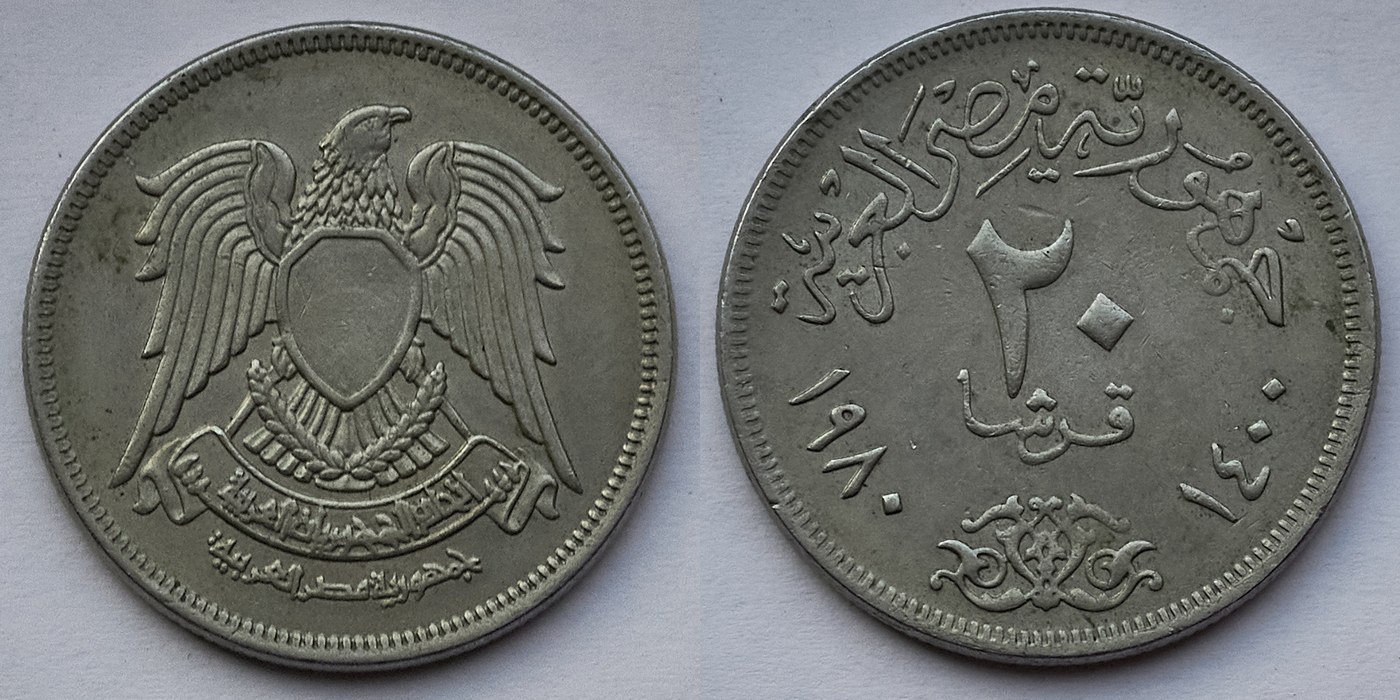
Begin with the two faces. The identifying pair for this coin is an ornamental Arabic calligraphic obverse — dense, decorative script inside a frame with no portrait — set against a reverse dominated by a heraldic eagle bearing a shield. On the example here the eagle is double-headed with a shield on its breast. That eagle-and-calligraphy pairing, rather than any single feature, is the quickest route to the type.
Confirm the denomination and date. The coin should read 20 piastres (20 qirsh), and this issue is dated 1980. Modern Egyptian coins often show a Gregorian year and an Islamic-Hijri year, so check the legends for both and use the date to separate this piece from other 20 piastres issues that share a similar layout across different years.
Check the metal and size. This is a cupro-nickel coin: silver-gray in color, hard, and with a bright ring, but with no precious-metal content. A true silver 20 qirsh from the earlier Khedivate era looks and feels different and belongs to a separate, older series — do not confuse the base-metal 20 piastres with those silver pieces. Weigh and measure the coin and match it to references for the specific issue, since Egypt used the 20 piastres denomination repeatedly with varying designs.
Watch the details that separate issues. Because Egypt reused standard denominations for many commemoratives, the eagle style, the wording of the Arabic legends, and the exact date are what pin down a particular coin. Read the calligraphy rather than assuming an event from the denomination, and compare the eagle rendering to catalog images.
Authentication cautions: modern Egyptian coins are rarely faked, but be wary of cleaned or polished surfaces that dull detail, and of pieces sold as silver when they are cupro-nickel. When precision matters, confirm the fabric, weight, and diameter against a trusted catalog for the exact date and design.
Frequently asked questions
How do I tell this from the older silver Egyptian 20 qirsh?
Check the metal and design. This commemorative is cupro-nickel with an eagle reverse, while the earlier 20 qirsh is silver and typically shows an Ottoman tughra. The two are different series despite the shared denomination value.
Where do I find the date on the coin?
Look within the calligraphic legends. Modern Egyptian coins commonly carry a Gregorian year (1980 on this piece) and often an Islamic-Hijri year as well, so check both when reading the coin.
How can I confirm which commemorative it is?
Read the Arabic legends and match the eagle design and date to a catalog of modern Egyptian coinage. The denomination alone does not identify the event, since 20 piastres was used for several different issues.
Is a magnet or weight test useful?
Cupro-nickel is non-magnetic, so a magnet will not stick, but that alone does not prove authenticity. Confirming weight, diameter, and design details against references for the specific date is more reliable.