
How to Identify the Egyptian 1 Pound
A collector's guide to identifying Egypt's 1981 World Food Day 1 Pound by its reverse design, dual date, metal, and weight.
Read the full Egyptian 1 Pound encyclopedia entry →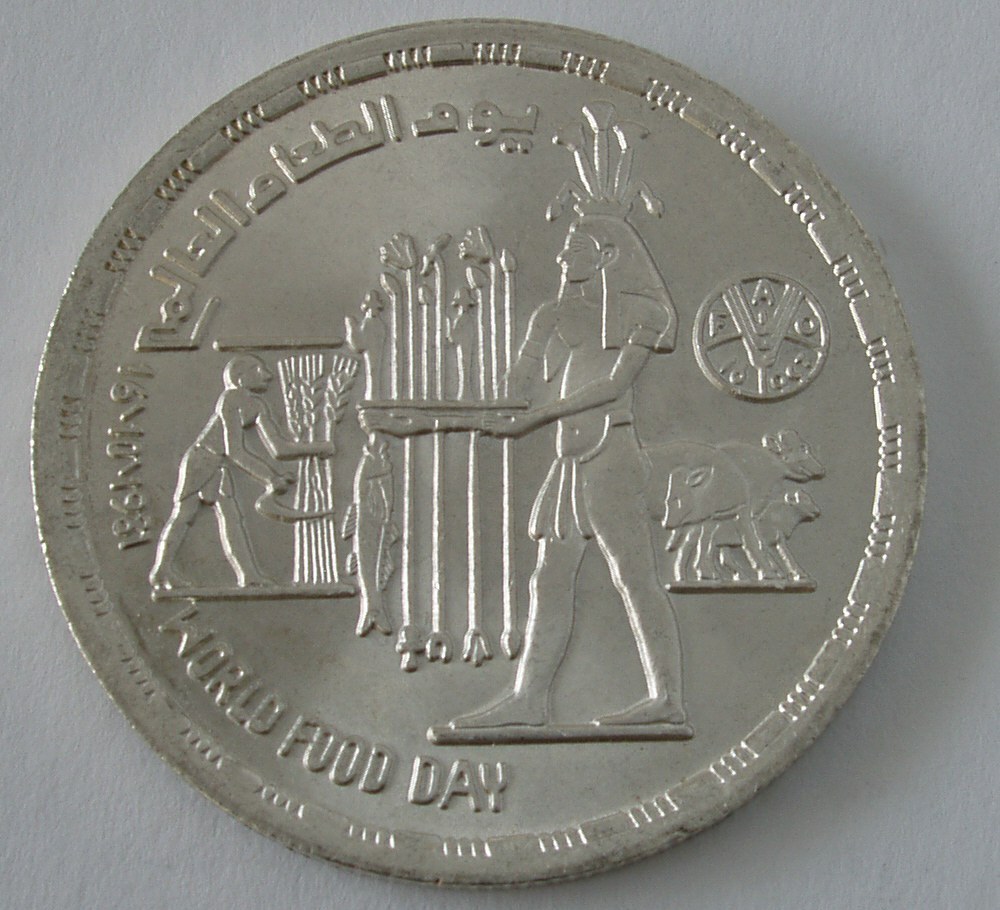
Begin with the reverse legend. The clearest diagnostic on this coin is the English phrase 'WORLD FOOD DAY' set with standing figures and sheaves of wheat. That combination places the piece firmly in the 1981 FAO commemorative theme and separates it from Egypt's many other commemorative and circulation designs of the era.
Confirm the date. Look for 1981 on the coin, usually paired with the Hijri year AH 1401. Egyptian issues of this period commonly show both calendars, so seeing a Gregorian and an Arabic-numeral Hijri date together is normal and expected. If only a different year appears, you are likely looking at a related but distinct commemorative.
Read the obverse for the denomination. Although these photos show only the reverse, the other face should carry Arabic legends naming the Arab Republic of Egypt and stating one pound. Do not assume the denomination from the reverse alone: Egypt struck several values on similar agricultural themes, so the Arabic value statement is what fixes it as a 1 Pound.
Check metal and weight to rule out the silver version. This example is cupro-nickel, a silvery-gray base-metal alloy that is comparatively light and non-magnetic, with a duller sheen than silver. Egypt's parallel silver commemorative pounds of the early 1980s are noticeably heavier and brighter; weighing the coin and comparing against a reference for the cupro-nickel type is the surest way to separate the base-metal issue from the precious-metal one.
Be cautious with condition and authenticity. Because these are collector-oriented commemoratives, most surviving pieces show little wear, so heavy circulation wear can be a warning sign worth a second look. Watch for cleaned or polished surfaces, and when metal or weight seem inconsistent with a genuine cupro-nickel strike, compare against catalog specifications or consult a specialist before assuming it is the precious-metal variant.
Frequently asked questions
How do I know this is the World Food Day issue and not another Egyptian pound?
The English 'WORLD FOOD DAY' inscription combined with standing figures and wheat sheaves on the reverse is the giveaway. Egypt's other commemorative pounds carry different legends and imagery, so this specific wording and agricultural scene identify the type.
How can I tell the cupro-nickel coin from the silver version?
Weight and appearance are the key tests. The cupro-nickel piece is lighter, non-magnetic, and duller in tone, while the silver version is heavier and brighter. Weighing the coin and comparing to catalog figures is the most reliable check.
Why is there Arabic on one side and English on the other?
The obverse uses Arabic for the country name, denomination, and date, following standard Egyptian coinage, while the reverse carries the English 'WORLD FOOD DAY' legend to reflect the international UN/FAO commemorative theme.
Should the coin show two different dates?
Yes. Egyptian coins of this era commonly carry both the Gregorian year (1981) and the Islamic Hijri year (AH 1401). Seeing both together is normal and helps confirm a genuine issue of the period.