
How to Identify the Edward VII Ten Cents
Canada's silver ten-cent coin issued 1902-1910 under King Edward VII, identified by his mature bearded portrait and a maple wreath reverse unchanged from the Victorian design.
Read the full Edward VII Ten Cents encyclopedia entry →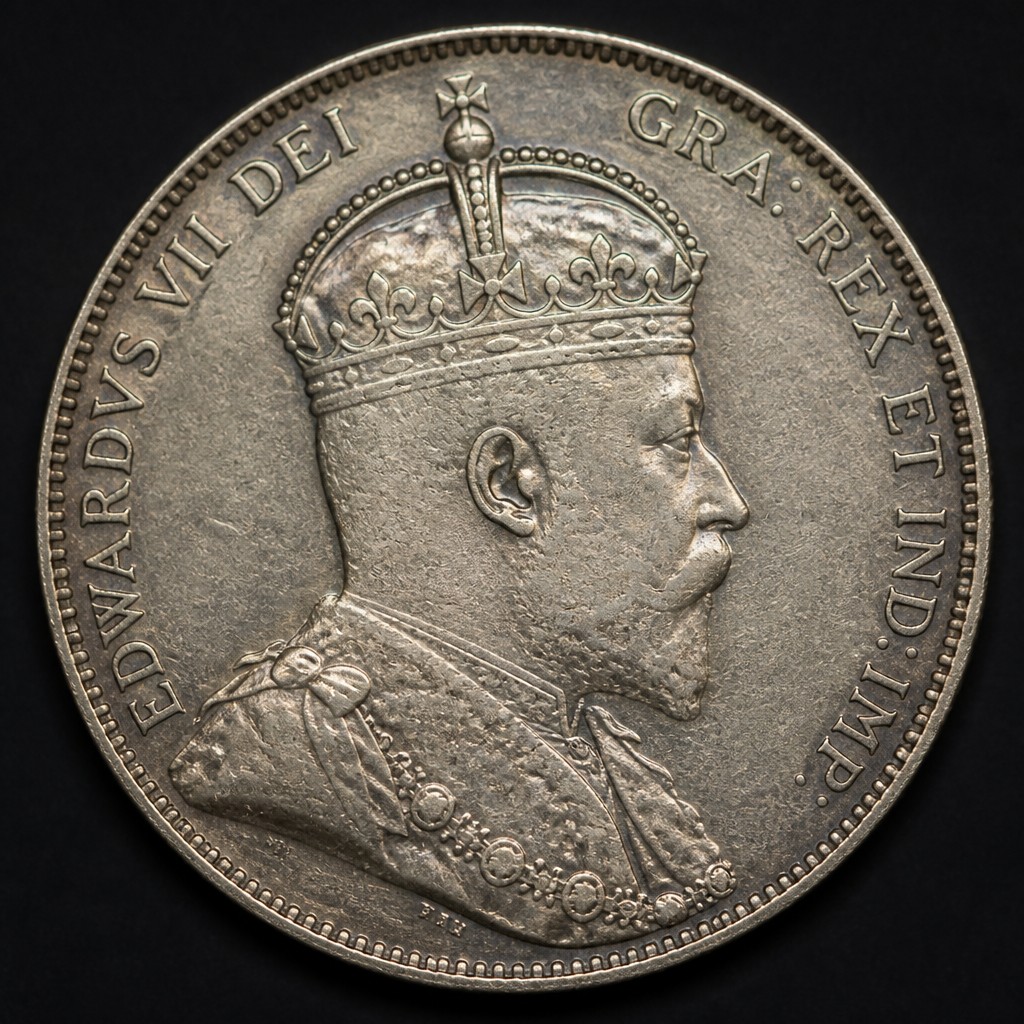
What It Is
This dime bridges the gap between Queen Victoria's long reign and King George V's later coinage, struck for Canada from 1902 through 1910 under King Edward VII.
Obverse Design
The obverse shows a mature, bearded portrait of King Edward VII, with a legend reflecting his titles including his role as Emperor of India.
Reverse Design
The reverse continues the established design used since 1858: a wreath of maple leaves surrounding "10 CENTS" and the date, essentially unchanged in layout from the Victorian-era dime.
Size, Weight, Metal & Edge
The coin remains .925 sterling silver, about 18mm in diameter and roughly 2.32 grams in weight, with a reeded edge, matching the dimensions of the earlier Victoria dime.
Mint Marks
Some years of this series were struck with a small "H" mintmark for Heaton's Mint in Birmingham, appearing below the date on the reverse. By this period Canada's own mint in Ottawa (opened in 1908) also began striking coinage, so careful examination near the date is needed to spot any mintmark.
Telling It Apart From Similar Coins
The most obvious way to distinguish this coin from the Victoria dime that preceded it is the obverse portrait: Edward VII's mature, mustached and bearded likeness looks quite different from Victoria's youthful profile, even though the reverse design is essentially identical. It should also be distinguished from the George V dime that followed, which returns to a clean-shaven, younger-looking royal portrait. Because this reign lasted less than a decade, the series is comparatively short, making the obverse portrait alone a fairly reliable way to bracket a coin's approximate date even before reading the actual year.
Judging Condition
Examine the king's mustache, beard, and hair detail on the obverse, and the wreath's ribbon and leaf veins on the reverse, for wear. Crisp facial hair detail is a good early indicator of a higher-grade example, while a smooth, featureless upper lip and cheek suggest heavier circulation.
Authenticity Red Flags
Check any claimed "H" mintmark carefully under magnification for signs it has been added or tooled, since small mintmarks on silver coins are a common target for alteration. Verify the coin's weight against known specifications, and be cautious of surfaces that appear artificially cleaned or polished, which can disguise true wear or hide damage. It is also worth comparing the overall wear pattern across the whole coin; a mintmark or date area that looks noticeably sharper than the rest of the design is a warning sign worth further investigation.
Frequently asked questions
How do I tell an Edward VII dime from a Victoria dime?
Compare the obverse portrait: Edward VII shows a mature, bearded likeness, quite different from Victoria's youthful profile, even though the reverse design is nearly identical.
What does the 'H' mintmark indicate?
It shows the coin was struck under contract at Heaton's Mint in Birmingham rather than in Canada, and appears below the date on certain years.
What metal is this coin made from?
It is .925 sterling silver, matching the fineness used for Canadian silver coinage before 1920.
Did Canada strike its own coins by this time?
The Ottawa mint opened in 1908, so some later coins in this reign may have been struck domestically, though not all carry any distinguishing mark for this.
What should raise suspicion about a coin's authenticity?
Signs of tooling near the date or mintmark, unusual weight or diameter, and unnaturally bright or polished surfaces are all reasons for closer examination.