
How to Identify the Edward VI Crown
A collector's guide to spotting a genuine Edward VI hammered silver crown by its portrait, legends, date, mint marks and fabric.
Read the full Edward VI Crown encyclopedia entry →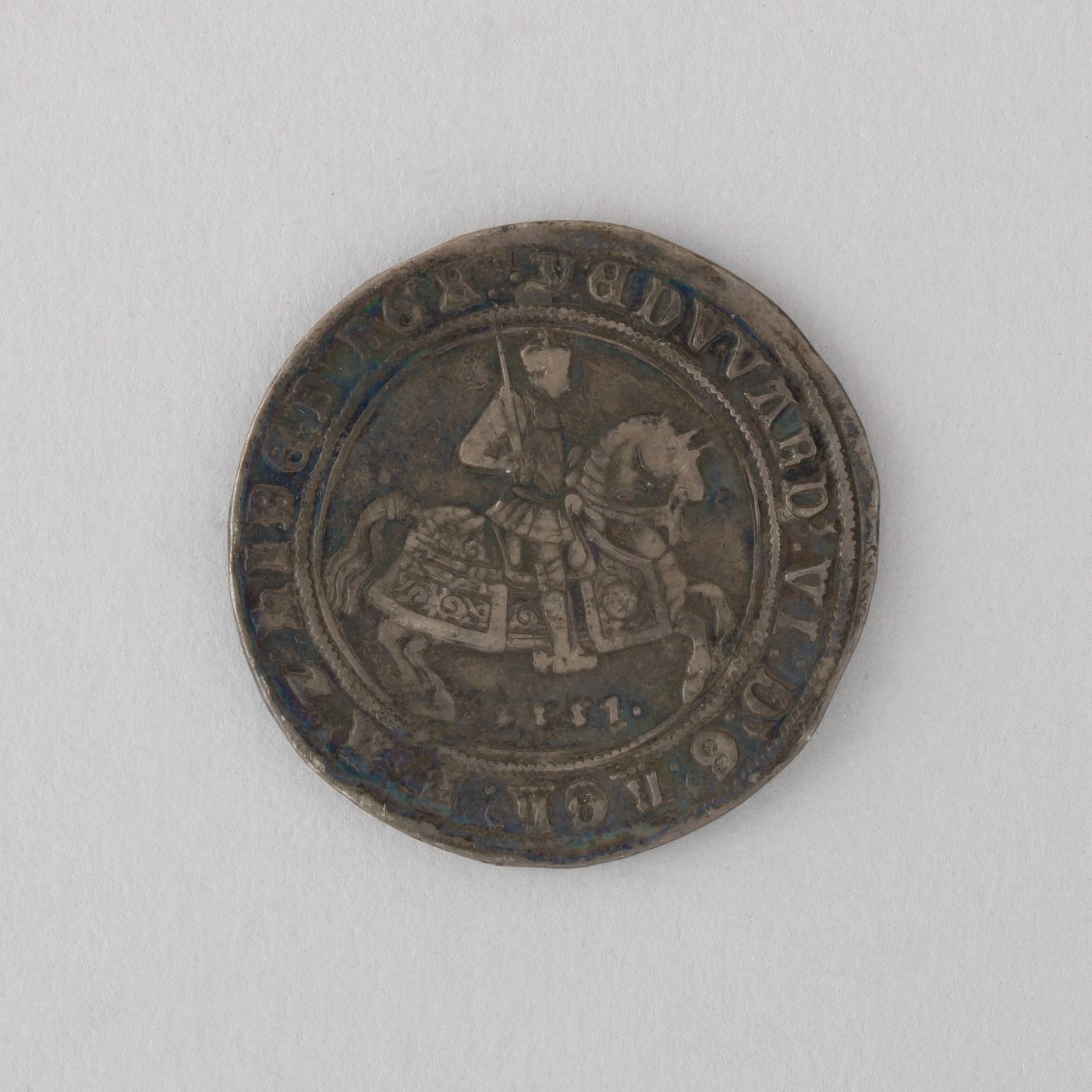
Begin with the obverse portrait. The Edward VI crown shows the king in armor facing right in a mounted, equestrian-style royal portrait, not a simple head-and-shoulders bust. On well-preserved coins you can trace the armored figure and the horse; on worn examples the armored figure facing right is often the clearest surviving detail. The Latin legend around the edge names Edward as king of England, France and Ireland, and this wording is a key confirmation of the type.
Check for the date. This crown is one of the earliest English coins to carry a date, placed below the figure, and genuine examples fall within the short 1551-1553 window. A date outside this range, or the absence of any date on a coin sold as an Edward VI crown, is a red flag.
Examine the reverse when it is visible. The documented reverse carries a shield of the royal arms over a cross, surrounded by the Latin motto meaning "I have made God my helper." Note that on the photographed example here the reverse is not shown, so reverse detail should be confirmed separately before attribution.
Assess size, metal and fabric. This is a large silver coin, roughly 40 mm or more across and around 30 grams, struck by hand. Expect a slightly irregular flan, some unevenness of strike, and detail that is stronger in some areas than others. A perfectly round, uniformly sharp coin with machine-like edges suggests a modern reproduction rather than a hammered original.
Locate the mint mark and beware of look-alikes. Small symbols in the legend (for example a 'y' or a tun) help fix the exact date and mint, and matching the mark to the date is part of proper attribution. Later English crowns of Elizabeth I, the Stuarts and beyond can superficially resemble it, and the type is heavily faked, so unusual weight, wrong metal color, casting bubbles, seams or soft mushy detail all warrant caution. For any significant purchase, favor coins with sound provenance or independent authentication.
Frequently asked questions
Does the Edward VI crown show a bust or a figure on horseback?
The classic type shows the king in armor facing right in a mounted, equestrian-style portrait. On worn coins this can read simply as an armored figure facing right rather than a clear horseman.
Where is the date on an Edward VI crown?
The date appears on the obverse below the figure and should fall within 1551-1553. This coin is notable as one of the first English coins to be dated.
How do I know it is hammered and not a modern copy?
Genuine examples are hand-struck, so expect a slightly irregular flan and uneven strike. Perfect roundness, casting seams, bubbles, wrong weight or soft detail point to a replica or forgery.
Why do mint marks matter on this coin?
Small symbols in the legend help pin down the exact date and mint within the short 1551-1553 series, which is essential for correctly attributing and valuing a given example.