
How to Identify the Edward III Noble
Collector checks for the medieval English gold noble: the ship-and-king obverse, floral cross reverse, size and metal, mint clues, and authentication cautions.
Read the full Edward III Noble encyclopedia entry →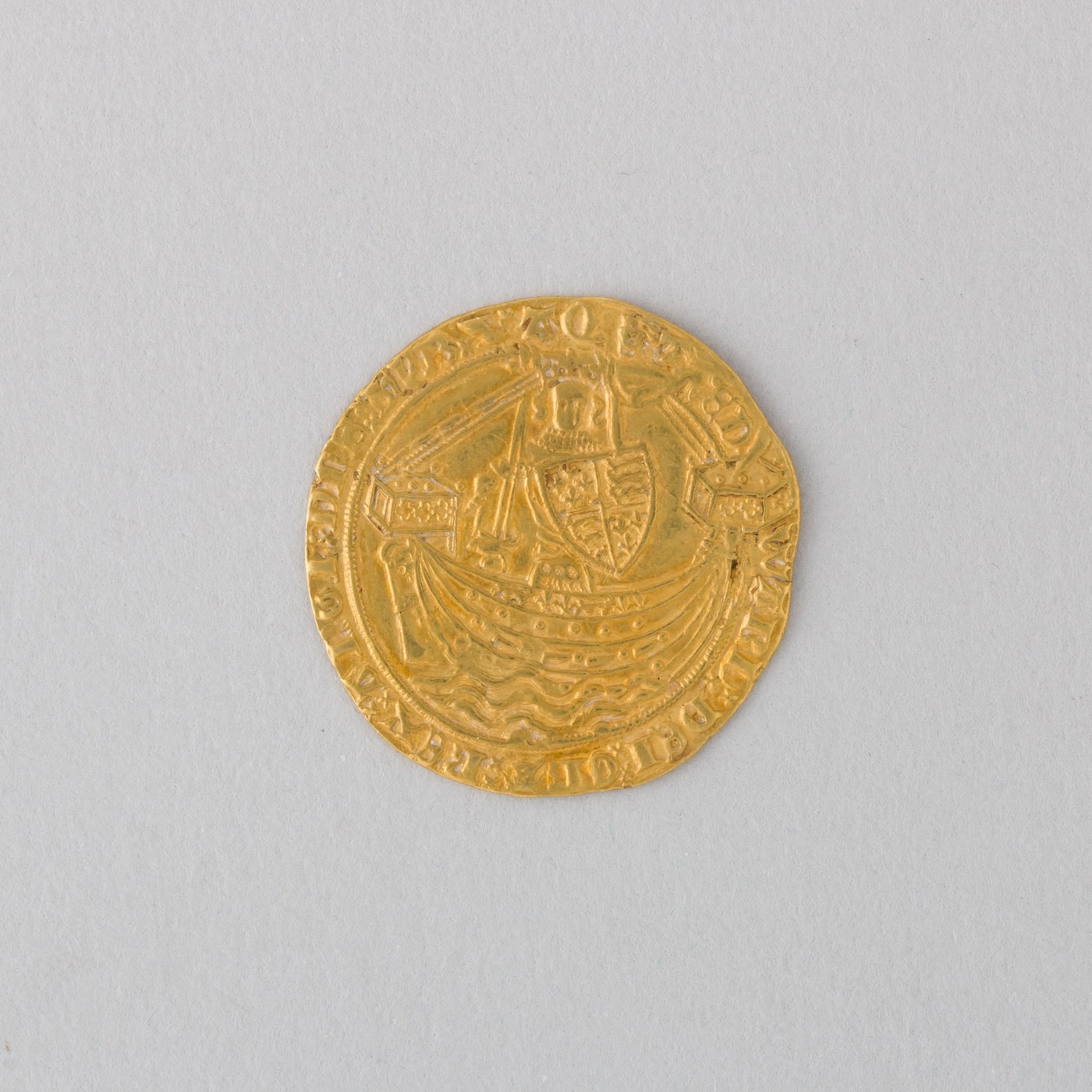
Start with the obverse scene, which is the noble's clearest fingerprint. You should see a crowned, armored king standing and facing forward inside a ship, holding an upright sword in one hand and a heraldic shield in the other. The shield is quartered with the lilies of France and the leopards (lions) of England, reflecting Edward III's claim to the French crown. A Latin legend and decorative bands surround the design.
Turn to the reverse. Expect an ornate cross with fleur-de-lis (floral) terminals spreading from a central ornament, enclosed within a tressure of arcs, with small crowns and lions set in the angles. This combination of a foliate cross, tressure, crowns, and lions is characteristic of the noble and distinguishes it from later or foreign gold coins that may borrow only parts of the motif.
Assess size and metal. The noble is a large but thin gold coin, broad in diameter yet light in the hand because of its flan. It should be struck in high-purity gold with a rich color, not pale or brassy. A much smaller coin with the same designs is likely a half-noble or quarter-noble rather than a full noble, and a base-metal or notably underweight piece is a warning sign.
Use legends and details to narrow the issue. Edward III's nobles were produced across several phases and at more than one mint, including London and Calais, and differences in the king's title, the letter forms, punctuation, and small marks in the field or at the start of the legend help place a coin within his reign. These fine details are best confirmed against a specialist reference or catalogue.
Authenticate carefully. Valuable medieval gold coins like the noble are frequently faked, including cast copies, modern reproductions, and altered pieces. Watch for casting seams, soft or mushy detail, incorrect weight or diameter, wrong lettering styles, and suspiciously perfect surfaces. Because both the stakes and the number of forgeries are high, seek expert authentication or third-party grading before any significant purchase or sale.
Frequently asked questions
How do I tell a noble from a half-noble or quarter-noble?
They share the same ship-and-cross designs, so judge by size and weight: the full noble is the largest and heaviest, the half-noble smaller, and the quarter-noble smallest. Diameter and weight are the key clues.
What is the single most distinctive feature to look for?
The crowned king standing in a ship holding a sword and a shield on the obverse. This ship-and-king scene is the noble's defining image and immediately separates it from most other medieval gold coins.
Where was the noble minted?
Edward III's nobles were struck at the London mint and, during parts of the reign, at Calais. Mint marks and small differences in the legends help identify where and when a given coin was made.
How can I spot a fake noble?
Check weight, diameter, and gold color, and look for casting seams, soft detail, or incorrect lettering. Given how often these coins are faked, expert authentication or third-party grading is strongly advised before buying.