
How to Identify the East African 5 Cents
A collector's guide to recognizing the holed copper-nickel East African 5 Cents by its crown, legend, metal, and central hole.
Read the full East African 5 Cents encyclopedia entry →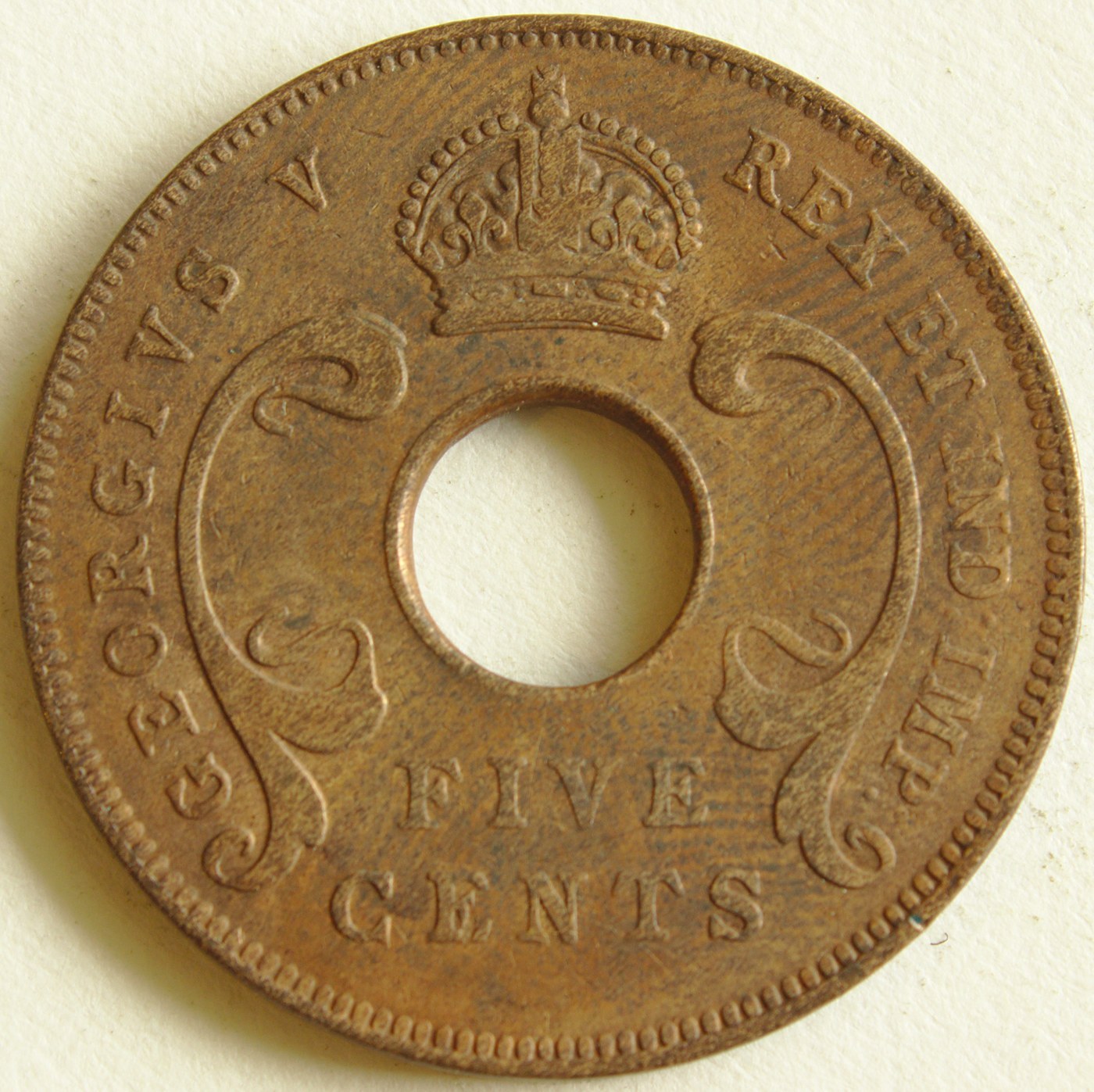
Begin with the central hole and the layout around it. The East African 5 Cents is pierced through the middle, with all of its devices arranged in concentric rings rather than around a portrait. On the crowned face you should see a royal crown above decorative scrollwork, with the value and the words EAST AFRICA reading around the opening. If a coin of this style has no hole, or the design is centered on a bust, it is not this type.
Confirm the metal and size. This is a copper-nickel piece, so the surfaces read as pale silvery-gray to dull gray, not the reddish-brown of bronze. It is small, thin, and light, consistent with a minor cent denomination. A piece that is heavy, thick, or clearly brass-yellow is likely a different coin or a modern copy.
Read the legends and date carefully. Look for the EAST AFRICA lettering and the 5 Cents value spaced evenly around the hole, with the year, such as 1924, forming part of the surrounding text. Any small mint letter near the date is worth noting, since it helps identify where the coin was struck and can distinguish scarcer combinations.
Watch for look-alikes. Several colonial and Asian coinages of the same era also used holed formats, so do not rely on the hole alone; the crown-over-scrollwork design and the explicit EAST AFRICA legend are what confirm this type. Be aware too that the neighboring 10 Cents shares the holed copper-nickel style but is a larger coin with a different stated value, so check the denomination text rather than assuming from the shape.
Finally, inspect the hole and surfaces for authenticity and condition. An original hole is struck cleanly and evenly; an enlarged, ragged, or off-center opening can signal damage or tampering. Corrosion, harsh cleaning, or a bent flan all reduce grade. When a date or mint letter is important to attribution, examine it under magnification and compare against reference listings for the series.
Frequently asked questions
What is the single fastest way to identify this coin?
Look for the central hole combined with a crown above scrollwork and the EAST AFRICA legend. That combination, in pale copper-nickel, points directly to the East African 5 Cents.
How do I tell the 5 Cents from the 10 Cents?
Both are holed copper-nickel coins in the same style, but the 10 Cents is larger and states a different value. Read the denomination text around the hole rather than judging by shape alone.
Should the coin have a portrait?
No. This type uses a crown instead of a royal bust, so identification relies on the crown, the EAST AFRICA legend, the value, and the date rather than on a portrait.
How can I spot a damaged or altered piece?
Check that the central hole is clean, even, and centered. A ragged, enlarged, or off-center hole, along with corrosion or a bent flan, indicates damage that lowers both authenticity confidence and value.