
How to Identify the Draped Bust Half Dollar
A collector's walkthrough for the 1796–1807 Draped Bust half dollar: the bust, star counts, small vs. heraldic eagle, lettered edge, and authentication cautions.
Read the full Draped Bust Half Dollar encyclopedia entry →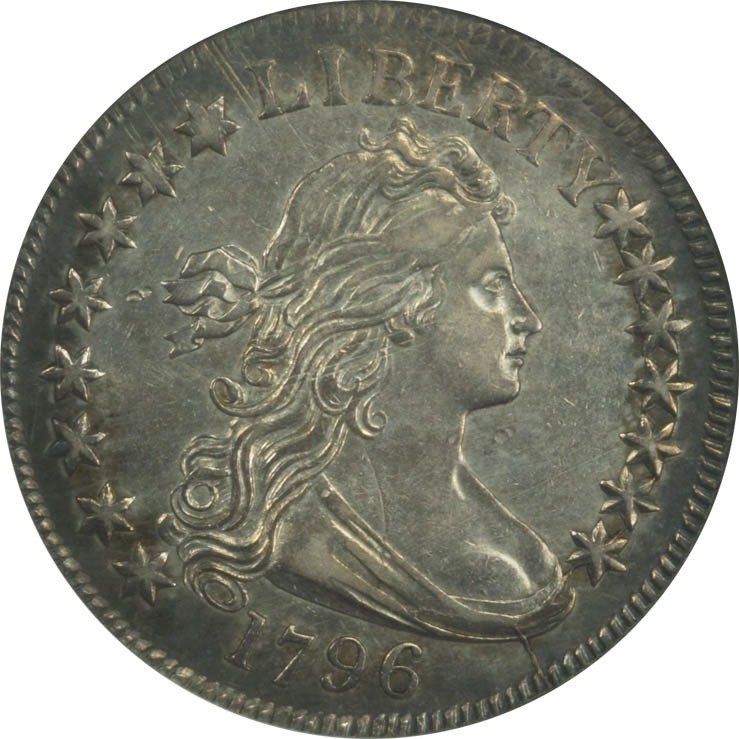
Begin with the obverse portrait. A Draped Bust half dollar shows Liberty facing right with flowing, curled hair and drapery at the shoulder, LIBERTY above and the date below. Count the stars flanking the head. The earliest coins — the rare 1796 and 1797 issues — carry fifteen or sixteen stars; the pictured coin shows fifteen. Later dates (1801–1807) use a different star arrangement, so an accurate count narrows the type immediately.
Turn to the reverse, which is the single most important diagnostic. The 1796–1797 coins show the Small Eagle: a thin, naturalistic bird standing inside an open wreath. If instead you see a large heraldic eagle with a shield on its breast, arrows, and an olive branch, the coin is an 1801–1807 issue, not the pictured 1796 Small Eagle type. Both are Draped Bust halves, but they are worth very different amounts.
Check the physical specifications. A genuine coin is large — about 32.5 mm across and roughly 13.5 grams — in early silver of about 89% fineness. Critically, the edge is not reeded: it is lettered, reading FIFTY CENTS OR HALF A DOLLAR. A plain or reeded edge on a supposed 1796–1807 half dollar is a warning sign. There are no mint marks on these coins; all were struck at Philadelphia.
Finally, be highly skeptical. The 1796–1797 halves are among the most counterfeited and altered coins in the hobby — added stars, re-engraved dates, tooled surfaces, and outright fakes are common, and modern copies exist. Weight, diameter, edge lettering, and die detail all matter. Any coin that appears to be a 1796 or 1797 half dollar should be submitted to a reputable grading service such as PCGS or NGC before you treat it as genuine, and it should never be cleaned beforehand.
Frequently asked questions
How do I tell a 1796 Small Eagle half from the later 1801–1807 type?
Look at the reverse eagle. The Small Eagle (1796–1797) is a slim bird inside an open wreath. The later type has a large heraldic eagle with a shield, arrows, and olive branch. The date and star count confirm it.
Does the edge really have writing on it?
Yes. Genuine Draped Bust halves have a lettered edge reading FIFTY CENTS OR HALF A DOLLAR, not a reeded or plain edge. A missing or wrong edge inscription is a red flag for a fake.
Are there mint marks to look for?
No. All Draped Bust half dollars were struck at the Philadelphia Mint and carry no mint mark. Any mint mark on this type indicates a problem coin.
I think I have a genuine 1796 — what should I do?
Do not clean it. Given the extreme rarity and the prevalence of counterfeits and alterations, have it authenticated and graded by a reputable third-party service before buying, selling, or insuring it.