
How to Identify the Draped Bust Dollar
A collector's walkthrough for confirming a Draped Bust Dollar: the draped portrait, eagle reverse types, large silver size, lettered edge, and authentication cautions.
Read the full Draped Bust Dollar encyclopedia entry →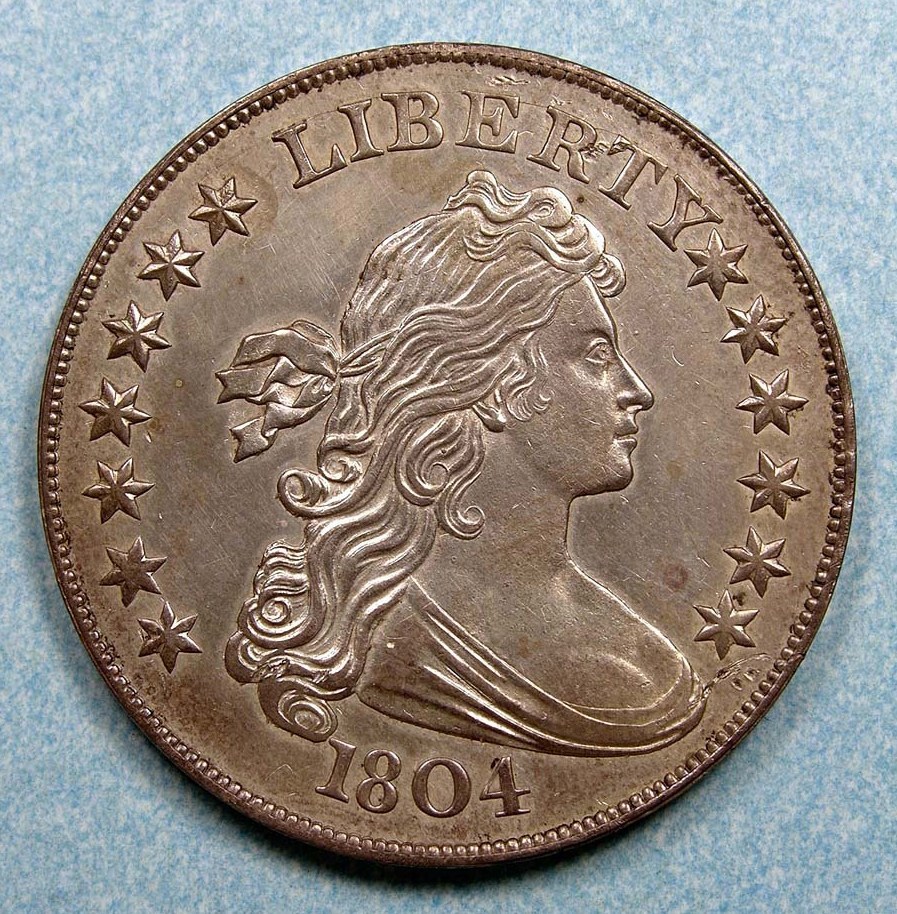
Begin with the obverse portrait. A Draped Bust dollar shows Liberty as a draped bust with long, flowing hair, LIBERTY arced above and the date below, with stars running around the border. The drapery across the shoulder and the loose curls distinguish this design from the earlier Flowing Hair dollar, which shows an untamed head of hair and no drapery. Count the stars along the rim — their number varies by year and is one of the main ways specialists attribute a specific issue.
Turn the coin over and identify the reverse type. On later issues, including the 1796-dated example here, you should see the Heraldic Eagle: a broad eagle with spread wings, a shield on its breast, an olive branch in one talon and arrows in the other, and a banner reading E PLURIBUS UNUM beneath an arc of stars and clouds. Earlier dollars instead show the Small Eagle, a slimmer bird perched on clouds within a wreath. Knowing which reverse you have narrows the date range immediately.
Confirm size and metal. This is a large coin — roughly 39–40 mm across and about 27 grams — struck in silver. Critically, the edge is lettered, reading HUNDRED CENTS ONE DOLLAR OR UNIT, not reeded with grooves. Feel and inspect the edge: a plain or reeded edge on a coin claiming to be an early dollar is a serious red flag. There is no mint mark to look for, since all were made in Philadelphia.
Because these coins are valuable and heavily faked, treat authentication as essential. Watch for cast fakes with soft, mushy detail, added or altered dates (especially anything reading 1804), tooled surfaces, and edges that lack proper lettering. Genuine examples were hand-struck from individually cut dies, so slight die-marriage differences are normal, but modern-looking uniformity or wrong weight is not. Send any candidate to a reputable grading service such as PCGS or NGC before buying, selling, or insuring it.
Frequently asked questions
How do I tell a Draped Bust dollar from a Flowing Hair dollar?
Look at the portrait. The Draped Bust shows Liberty with drapery over the shoulder and controlled curls, while the Flowing Hair dollar has loose, untamed hair and no drapery. Both are large early silver dollars.
What should the edge of a genuine coin look like?
It should be lettered, reading HUNDRED CENTS ONE DOLLAR OR UNIT, rather than reeded or plain. An incorrect edge is a strong sign of a fake or a wrong-denomination piece.
Is there a mint mark to check?
No. All Draped Bust dollars came from the Philadelphia Mint and carry no mint mark, so a mint mark would indicate a problem coin.
My coin is dated 1804 — is it a fortune?
Almost certainly it needs expert scrutiny. Genuine 1804 dollars are extraordinarily rare and were struck decades after 1804; the date is a favorite target for fakes and alterations, so have it authenticated before assuming anything.