
How to Identify the Draped Bust Dime
A collector's walkthrough of the 1796–1807 silver dime: its draped Liberty, star count, eagle reverse types, tiny size, and how to spot fakes.
Read the full Draped Bust Dime encyclopedia entry →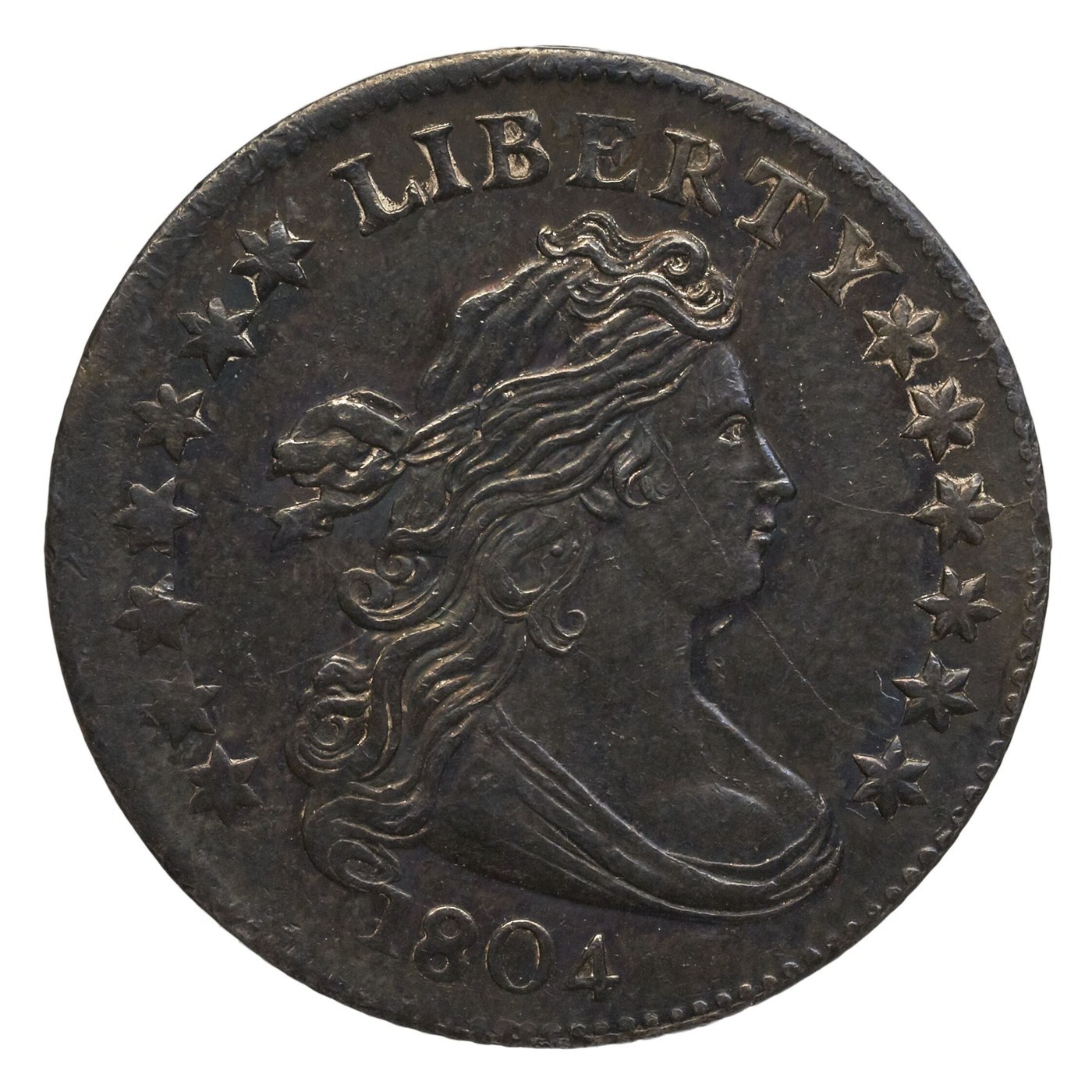
What This Coin Is
The Draped Bust Dime is the first ten-cent coin of the United States, struck in silver at the Philadelphia Mint from 1796 through 1807. The photographed coin is dated 1796, the inaugural year. Because the design carries no numeral of value, identifying it means reading the portrait, the border stars, the eagle reverse, and confirming the coin's small size and silver metal.
Read the Obverse
The obverse shows Liberty with long, curled hair and drapery gathered at the shoulder — the feature that names the type. A ring of stars surrounds the bust, LIBERTY arches above the head, and the date sits below; on this coin it reads 1796. Count the stars: the 1796 issue has fifteen, matching the number of states that year. A clear date and readable star ring are the primary confirmations, since wear softens the hair strands first.
Read the Reverse
The reverse (not shown on this coin) determines the sub-type. Dimes of 1796 and part of 1797 use the Small Eagle reverse: a slender eagle perched within an open wreath, with UNITED STATES OF AMERICA around the rim. From 1798 onward the reverse is the Heraldic Eagle — a broader eagle with a shield on its breast, arrows and an olive branch in its talons, and clouds and stars above. Neither reverse states the denomination.
Check Size, Metal, and Edge
This is a small, thin silver coin, only about 19 mm in diameter and light in the hand — clearly smaller than a quarter or half dime look-alike would suggest. The edge is reeded, and the surfaces should look like toned silver rather than bright white or coppery. There is no mint mark, because all dimes of this era came from Philadelphia. Weighing and measuring a suspect coin is a useful early filter: wrong diameter, wrong weight, or a magnetic response rules out a genuine piece.
Look-Alikes and Authentication Cautions
Do not confuse the Draped Bust dime with the tiny Draped Bust half dime, which shares the same design at a smaller size, or with the later Capped Bust dime (from 1809), which uses a different Liberty portrait. Because early silver dimes — especially the 1796 first year — are scarce and valuable, they are frequently faked, cast, cleaned, or altered from other dates. Be wary of coins that look unusually sharp for their age, show tooling in the hair or stars, or have suspicious edges. Any promising Draped Bust dime should be authenticated by a reputable grading service before you rely on its value.
Frequently asked questions
How do I tell a Draped Bust dime from the half dime?
They share the same design, so go by size. The dime is about 19 mm across, while the Draped Bust half dime is noticeably smaller, around 16.5 mm.
What is the difference between the two reverse types?
Dimes of 1796–1797 use a Small Eagle perched in a wreath, while dimes from 1798 onward use a larger Heraldic Eagle with a shield, arrows, and an olive branch.
Where is the mint mark on a Draped Bust dime?
There isn't one. Every dime of this period was struck at the Philadelphia Mint, which used no mint mark.
Should I clean an old silver dime before identifying it?
No. Cleaning strips the original surface and sharply lowers value on early silver. Identify and, if needed, authenticate the coin as-is with its natural toning intact.