
How to Identify the Double Florin
The Double Florin was a large Victorian silver coin worth four shillings, struck only from 1887 to 1890 and often confused with the similarly sized crown.
Read the full Double Florin encyclopedia entry →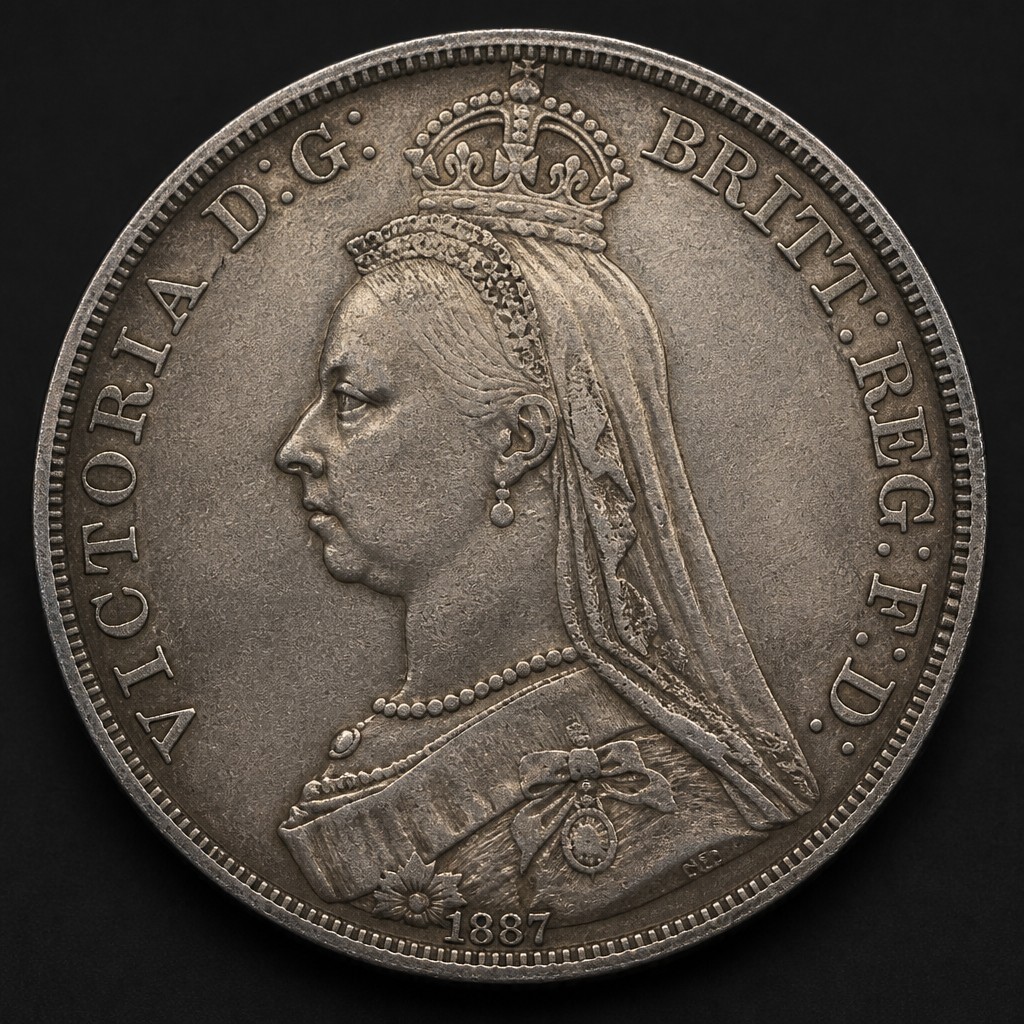
What It Is
The Double Florin is a British silver coin valued at four shillings, struck for only four years (1887-1890) during Queen Victoria's Jubilee coinage. It was intended to fill a gap between the two-shilling florin and the five-shilling crown, but its similarity in size to the crown caused confusion and led to its withdrawal. Today it is a popular one-type-per-collection coin because its short run makes a complete date set achievable.
Obverse Design
The obverse carries the "Jubilee head" of Queen Victoria: a small crowned bust wearing a veil, facing left, encircled by the legend VICTORIA DEI GRATIA and the date. This same small Jubilee portrait appears on other coins struck between 1887 and 1893, so the reverse is the key to identifying a Double Florin specifically rather than the shared obverse alone.
Reverse Design
The reverse shows four crowned cruciform shields representing England, Scotland, Ireland, and England again, arranged around a central Garter star. National emblems - a rose, thistle, and shamrock - fill the angles between the shields. The denomination appears as "ONE DOUBLE FLORIN" in the design, spelled out rather than expressed purely as a numeral.
Size, Weight, Metal & Edge
Struck in sterling silver (.925 fine), the coin weighs about 22.6 grams and measures roughly 36mm across, with a milled (reeded) edge. Its heft and diameter are very close to those of the crown, which is exactly what caused public confusion at the time and is the single most important fact to keep in mind when handling one.
Mint Marks & Dating
All Double Florins were struck at the Royal Mint in London, so there is no mintmark to search for. The date sits below the bust on the obverse. Collectors specifically look for the 1887 issue, which exists with two numeral styles in the date - a "Roman I" and an "Arabic 1" - a well-known variety, along with a rarer "inverted 1" variant that is prized by specialists.
Telling It Apart From Similar Coins
The main lookalike is the crown of the same era, which shares a similar diameter. Check the reverse: the crown shows St George slaying the dragon, while the Double Florin shows the four shields and Garter star pattern. Also compare to the ordinary florin, which is noticeably smaller and lighter, and to the halfcrown, which is smaller still and carries different heraldic detail.
Grading at a Glance
Look at the fine details of Victoria's hair and the crown's jewels for wear - these high points flatten first. On the reverse, check the definition of the shield borders and the small emblems in the angles. Lightly circulated pieces still show crisp lettering; heavily worn examples show a smoothed, low-relief portrait and shields with softened outlines.
Authenticity Red Flags
Because the coin's silver content and size match several other Victorian crowns and coins, be alert to pieces with mismatched weight, a soft or mushy strike, or a reverse pattern that doesn't precisely match the four-shield design. Edges that look filed, re-milled, or inconsistent in reeding pattern are also worth extra scrutiny, as is a date that has been re-engraved to mimic a scarcer variety.
Frequently asked questions
Why was the Double Florin discontinued so quickly?
It was too easily mistaken for the crown due to their similar size and weight, causing confusion in everyday transactions, so production stopped after 1890.
What does 'Roman I' versus 'Arabic 1' mean on the 1887 issue?
It refers to two different styles used for the numeral '1' in the date, creating two collectible varieties of the same year.
Is the Double Florin the same as a crown?
No. They are similar in size but different denominations; the reverse designs (four shields versus St George and the dragon) distinguish them clearly.
What metal is the Double Florin made of?
Sterling silver, .925 fine, matching the standard used for British silver coinage of the era.