
How to Identify the Domitian Denarius
A silver denarius of Emperor Domitian, most often recognized by its standing Minerva reverse and the GERM victory title added to his obverse legend.
Read the full Domitian Denarius encyclopedia entry →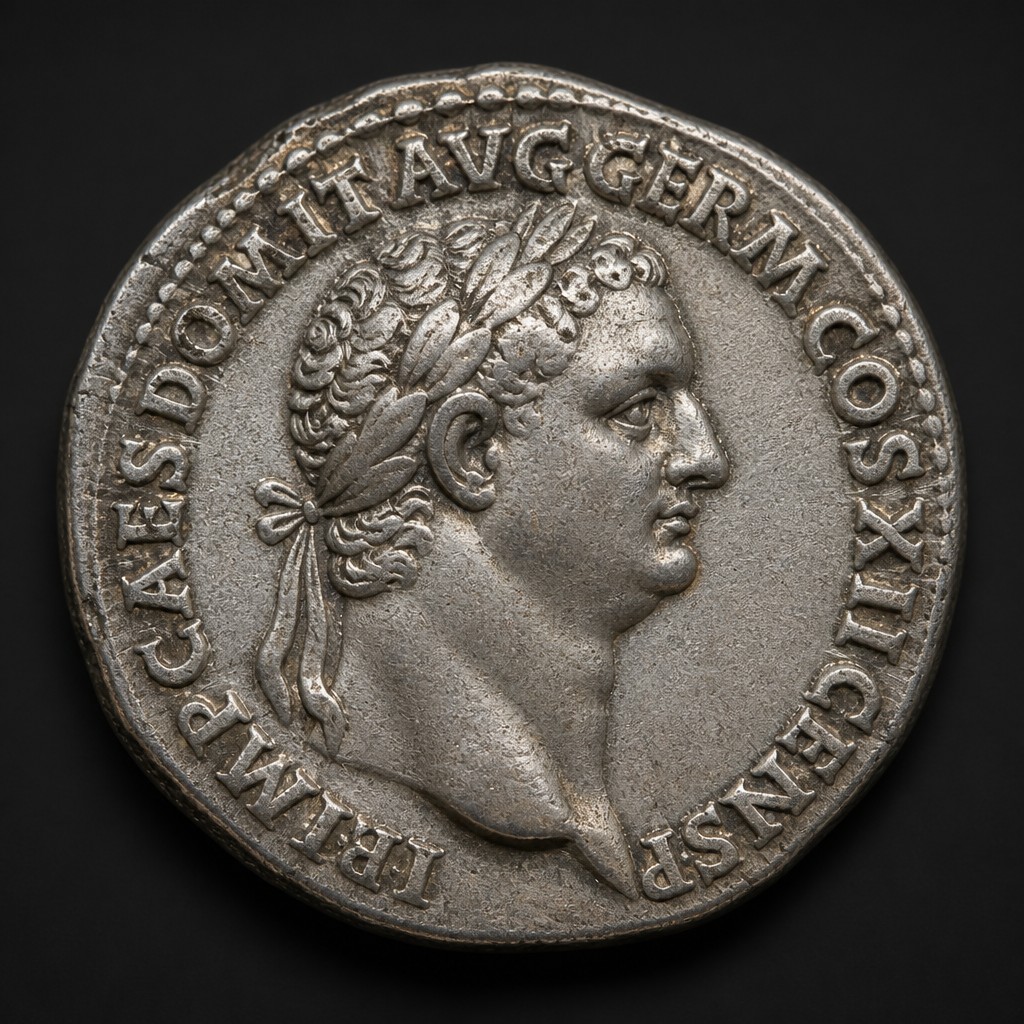
What the Coin Is
Domitian, the younger son of Vespasian, ruled from AD 81 to 96 as the last Flavian emperor. His denarius coinage is abundant and features one of the most instantly recognizable reverse types in the entire Roman series: the goddess Minerva, his personal patron deity.
Obverse Design & Inscriptions
The obverse shows a laureate head of Domitian right, with a heavier, more mature face than his brother Titus's portraits, often with a receding hairline emphasized in later issues. The legend typically reads IMP CAES DOMITIANVS AVG GERM, the GERM (Germanicus) title having been adopted after his AD 83-85 campaigns along the Rhine, along with P M TR P and a consulship numeral.
Reverse Design & Inscriptions
By far the most common reverse shows Minerva standing or advancing left, holding a spear and resting her other hand on a shield, sometimes with a small owl, ram, or other symbol in the field marking different officina (workshop) varieties within the enormous Minerva series. Other reverses include seated personifications such as Fortuna or Ceres, and imperial titulature encircling a simple design.
Size, Weight, Metal & Edge
The coin measures approximately 17-19mm in diameter and weighs about 3.0-3.5 grams, consistent with the late first-century denarius standard, with silver fineness in the low-to-mid 90s percent range. The edge is plain and unreeded.
Mint Marks & Where to Find Them
All denarii of this period were struck at Rome; there is no separate mint-letter system. Small field symbols accompanying the Minerva reverse (an owl, a ram, a star, and similar marks) are sometimes described informally as "control marks" distinguishing different die series rather than different mints.
Telling It Apart from Similar Coins
The GERM title is a useful marker: since it was adopted partway through his reign, its presence or absence, together with the tribunician power (TR P) numeral, helps narrow the approximate striking date. Compared to Titus's rounder, younger face, Domitian's portrait is heavier through the jaw and neck. Compared to Nerva's older, gaunt appearance that followed him, Domitian looks noticeably more robust.
Judging Condition & Grade at a Glance
On the obverse, check the hair above the forehead and the fullness of the cheek and jaw for wear. On the Minerva reverse, look at the definition of the shield's decorative device, the folds of her drapery, and the crest of her helmet; these details wear away quickly and are a reliable guide to overall grade.
Authenticity Red Flags
Fourrée (silver-plated) fakes are frequently encountered for this reign, given how common genuine Minerva denarii are as a "starter" ancient coin; watch for a coppery flash at any wear point or nick. Modern cast reproductions typically show a visible seam around the edge and a slightly soft, mushy rendering of Minerva's shield and drapery compared to the crisp linear engraving of a genuinely struck coin.
Frequently asked questions
Why does Minerva appear on so many of Domitian's coins?
Minerva was Domitian's personal patron goddess, and he featured her on the reverse of the vast majority of his later denarii as a mark of religious devotion and political branding.
What does the GERM title tell me?
GERM stands for Germanicus, a victory title Domitian took after campaigns along the Rhine in the mid-80s AD, so its presence indicates a coin struck from that point in his reign onward.
How do I distinguish Domitian's portrait from Titus's?
Domitian's face is generally heavier and more mature-looking, often with a receding hairline emphasized on later dies, compared to Titus's rounder, fuller-cheeked youthful portrait.
Are small symbols near Minerva important?
Small marks like an owl or ram near Minerva are die or workshop indicators within the huge Minerva series rather than separate mint identifiers, useful mainly for specialist die-variety collecting.
What is the easiest way to spot a fake?
Look for a coppery color showing through at any scratch or wear point, which signals a silver-plated forgery rather than a solid silver original.