
How to Identify the Dirham of Qirwash ibn al-Muqallad
A collector's guide to attributing this Uqaylid silver dirham of Mosul by its Arabic legends, marginal date, flan, and fabric.
Read the full Dirham of Qirwash ibn al-Muqallad encyclopedia entry →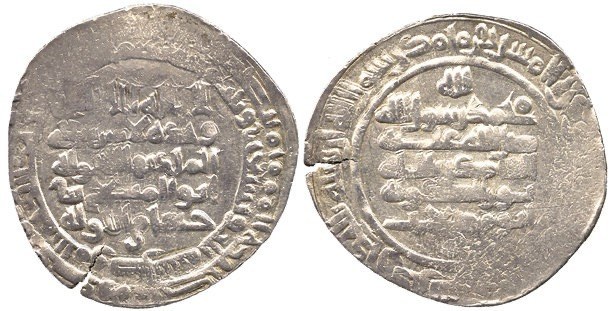
Start with the fabric. This is a hand-struck (hammered) silver dirham in the classic medieval Islamic mould: thin, broad, and often slightly irregular or wavy at the edges, with legends that may run partly off the flan. If you are looking at a thick, small, or machine-perfect coin, it is not this type. Expect variation in weight and diameter rather than a fixed standard.
Read the layout next. The obverse should show an Arabic inscription in three lines occupying the central field, without any image. The reverse should show a central Arabic legend enclosed by a marginal inscription running around the rim. On issues of this kind the margin carries the mint-and-date formula, so the year 393 AH will appear spelled out in Arabic words there, never as numerals.
To attribute the coin specifically to Qirwash ibn al-Muqallad rather than to a generic Islamic dirham, you must locate the ruler's name and titles within the field legends and confirm the Uqaylid context. Because these coins commonly also name the reigning Abbasid caliph (and sometimes a Buyid overlord), matching those names against the 393 AH period is a strong cross-check. If you cannot read the field, treat the attribution as tentative.
Beware of look-alikes. Contemporary dirhams from neighbouring Buyid, Marwanid, and other Jaziran authorities share the same script, format, and religious legends, so surface appearance alone is not decisive; the differentiator is always the names in the field. Illegible, clipped, or overstruck flans can be genuinely ambiguous even to specialists.
On authentication, favour examples with consistent silver toning, crisp struck (not cast) detail, and no seams or bubbles that would betray a cast forgery. Given the specialist nature of the series, secure a reading from published Islamic references or a knowledgeable dealer before paying a premium, and treat unprovenanced pieces with appropriate caution.
Frequently asked questions
How can I tell this from an ordinary Abbasid or Buyid dirham?
The format and religious legends are shared across the region, so the deciding factor is the name in the field. Look for Qirwash's name and the Uqaylid context; the caliph named should also fit the 393 AH period.
Where do I find the date on the coin?
The date is written out in Arabic words within the marginal inscription on the reverse, as part of the mint-and-date formula, rather than shown as numerals.
How do I spot a fake?
Genuine pieces are struck, not cast. Watch for casting seams, air bubbles, a soft mushy surface, or wrong toning. Struck detail, natural wear, and credible provenance are reassuring signs.
Does weight help with identification?
Only loosely. Medieval dirham flans vary and are often clipped or unevenly struck, so weight supports but never confirms an attribution. The legends are the primary evidence.