
How to Identify the Dirham of Caliph al-Mansur
A collector's guide to the early Abbasid silver dirham of al-Mansur: reading the AH date and mint, the inscriptional layout, size and authentication.
Read the full Dirham of Caliph al-Mansur encyclopedia entry →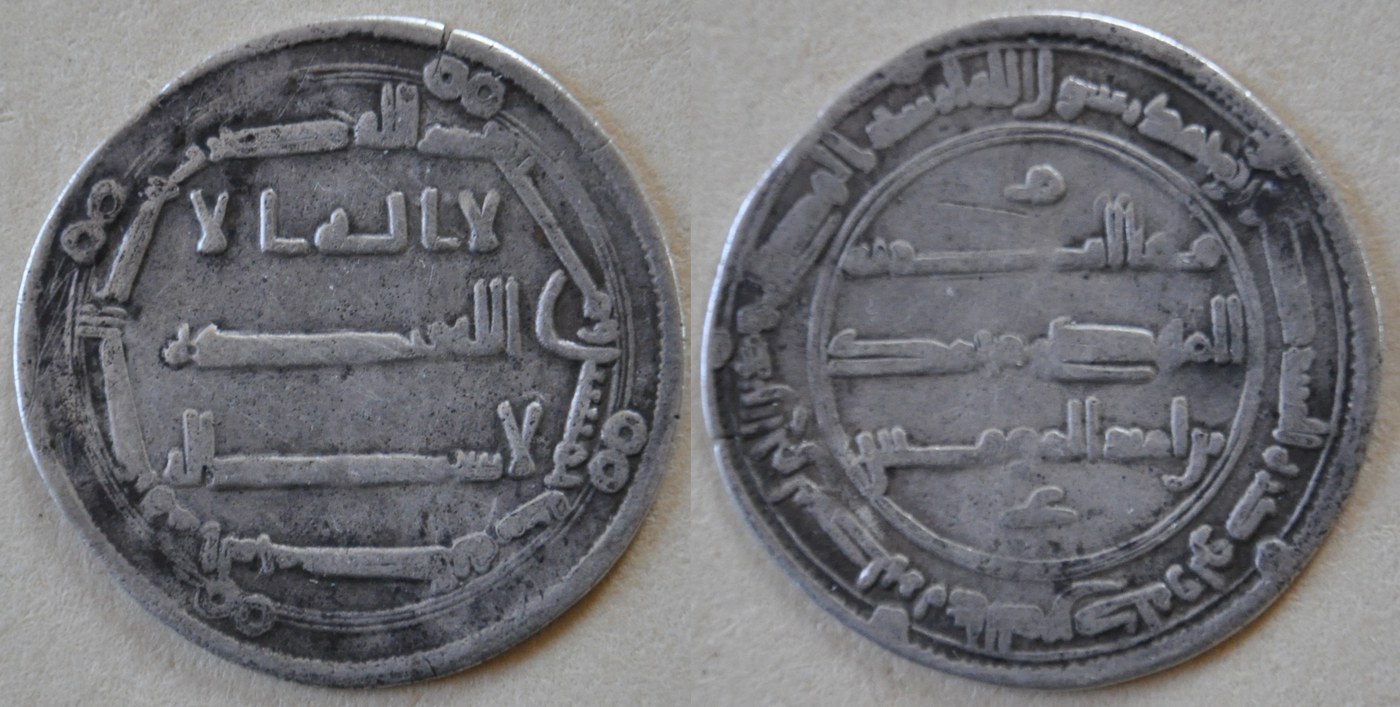
Start by confirming the format. This dirham is fully aniconic: both sides carry only linear Arabic inscriptions, with no portrait or figure. The obverse has a multi-line central legend inside a decorative border, ringed by a marginal inscription; the reverse has a second central legend with marginal text. If you see purely calligraphic silver with a bordered central field and no imagery, you are looking at a reform-type dirham rather than an earlier figural coin.
Read the reverse margin for mint and date. The attribution to al-Mansur's reign hinges on the AH date, which on the photographed coin is AH 150 (767 CE), and the mint name is stated in the same marginal legend. You do not need to translate every word, but locating the date and mint in the reverse margin is the essential step; the coinage is anonymous, so you will not find the caliph's name anywhere on the coin.
Check metal, size and weight. A genuine dirham of this period is silver, struck as a broad thin flan on the order of roughly 2.7–3.0 grams and about 24–26 mm in diameter, with slightly irregular, hand-struck edges. Silver may tone gray or develop light patina, but a coin that is magnetic, distinctly the wrong weight, or shows a base-metal color is a warning sign.
Separate it from look-alikes. Umayyad reform dirhams share the identical inscriptional style and are distinguished mainly by mint, AH date and legend details — an AH 150 date points to the Abbasid period under al-Mansur, not the Umayyads. Gold dinars of the era carry similar text but are a different metal and smaller and thicker, while copper fals are base metal. Mismatched date, mint, metal or module usually means a different coin than this dirham.
Apply sensible authentication caution. Because the type is common, casual fakes and cast reproductions exist. Genuine coins are struck, with crisp Kufic lettering, correct weight and diameter, and no casting seams or bubbles. Since the date and mint are read from Arabic legends, have any uncertain example confirmed by a specialist in Islamic coinage, and favor pieces where the AH 150 date and mint name are legible.
Frequently asked questions
How do I find the date and mint on the coin?
They are in the marginal legend, chiefly on the reverse: the mint name and the AH year (here AH 150 / 767 CE) are written in Arabic around the central inscription. Reading that margin is how the coin is dated and attributed, since no caliph is named.
How can I tell it apart from an Umayyad reform dirham?
They look almost identical in layout. The distinction comes from the mint, the AH date and legend details; an AH 150 date places the coin in the Abbasid period under al-Mansur rather than in the earlier Umayyad series.
What weight and size should a genuine dirham be?
Roughly 2.7–3.0 grams of silver and about 24–26 mm across, struck on a broad thin flan. A magnetic coin, a large weight discrepancy, or a base-metal appearance points to a fake or a non-silver copy.
How do I avoid buying a cast reproduction?
Look for sharp struck detail in the Kufic lettering, correct weight and diameter, and no seams or surface bubbles that betray casting. When in doubt, get a specialist opinion and prefer coins with a legible date and mint and clear provenance.