
How to Identify the Denier of Charlemagne
A collector's guide to identifying a silver denier of Charlemagne by its cross-and-legend obverse, CARLVS REX FR inscription, royal monogram reverse, size and fabric.
Read the full Denier of Charlemagne encyclopedia entry →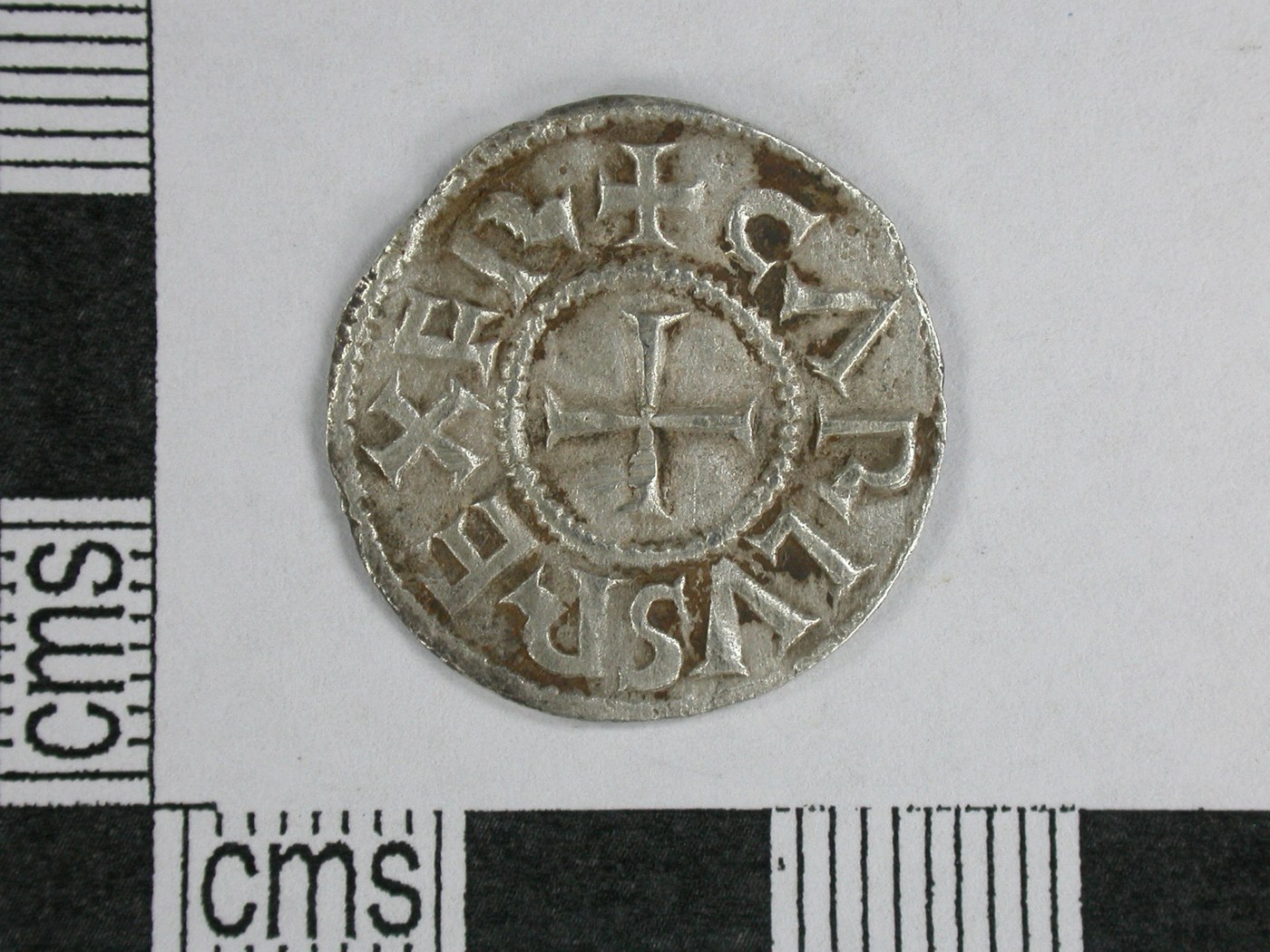
Begin with the legend, because it is what separates a Charlemagne denier from the mass of anonymous medieval silver. On the reformed royal type you are looking for CARLVS REX FR (variants include CAROLVS REX F or REX FR), the Latin name and title of Charles as King of the Franks, running around the rim. On the photographed coin this circles a small equal-armed cross enclosed in a beaded inner ring—that cross-plus-beaded-circle plus royal legend is the core diagnostic. Turn the coin under raking light and record every letter you can make out before drawing conclusions.
Next read the other face. The reverse commonly carries the royal name compressed into a monogram—the KRLS/KAROLVS monogram built from the letters of Charles's name—or a mint name spelled across the field, sometimes ringed by a legend such as a place name or CHRISTIANA RELIGIO on temple types. Do not jump to "portrait": on worn coins the tight central monogram can resemble a small head or bust. Trace the strokes as letters first; a genuine laureate portrait is a rare late-reign type and is paired with a distinct temple reverse, not a monogram.
Check size, weight and fabric, which are quietly decisive. Expect a thin silver flan of about 19–21 mm, light in the hand (roughly 1.5–1.8 g on the reform standard), struck by hand so the edges are slightly irregular and the design is often off-center with flat or double-struck patches. The metal should read as honest silver—gray or gently toned—rather than bright, hard white. A perfectly round, uniform, heavy or suspiciously crisp "denier" deserves scrutiny.
Use mint signatures to narrow attribution. Many deniers name their mint, either replacing the monogram or ringing it; matching that name and the exact legend arrangement to a specialist reference pins down where and roughly when the coin was struck, and materially affects value. Note the letter forms too—Carolingian engraving has a characteristic style that later imitations often get subtly wrong.
Finally, be cautious about look-alikes and fakes. Immobilized and posthumous issues kept using Charlemagne's name and types for generations, so a CARLVS legend alone does not guarantee a coin struck in his lifetime. Cast copies, tooled surfaces, wrong weights and modern replica strikes are all common. For any coin you intend to buy or sell, compare it against trusted catalogs of Carolingian coinage or have it examined by a specialist rather than relying on the royal name by itself.
Frequently asked questions
Which single feature confirms it is Charlemagne's?
The obverse legend. CARLVS REX FR (Carolus Rex Francorum) around a central cross is the signature of his reformed royal denier. Combine the legend with the reverse monogram or mint name to firm up the attribution.
How do I tell a monogram from a portrait?
Trace the central device as letters. The KAROLVS monogram is built from the strokes of Charles's name and only resembles a bust when worn. A real portrait denier shows a clear laureate profile head and is paired with a temple reverse, and such coins are rare.
Could a coin bearing his name still be a later issue?
Yes. Mints continued striking coins in Charlemagne's name after his death (immobilized types), so the legend alone does not prove a lifetime strike. Style, mint signature and weight, checked against references, help place a coin correctly.
What are the main authentication red flags?
Watch for cast seams or granular surfaces, a too-perfect round shape or milled-looking edge, incorrect weight, bright unnatural metal, and clumsy or misshapen lettering. Genuine deniers show hand-struck irregularity and period-correct style; verify important coins with a specialist.