
How to Identify the Denarius of Vespasian
A collector's guide to recognizing a Roman silver denarius of Vespasian by its portrait, legends, size, and hand-struck fabric.
Read the full Denarius of Vespasian encyclopedia entry →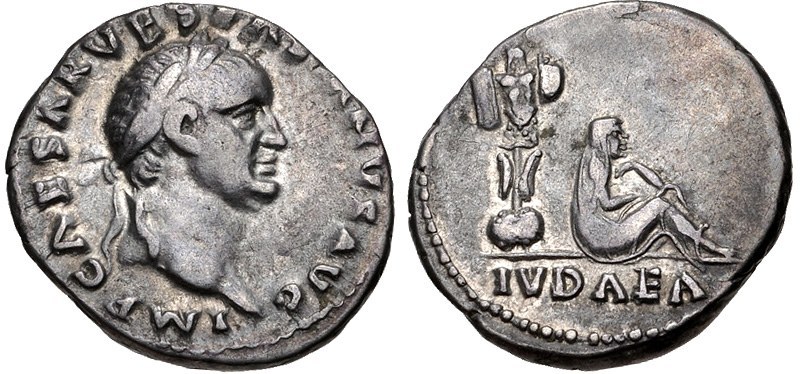
Begin with the portrait and the obverse legend, which are the decisive clues. A denarius of Vespasian shows the laureate head of a mature man facing right, with a distinctive broad, jowly face and receding hairline that Roman engravers portrayed realistically. Read the letters around the head: the name VESPASIANVS must appear, usually within a titulature like IMP CAESAR VESPASIANVS AVG, often followed by abbreviations such as COS, PON MAX, or a tribunician year that can help pin down the date.
Confirm the physical characteristics. This is a small silver coin, roughly 17 to 19 mm in diameter and about 3 grams in weight. Because it was struck by hand between dies, the flan is slightly irregular, the design is frequently off-center, and the edges are uneven, with occasional cracks. Genuine silver shows natural toning and honest wear; a coin that is perfectly round with sharp machined edges is a modern reproduction rather than an ancient strike.
Work out the reverse separately, since Vespasian used many types. Expect a standing or seated personification such as Pax, Fortuna, Aequitas, Salus or Victory, sometimes a sacrificial implement, animal, or captive scene, each accompanied by its own Latin legend. Rather than expecting one image, identify the specific figure and read its inscription, then match the obverse-and-reverse combination to a reference like RIC (Roman Imperial Coinage) to name the exact issue.
Watch for look-alikes and fakes. Other Flavian rulers, especially his sons Titus and Domitian, appear on very similar denarii, so always verify the name in the legend rather than judging by portrait style alone. Vespasian is also a heavily forged emperor: be wary of cast copies (which show a seam or grainy surface), tooled or re-engraved details, and modern replicas sold as souvenirs. For any coin of significant value, favor examples with documented provenance or third-party authentication, and compare weight, diameter, and die style against verified specimens.
Frequently asked questions
How do I distinguish Vespasian from his sons Titus and Domitian?
All three appear on similar Flavian denarii, so read the obverse legend rather than the face. Only Vespasian's coins carry the name VESPASIANVS; Titus and Domitian are named separately in their own legends, though they can appear as Caesars on some of Vespasian's issues.
What size and weight should a genuine example be?
A denarius of Vespasian is about 17 to 19 mm across and roughly 3 grams. Coins far outside that range, or that are perfectly round with machined edges, are likely reproductions or a different denomination.
How can I spot a fake or cast copy?
Look for a seam around the edge, a grainy or bubbly surface, mushy lettering, or a weight and diameter that don't match verified specimens. Hand-struck ancient coins have sharp, slightly irregular relief; suspiciously smooth or seamed pieces warrant caution and, ideally, expert authentication.
Do I need to identify the reverse to name the coin?
Yes. Because Vespasian struck many reverse types, the specific figure and its legend, combined with the obverse titles, are what match the coin to a catalogue reference and identify the exact issue.