
How to Identify the Denarius of Octavian and Caesar
A collector's guide to recognizing an Imperatorial silver denarius by its paired portraits of Octavian and Julius Caesar, Latin titles, and hand-struck fabric.
Read the full Denarius of Octavian and Caesar encyclopedia entry →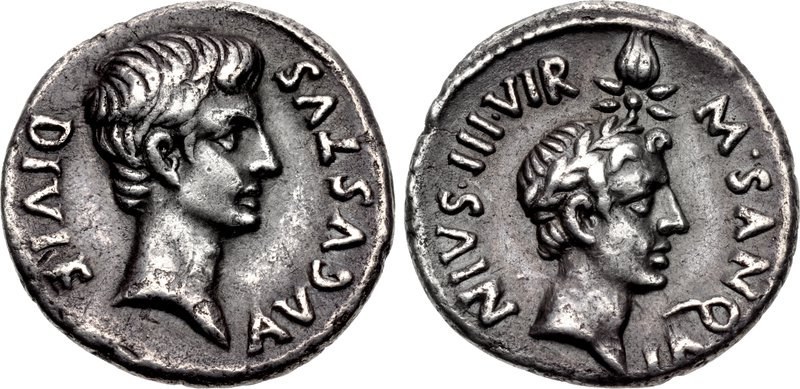
Begin with the two portraits, which are the heart of this type. Look for a male head on each face: the youthful, bare, clean-shaven head of Octavian on one side and the older head of Julius Caesar on the other, sometimes shown wreathed or veiled. Note the facing directions and the contrast between the smooth-featured young heir and the leaner, more mature Caesar. A denarius that pairs these two specific portraits is what defines the issue, as opposed to later coins that show Octavian, now Augustus, alone.
Read the legends carefully. Around the heads run abbreviated Latin inscriptions naming Caesar and giving Octavian's titles, including references to his role as one of the three men appointed to reorganize the state (the Second Triumvirate). Even fragmentary lettering helps: use good light and magnification, since on worn or off-center flans the legends are often only partly legible. The names and titles, together with the paired heads, tie the coin to the years around 43–42 BC.
Confirm size, weight, and metal. A denarius of this period is a small silver coin, roughly 17–20 mm in diameter and generally near 3.5–4 grams, though wartime military issues vary. Weigh and measure the coin against reference figures and check that it is silver with the toning and surface texture of genuine ancient metal, not the bright shine of a modern copy. Expect the irregularities of hand striking: uneven flans, off-center designs, and die-to-die differences in the legends.
Watch for look-alikes and fakes. Do not confuse this with later Augustan denarii showing a single portrait, or with unrelated Roman portrait coins that reuse similar heads. Because this is a famous and valuable Imperatorial type, it is heavily counterfeited, cast, and tooled; be cautious of pieces that look too smooth, too sharp, or suspiciously flawless. Treat authentication, expert opinion, and documented provenance or third-party certification as part of the identification rather than an afterthought.
Frequently asked questions
How do I tell Octavian from Caesar on the coin?
Octavian is the youthful, bare, clean-shaven head, while Julius Caesar is shown older and leaner, sometimes wreathed or veiled. The pairing of a young heir with an older predecessor is the key visual cue.
What legends should I look for?
Abbreviated Latin inscriptions naming Caesar and giving Octavian's triumviral titles run around the portraits. Even partial lettering, read under magnification, helps confirm the type and its date of around 43–42 BC.
How can I confirm it is a genuine denarius and not a later coin?
Check that it is a small silver piece near 17–20 mm and roughly 3.5–4 grams with paired portraits of both men. Later Augustan coins usually show Octavian alone, so the two-portrait design points to the Imperatorial issue.
How do I avoid buying a fake?
This is a heavily forged and tooled type. Favor coins with credible provenance, auction or dealer records, or third-party certification, and be wary of examples that look unnaturally smooth, sharp, or perfectly centered.