
How to Identify the Denarius of Nerva
A collector's guide to recognizing a Roman silver denarius of Nerva by his laureate portrait, the IMP NERVA CAES AVG legend, seated reverse, and silver fabric.
Read the full Denarius of Nerva encyclopedia entry →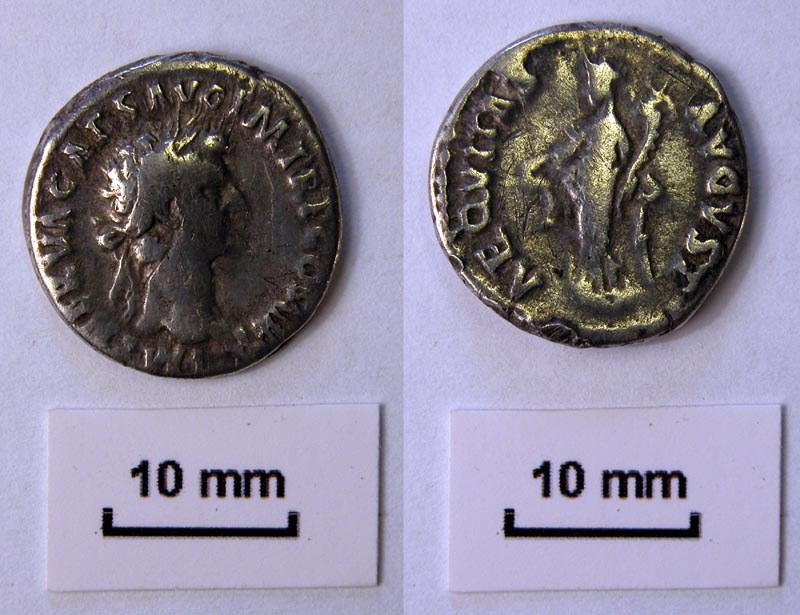
Begin by placing the coin in the right series. This is a Roman Imperial denarius: a small, hand-struck silver coin about 17-19 mm in diameter and roughly 3.0-3.6 grams. Expect a slightly irregular flan, some off-center striking, and a solid silver look with age toning. If the piece is large, perfectly round, thick, or brassy in color, it is likely a later coin, a provincial bronze, or a replica rather than an imperial denarius.
Study the obverse portrait. Nerva is shown as an older man with a laureate (wreathed) head facing right, with a distinctive long, hooked nose and a lean, elderly profile — a genuinely individualized portrait rather than an idealized head. Style is a useful check: dies of this reign render the aging features fairly consistently, and a soft, generic, or youthful face is a warning sign.
Read the obverse legend carefully, as it is the decisive attribution clue. It should render Nerva's titles in Latin capitals as IMP NERVA CAES AVG (or a related expanded form) running clockwise around the portrait. Confirm each element — IMP for Imperator, NERVA the name, CAES for Caesar, AVG for Augustus — since a misread or invented legend often exposes a fake or a misattribution to another emperor.
Check the reverse type and its legend. On this coin a seated figure of Concordia faces left, holding a patera and cornucopia. Nerva used several similar seated personifications — Aequitas, Fortuna, Salus, and others — so match both the attributes the figure holds and the reverse legend to a reference catalogue to pin down the exact type rather than relying on the seated pose alone.
Finally, weigh authentication cautions. Roman silver is heavily counterfeited, and cast forgeries betray themselves through soft or blurry detail, edge seams, surface bubbles or pitting, and incorrect weight, while tooled or re-engraved genuine coins show unnaturally sharp lines cutting through the wear. Genuine struck denarii have crisp, coherent die detail. For any valuable example, third-party certification by a recognized ancient-coin grading service is the safest way to confirm both authenticity and grade.
Frequently asked questions
What single feature confirms it is a coin of Nerva?
The obverse legend. Look for the name and titles rendered as IMP NERVA CAES AVG in Latin capitals around the laureate portrait. Combined with the individualized elderly, hook-nosed profile, that inscription attributes the coin to Nerva.
What size and weight should a Nerva denarius be?
A genuine denarius of this period is small — about 17-19 mm across and roughly 3.0-3.6 grams of silver, often on a slightly irregular flan. Coins far outside that range, or ones that are magnetic, should be treated as suspect.
Do all Nerva denarii show Concordia on the reverse?
No. This example shows a seated Concordia, but Nerva's denarii use several reverses, including Aequitas, Fortuna, Libertas, and Salus. Match the figure's attributes and the reverse legend to a catalogue to identify the specific type.
How do I spot a fake?
Check for cast signs — soft or blurry detail, edge seams, surface bubbles, and wrong weight — and for tooling, which shows sharp lines cutting through worn areas. Genuine coins are struck with crisp die detail. For valuable pieces, use a reputable ancient-coin grading service.