
How to Identify the Denarius of Marcus Aurelius
A collector's guide to confirming a Marcus Aurelius silver denarius by its bearded portrait, legends, reverse personification, size, and metal.
Read the full Denarius of Marcus Aurelius encyclopedia entry →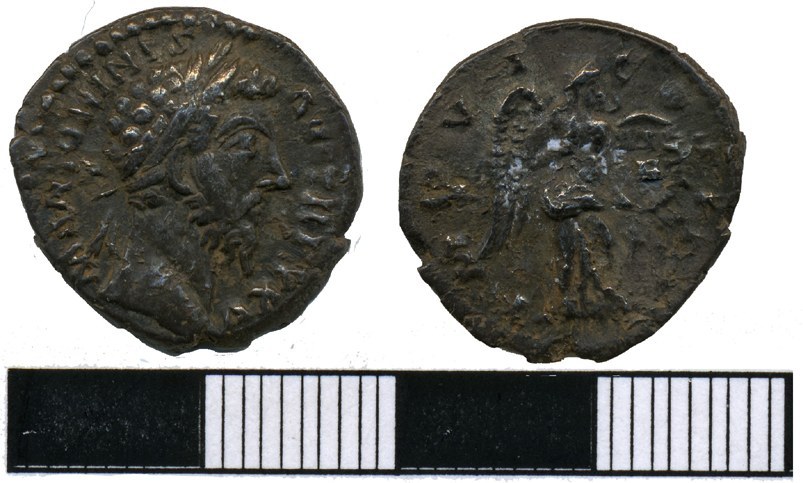
Start with the obverse portrait and legend. A denarius of Marcus Aurelius shows a mature man with a full curled beard and laurel wreath, facing right. Read the surrounding Latin: genuine examples carry forms of his name such as M ANTONINVS AVG, frequently followed by titles like TR P (tribunician power) with a numeral and COS III. Those titles are the key to dating — a reign-long series means the numerals, not the portrait, tell you the year, and a date around 170-171 AD corresponds to the tribunician and consular titles he held in that stretch.
Next, work out the reverse type. This coin shows a standing draped female personification. Identify her by her attributes and legend: Felicitas typically holds a caduceus and cornucopia; Aequitas holds a balance scale and cornucopia; other virtues (Fortuna, Salus, Providentia) carry their own props. Matching the figure's attributes to the reverse inscription is what separates one type from another and gives you the exact catalog attribution.
Check the physical characteristics. A genuine denarius is a small hand-struck silver coin, about 17-19 mm in diameter and roughly 2.8-3.4 grams. Because it was struck by hand, expect a slightly irregular flan, occasional off-center strikes, and natural die wear. The metal should look like old silver — soft grey toning, honest wear on the high points, and a faintly grainy surface — not bright, smooth, and uniform.
Be alert to look-alikes and pitfalls. Other bearded Antonine emperors (Antoninus Pius, Lucius Verus, later Commodus) can resemble Marcus Aurelius at a glance, so always confirm the name in the legend. "Limes" denarii, contemporary silver-plated copies, and later cast forgeries all exist; the same standing-personification reverses were reused across many rulers, so never identify by the reverse type alone.
Finally, apply authentication caution. Ancient silver is heavily faked, and cast copies often show a seam, soft mushy detail, bubbles, or repeated flaws. Compare portrait style and lettering against verified references, weigh and measure the coin, and treat unusually perfect or suspiciously shiny pieces with skepticism. For anything of real value, buy from a reputable dealer or seek third-party authentication before relying on the attribution.
Frequently asked questions
What is the single fastest way to confirm Marcus Aurelius?
Read the obverse legend for a form of his name — M ANTONINVS AVG (Marcus Aurelius Antoninus) — paired with the bearded, laureate right-facing portrait. The name in the inscription is decisive, since several Antonine emperors share the bearded look.
How do I tell Felicitas from Aequitas on the reverse?
Check what the standing woman holds. Felicitas typically carries a caduceus (a winged herald's staff) and a cornucopia; Aequitas holds a balance scale and a cornucopia. The reverse legend naming the figure confirms which it is.
What size and weight should a genuine denarius be?
Expect a small silver coin about 17-19 mm across and roughly 2.8-3.4 grams, hand-struck with a slightly irregular flan. Coins far outside this range, or that respond to a magnet, are warning signs of a fake or plated copy.
How can I spot a fake or cast copy?
Look for a casting seam on the edge, soft or blurry detail, surface bubbles, and repeated flaws that betray a mold. Genuine struck coins show crisp (if worn) detail and natural toning. When in doubt, get third-party authentication.