
How to Identify the Denarius of M. Sanquinius
A collector's guide to recognizing the Augustan silver denarius of moneyer M. Sanquinius by its portrait, herald-and-star reverse, and 17 BC context.
Read the full Denarius of M. Sanquinius encyclopedia entry →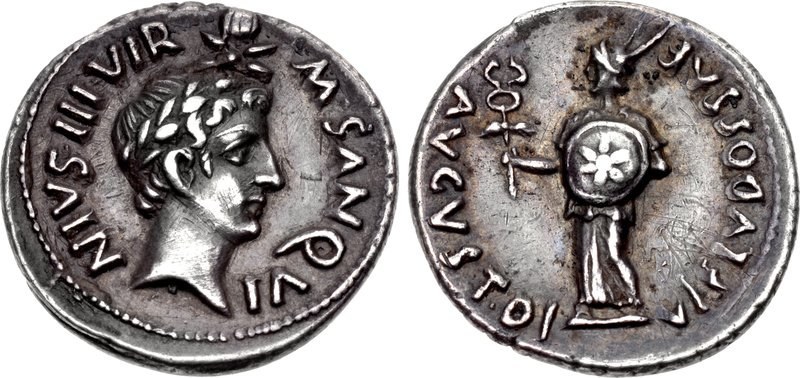
Start by confirming you are looking at an ancient hand-struck Roman denarius. It should be a small silver coin, roughly 18–20 mm across and about 3.5–4 g when little worn, with a slightly irregular flan and Latin lettering cut by hand rather than the crisp, uniform look of a machine-made modern coin. The metal is silver, not gold or bronze; a gold piece of the same design would be the rarer aureus.
Read the two faces together. The obverse carries a male head facing right with a surrounding Latin legend that typically references Augustus as son of the deified Caesar (forms of AVGVST DIVI F). The reverse shows a standing figure—understood as the herald of the Secular Games—near an altar, with a star in the field, and the moneyer's name SANQVINIVS. It is that combination of the Sanquinius name plus the herald-and-star reverse that pins the attribution; neither element alone is enough.
Note the mint and date context. These were struck at Rome around 17 BC as part of the moneyer coinage of Augustus, so there is no separate mintmark to hunt for; the moneyer's name and the office abbreviation (a form of IIIVIR, for the board of three) serve that role. Because dies were hand-cut, expect variation in centering, style, and how much of the legend survived the strike—match the readable letters against catalogued Augustan moneyer types rather than expecting an exact match to any one photograph.
Be cautious about look-alikes and fakes. Other Augustan moneyers of the same years issued thematically related denarii, so do not assume every herald or star reverse is Sanquinius—check the name. Augustus-era silver is heavily counterfeited, including cast copies and modern die-struck forgeries, so watch for casting seams, wrong weight, unnatural surfaces, and lettering that looks tooled. For any significant purchase, rely on reputable dealers, published auction records, and third-party authentication rather than the coin's appearance alone.
Frequently asked questions
What single feature best identifies this coin?
The moneyer's name SANQVINIVS in the reverse legend, paired with the standing herald and star, is the decisive combination. The Augustan obverse legend referencing the deified Caesar's son supports the attribution.
How big and heavy should a genuine example be?
As a Roman denarius of the period it is a small silver coin, typically about 18–20 mm in diameter and around 3.5–4 g when little worn. Significant deviations in size or weight are a warning sign.
Is there a mintmark to look for?
No. It was struck at Rome as moneyer coinage, so instead of a mintmark you rely on the moneyer's name and the board-of-three office abbreviation (a form of IIIVIR) in the legend.
How can I avoid buying a fake?
Augustan silver is widely forged. Check for casting seams, incorrect weight, unnatural surfaces, and tooled lettering, and buy from reputable dealers with authentication or documented auction provenance rather than judging by images alone.